Tier 2 knee surgeon becomes the region's go-to name for knee replacement
5,000+knee replacements behind the positioning
The problem. An orthopaedic surgeon in a tier 2 city practised inside his family's multispecialty hospital, which the town knew as the place for everything, so nobody saw him as the knee specialist. He was about to bring in a robotic surgery system nobody knew was coming, and online his joint unit did not show up when people searched for knee replacement in his city.
What we did. We built his positioning around one outcome, helping people walk without knee pain again, and gave his unit its own identity: a dedicated joint centre with its own name, website and Instagram at the same hospital address. We set up a separate Google Business Profile for the joint centre with weekly educational posts, and built separate knee and hip replacement landing pages in Hindi, each with its own tracking and lead forms flowing into the CRM. We ran a "coming soon" content build-up before the robot launched and made short Hindi educational videos that did not need the doctor on camera.
The result. Within months, the joint centre started showing up on the map for the exact problem it solves. When someone in that region thinks about knee replacement now, they think of him.
From Known Doctors Get Booked, Chapters 1 and 2
Orthopaedic practice raises appointments without spending more on ads
The problem. An orthopaedic practice spending steadily on ads felt the ads weren't working. In fact, many leads were called back the next day, some were never called at all, and nobody was tracking the numbers.
What we did. We looked at the front desk rather than the ads. We helped the clinic build a proper response and follow-up system.
The result. Appointments rose, without spending a rupee more on ads.
From Good Doctors Go Broke, Chapter 1
All-inclusive knee replacement plan stops families delaying the decision
The problem. An orthopaedic surgeon billed knee replacements with the surgery, room, implant and physiotherapy all priced separately. Families couldn't work out the final cost, and that uncertainty made them delay.
What we did. We turned the surgery into one all-inclusive plan, from the first scan to walking without support. We built three options around the implant, the technology and the length of physiotherapy support, with one clear recommendation. We added milestone payments and help with insurance paperwork.
The result. Families finally knew the full number on day one, and stopped putting off the decision because of it.
From Good Doctors Go Broke, Chapter 4
Orthopaedic surgeon's surgeries rise within weeks after definite consultation endings
The problem. A skilled orthopaedic surgeon ended almost every consultation with "Think about it and let us know." Patients loved him, but most of them never came back.
What we did. We worked with him on one change: a definite ending to every consultation. Every patient now leaves with a surgery date, a test with a review slot, or a family session on the calendar.
The result. His surgeries rose within weeks, and his patients said they felt more looked after, not less.
From Good Doctors Go Broke, Chapter 7
Knee replacement practice answers family doubts in one video call
The problem. A knee replacement practice kept hearing "I need to ask my son", and the son usually lived in another city.
What we did. We started offering a short video call with the doctor for the family. The call was booked before the patient left the clinic.
The result. The children heard the doctor explain the surgery themselves, and the family's doubts were answered in one conversation instead of weeks of back and forth.
From Good Doctors Go Broke, Chapter 8
Hospital nurse trained as coordinator gives joint unit its steadiest conversions
The problem. A hospital was struggling to find a coordinator for its joint replacement unit, because candidates from sales backgrounds felt too pushy to patients.
What we did. One of the hospital's own nurses, known for how much patients trusted her, was ready for a change. We trained her on the plans, the payment options and objection handling.
The result. Patients and families trusted her from the first conversation, and the unit's conversions became the steadiest they had ever been.
From Good Doctors Go Broke, Chapter 9
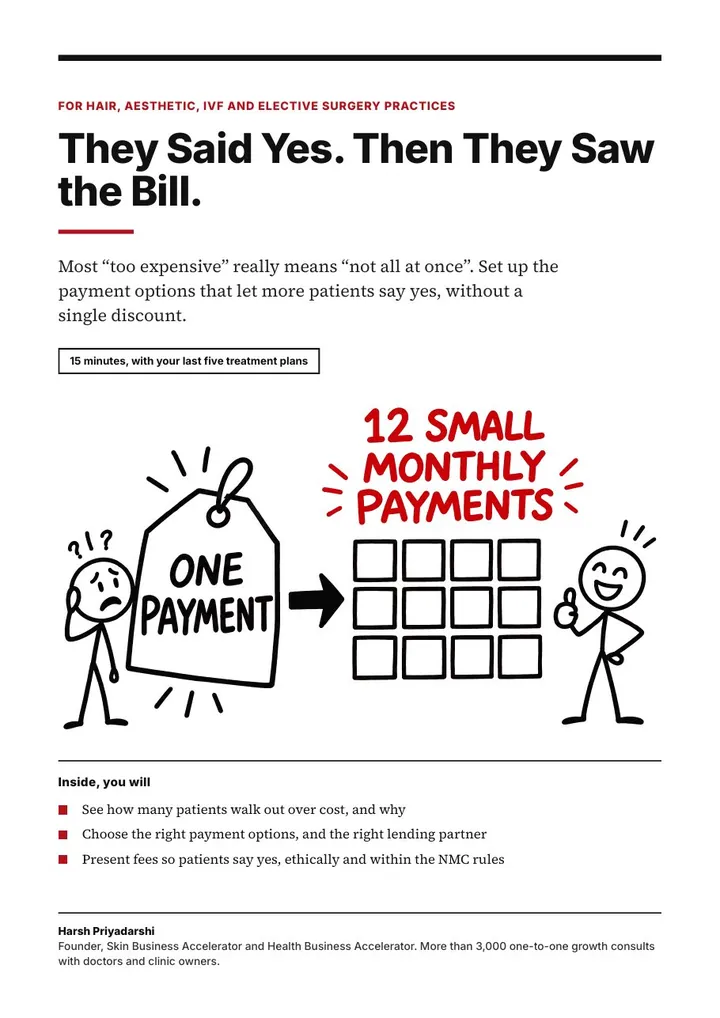
Milestone payments let knee replacement families stop delaying surgery
The problem. A knee replacement unit found that many families could manage the cost but struggled with one large payment.
What we did. We built a milestone plan around the phases of the treatment: a part at booking, a part at surgery and the rest during physiotherapy. Insurance support was added where it applied.
The result. Families who had been delaying surgery could finally plan for it.
From Good Doctors Go Broke, Chapter 10
Knee replacement unit sees patients return earlier for their second knee
The problem. A knee replacement unit discharged patients after physiotherapy and rarely saw them again, even though many had arthritis in the other knee too.
What we did. We set up a completion review with the surgeon and a review calendar at three months, six months and a year. Patients got a simple explanation of the early signs in the other knee.
The result. Many patients came back for their second knee earlier, before the damage got severe, and with far less fear because they already trusted the team.
From Good Doctors Go Broke, Chapter 11
Joint replacement review calendar brings patients and their families back
The problem. A joint replacement unit lost touch with most of its patients once their physiotherapy ended.
What we did. We built a review calendar for every patient at three months, six months and one year after surgery. Each review got a short, personal reminder before it, and anyone who didn't reply got a call.
The result. The reviews brought patients back, and many came with their other knee or with a family member who needed help too.
From Good Doctors Go Broke, Chapter 12
Knee replacement unit turns patients' relatives into early consultations
The problem. A knee replacement unit noticed that almost every patient came to reviews with a son, a daughter or a spouse, and many of those family members had joint problems of their own.
What we did. We trained the team to welcome family members as guests and answer their questions too. Every family got a short guide to the early signs of joint problems.
The result. Family members started booking their own consultations, often months before their pain became severe.
From Good Doctors Go Broke, Chapter 13
Family sessions turn knee replacement families from obstacle into yes
The problem. An orthopaedic surgeon kept losing knee replacement patients after what felt like a great consultation. The patient was convinced, but the children were the ones deciding, and they had never heard the doctor explain anything.
What we did. We built a family session into every plan, in person or on a video call, and assigned one coordinator to every family from the first scan to the last physiotherapy session. We added milestone payments and insurance support to the written plan next to the fee. We created simple guidance for families travelling from other towns.
The result. The family stopped being the obstacle and became the reason the patient said yes.
From Known Doctors Get Booked, Chapter 3
Joint replacement unit sees exactly what its Google profile brings in
The problem. A hospital's joint replacement unit got calls every day, but nobody knew how many came from Google, and the doctor kept asking whether the profile was worth the effort.
What we did. We added a tracked number to the profile and tags to every website link. We started logging the source of every call in the CRM.
The result. Within a month, he could see exactly how many patients the profile brought in, and it became the channel he cared about most.
From Known Doctors Get Booked, Chapter 6
Knee surgeon becomes local doctors' first choice for knees within a year
The problem. A knee surgeon in a very competitive city was struggling to stand out.
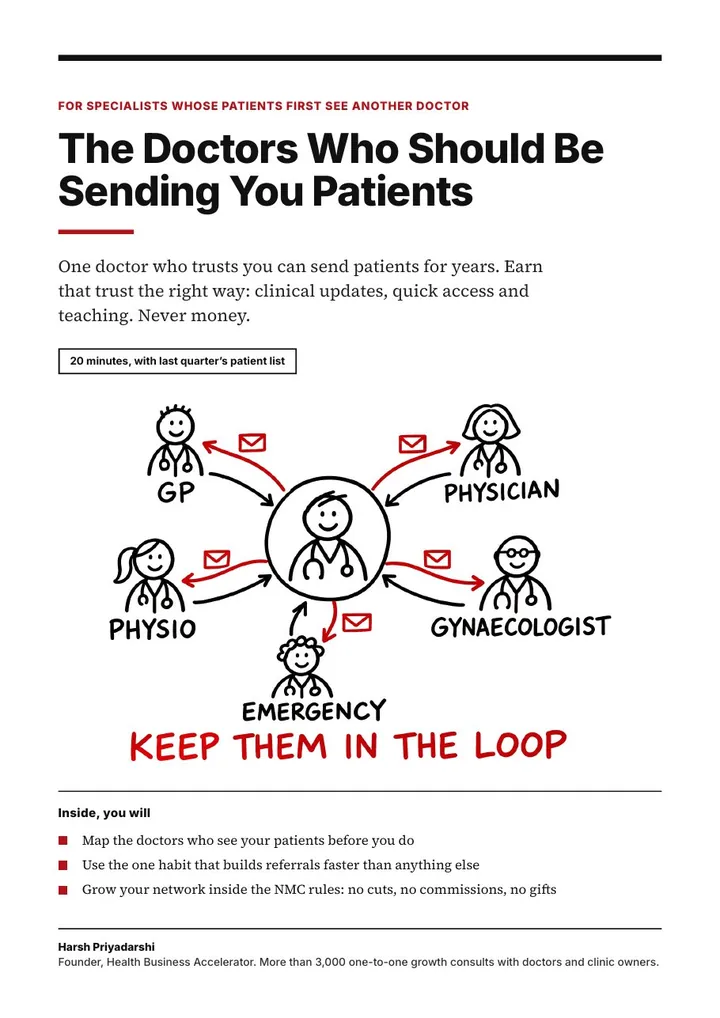
What we did. We built a teaching session every quarter for general practitioners and physiotherapists on when to refer knee patients and what happens after surgery. We added a one-page referral guide and a direct WhatsApp line for referring doctors.
The result. Within a year, he was the surgeon local practitioners thought of first for knees, because he was the one who had taught them.
From Known Doctors Get Booked, Chapter 11
Orthopaedic clinic's office wellness talks bring a steady stream of patients
The problem. An orthopaedic clinic sat right next to a big business district, yet almost none of its patients came from the offices around it.
What we did. We built a thirty-minute talk on back and neck pain from long hours at a desk and pitched it to nearby HR teams as a free wellness session. We added a short posture and pain questionnaire, with a call within a day for everyone who wanted a consultation.
The result. The offices that hosted the talk started sending a steady stream of patients, and several invited the doctor back every quarter.
From Known Doctors Get Booked, Chapter 12
Insurance panels make cashless a reason to choose the joint unit
The problem. A joint replacement unit kept losing insured patients after they had already decided on surgery, as families moved to network hospitals at the last moment.
What we did. We listed the insurers most of their patients held and went after those panels first. We set up a dedicated TPA desk with a clear checklist for every pre-authorisation, and added the list of empanelled insurers to the website, condition pages and Google profile.
The result. Insured patients stopped leaving at the last step, and cashless became a reason to choose them.
From Known Doctors Get Booked, Chapter 13
Client stories are composites. Names are left out, and each story combines details from more than one practice, with some details changed, to protect privacy.