Price knee and hip replacement as one all-inclusive plan, from the first scan to walking without support, with three honest options built around the implant, the technology and the length of physiotherapy. Recommend one clearly, then let a coordinator explain milestones, EMI and insurance. Never discount. If budget is the issue, change the scope or the way the family pays, not the price.
An orthopaedic surgeon we worked with billed knee replacements the way most hospitals do. Surgery, room, implant and physiotherapy, all priced separately. Families couldn't work out the final number, and that uncertainty made them delay. Not because they didn't trust him. Because nobody could tell them what it would cost from start to finish.
We turned it into one plan, from the first scan to walking without support. Families finally knew the full number on day one, and stopped putting off the decision because of it.
How should an orthopaedic consultation run?
The consultation is where your skill becomes a surgery date or goes home with the patient. In joint replacement, it runs best like this.
Frame it in the first two minutes. "Today I'll understand what's been happening, examine you properly, and by the end you'll know what's going on, your options, and what I'd recommend." That tells the patient and the family a recommendation is coming.
Listen first. What have they tried? How does it affect the day? Ask the two most important questions: what made you come in now, and what would it mean if this was sorted out? You will hear things like "I want to walk my granddaughter to school" or "I want to sit through my son's wedding without pain". Write those words down.
Narrate the examination. "When I bend your knee like this, can you feel that? That's the cartilage wearing down." Put their X-ray beside a healthy one on the screen.
Name the diagnosis honestly, including where it is heading if nothing is done. Not to scare them. Because they deserve to know.
Recommend one plan, then end with a definite next step: a surgery date, a test with a review slot, or a family session booked before they leave. Never "think about it and let us know". One skilled surgeon we worked with ended almost every consultation that way. Patients loved him, and most never came back. When every consultation got a definite ending, his surgeries rose within weeks.
How do you price knee replacement as a plan?
Stop pricing the parts. Price the outcome. Build the plan like this:
- Start from the outcome: walking without support, and back to daily life.
- List every step to get there, including the ones usually billed separately: scans, pre-surgery tests, the surgery, the implant, the hospital stay, medicines, physiotherapy and review visits.
- Set the timeline, from the first scan to the final review.
- Include aftercare, because that is where results are protected.
- Price the whole thing as one number, and write down clearly what is not included.
Then build three honest options, as described in Good Doctors Go Broke.
| Basic | Recommended | Complete | |
|---|---|---|---|
| Implant and technology | Standard implant, conventional technique | The implant you would choose for this patient | Same, with the technology you'd choose for the longest-lasting result |
| Physiotherapy | In-hospital sessions | In-hospital plus structured outpatient rehab | Extended rehab, with home sessions where possible |
| Reviews | One review | Reviews at three, six and twelve months | Reviews for two years, including the other knee |
| Best for | A tight budget | The best realistic recovery | The fullest, longest-lasting result |
Present them from Complete down to Basic, after the diagnosis and the outcome. Then say plainly which one you would choose for this patient, and why. Every option must be a genuine, safe treatment. Never build a fake option to push people somewhere.
Who should talk about the money?
You stay the doctor. The coordinator handles the money.
When you finish, introduce the coordinator by name in front of the family: "Anjali will take you through the plan and the details, and she'll be your contact from here." She sits with them in a quiet room, with the written plan between them. That plan has the diagnosis in plain words, the outcome in the patient's own words, your method phase by phase, the three options with your recommendation marked, the fee and every payment option next to it.
Families often decide at home. So the written plan has to answer the questions the son in another city will ask at the dinner table.
Which payment options work for joint replacement?
Most "too expensive" is really "not all today". So the coordinator asks one question first: is it the total amount, or paying it all at once?
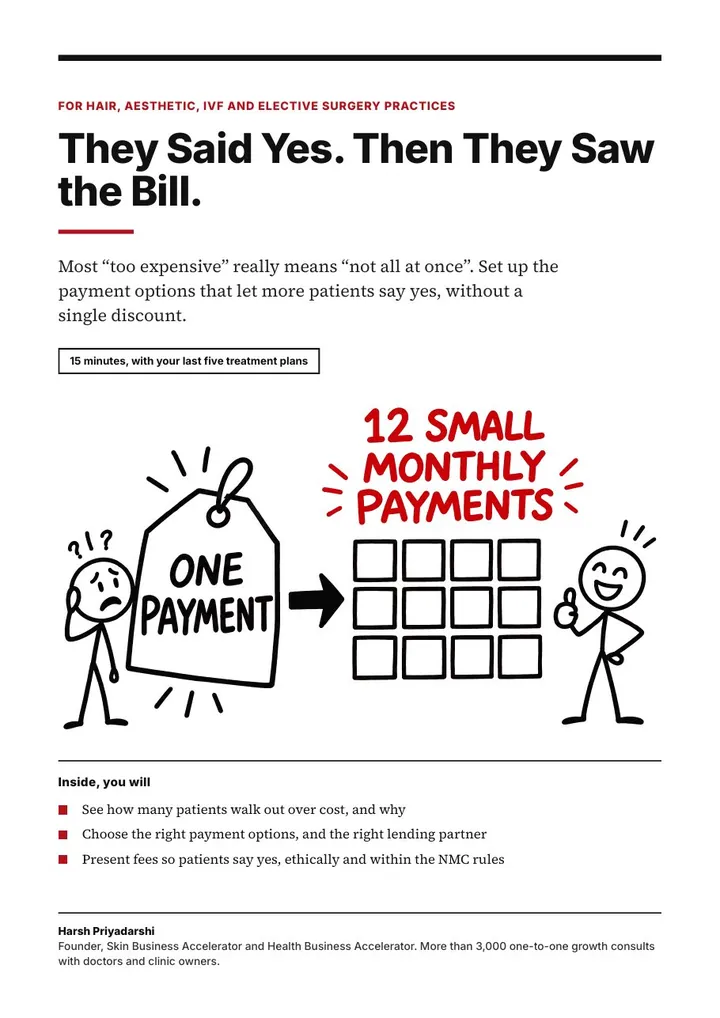
Say the Recommended plan is ₹2,40,000. A milestone plan built around your method could be ₹40,000 at booking, ₹1,60,000 on the day of surgery and ₹40,000 across the physiotherapy phase. Or, through a lending partner, 12 monthly payments of ₹20,000. Same plan, very different feeling.
Offer these to every family as normal options, not favours:
- Full payment for families who prefer it.
- Milestones across Assess, Replace and Rebuild, which costs you nothing.
- EMI through two or three healthcare lending partners, so if one declines, another may approve.
- Insurance and cashless, handled by a trained TPA desk that owns pre-authorisations every day.
Two warnings. No-cost EMI is never free. Usually you pay the interest as a fee, so build it into your margins. And never accept a panel package below your real cost. If your real cost for a procedure is ₹1,80,000 and a panel offers ₹1,60,000, you lose ₹20,000 on every case while feeling busy.
How do you hold your fees without discounting?
No discounts. No limited-period offers. Write every plan on one fee sheet, and make sure the surgeon, front desk and coordinator all quote from it.
When a family asks for a discount, give your team one line: "Our fees are the same for every patient. If budget is a concern, we can look at another plan or spread the payment." Change the scope or the payment, never the price.
Here is why. Say your plan is ₹2,40,000 and it costs you ₹1,60,000 to deliver, leaving ₹80,000. A 10% discount drops the price to ₹2,16,000 and the profit to ₹56,000. You now need about 43% more surgeries just to stand still. And the families who paid full price feel cheated when they hear.
The only real urgency in joint replacement is the patient's own "why now": the wedding, the trip, the fall, the stairs at home. Speak to that, honestly. Waiting can make surgery harder and rehab slower, so explain what delay costs in their case, without fear. If you want help building this, see our conversion systems and our orthopaedics page.
The short version
- Run every consultation to a definite ending: a surgery date, a test with a review, or a family session.
- Price joint replacement as one all-inclusive plan, with three honest options and one clear recommendation.
- The surgeon recommends. The coordinator handles fees, milestones, EMI and insurance.
- Print the monthly figure and every payment option next to the fee on the written plan.
- Never discount. Change the scope or the way the family pays, and keep package rates above your real cost.
Frequently asked questions
Should orthopaedic surgeons charge for the first consultation?
Yes. A paid consultation signals value and brings in families who are serious. If you want to soften it, adjust the consultation fee against the surgery plan when they go ahead. Explain on the phone what the consultation includes, such as the examination, a review of reports and a written plan, so the fee feels fair.
How do I explain what is not included in a knee replacement package?
Put it in writing on the plan, in plain words, before admission. Typical exclusions might be a longer stay than planned, treatment for unrelated conditions or extra investigations, depending on your hospital. A family surprised by a bill on discharge day will remember the bill, not the surgery, so explain it early.
What if the family wants to compare our price with a cheaper hospital?
Encourage a fair comparison rather than criticising anyone. Help them compare who operates, which implant, what is included, how physiotherapy and reviews work, and what results they can see. Give them your written plan to compare with. Families who compare on outcomes and care rarely choose on price alone.
When should an orthopaedic practice raise its fees?
Pick one fixed date every year, such as the start of the financial year. Raise for new patients only, honour every written quote, and pair the rise with something new like longer physiotherapy support. Raise more when surgery conversion stays above benchmark, the waiting list grows, or the operation theatre is fully booked.
On a free growth call, my team traces your last month from enquiry to treatment and shows you your biggest leak in rupees.