Orthopaedic retention starts with physiotherapy completion: book every session when the patient says yes and call anyone who misses one within a day. Then run a review calendar at three months, six months and a year, explain early signs in the other knee, welcome family members as guests, and send referring GPs and physiotherapists an update after every surgery, with the patient's consent.
A knee replacement unit we worked with discharged patients after physiotherapy and rarely saw them again. Many of those patients had arthritis in the other knee too. They simply had no reason to come back until the pain got bad, and by then some had gone elsewhere.
In orthopaedics, the most profitable part of the relationship begins after the surgery. Here is how to keep it.
Where does lifetime value come from in an orthopaedic practice?
Lifetime value grows from six places, and in orthopaedics each one looks specific.
| Source | What it looks like in orthopaedics |
|---|---|
| Plan completion | Every physiotherapy session finished, so the patient gets the full result |
| Follow-ups and maintenance | Reviews at three, six and twelve months, and a joint health plan |
| Related care | The second knee, the hip, back pain, or a sports injury in the family |
| Family and friends | The son, daughter or spouse who comes to every review |
| Long-term plans | A structured year of strengthening and reviews |
| Reputation | The patient who walks into a wedding without a stick, and tells everyone why |
If you fix only one thing, fix the first.
How do you get patients to finish physiotherapy?
Physiotherapy is where knee results are protected, and where most patients drop out. Pain eases, life gets busy, and the sessions stop at week three.
- Book every session on the day they say yes. A patient who leaves with all their dates in the phone is far more likely to finish than one who has to call each time.
- Track every patient against the plan in your CRM, with the next due session and any missed ones.
- Call within a day when a session is missed. Warmly. How are you? What got in the way? Most dropouts happen for small reasons: a son's car not available, a payment worry, fear that pain is not normal.
- Show progress. Measure range of movement or walking distance at each phase, and share it with the patient. Celebrate each phase of your method.
- End with a completion review with the surgeon, who goes through the result and books the first follow-up before the patient leaves.
What review calendar should an orthopaedic practice run?
After surgery, set reviews at three months, six months and a year, and book the first one at the completion review. Send a short, personal reminder before each one, and call anyone who doesn't reply.
That same unit added exactly this, plus a simple explanation of the early signs in the other knee. Many patients came back for their second knee earlier, before the damage got severe. And with far less fear, because they already trusted the team.
Between reviews, send one useful message every month or two: a strengthening tip, a short video, a reminder before the monsoon for patients who struggle in damp weather. The clinic stays in their life without ever feeling like spam.
For patients who suit it, offer a joint health plan: a year of scheduled reviews, strengthening sessions and priority access to the team, priced on its value, not as a discount for paying upfront.
How do you bring back orthopaedic patients you've lost touch with?
Your database is the fastest, cheapest channel you have. In orthopaedics, split it like this, and give each group its own reason to hear from you:
- Advised surgery, never went ahead. Often the largest group. A personal call asking how they are, and whether anything has changed, like the stairs, the pain at night, or a family event coming up.
- Booked and never came. A warm note with a new slot, and an offer to include the family on a call.
- Stopped physiotherapy halfway. Your warmest patients. Call them first.
- Due for a review. "It's been a year since your surgery, and it's time for your review."
- Happy past patients. A short guide to early signs of joint problems that they can pass to family.
Message only people who agreed to hear from you, take anyone off who asks, and make sure every reply reaches a human within minutes.
Say you have 300 patients who had one knee replaced in the last three years. If even 1 in 20 needs the other knee done in the coming year and comes back to you, that is 15 surgeries. On a ₹2,40,000 plan, that is ₹36,00,000 from patients who already trust you, at almost no acquisition cost. That is the kind of maths our retention and reactivation work is built on.
How do you turn joint patients into referrals?
Welcome the family. Almost every joint patient comes to reviews with a son, a daughter or a spouse, and many of them have joint problems of their own. Treat them as guests, answer their questions, and give every family a short guide to early signs. In one unit, family members started booking their own consultations, often months before their pain became severe.
Ask at the right moment. Not on discharge day. At the review where the patient walks in without support. "If you know anyone going through what you went through, we'd be glad to help them too." Give them a short WhatsApp message they can forward.
Ask for a review at the same moment, from every patient, never with anything offered in return.
Track it. Add a "referred by" field to every new patient, and thank every referrer personally. Recognition, never payment.
How do you keep GPs and physiotherapists referring?
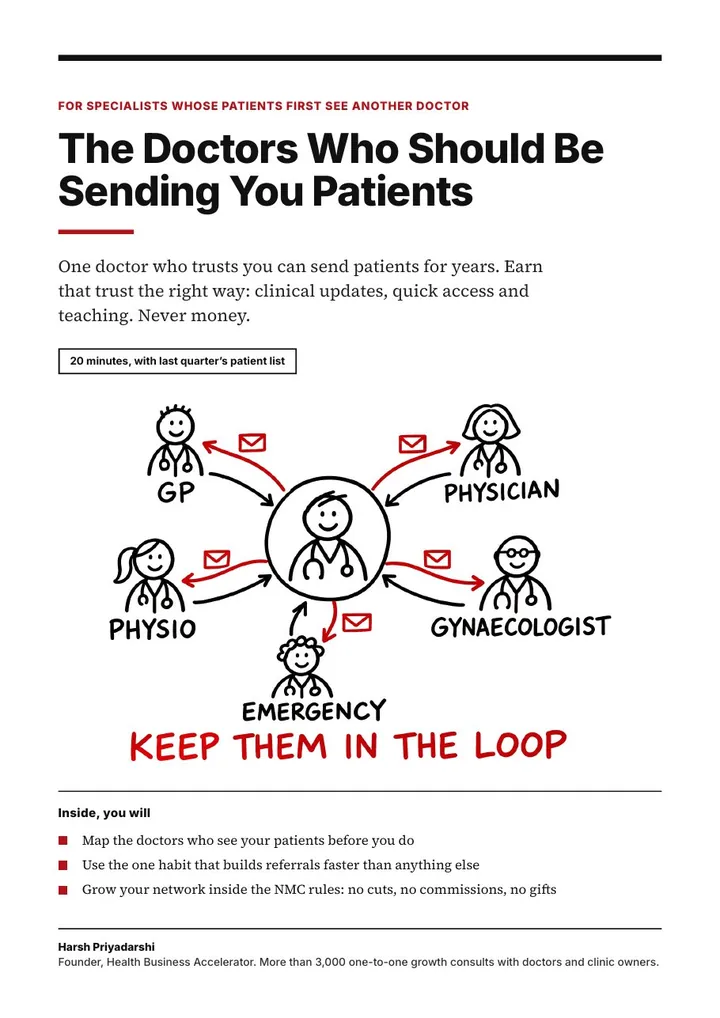
Map everyone who sees your patients first: general practitioners, physicians, physiotherapists and sports clinics. Then build the one habit that matters most: with the patient's consent, send the referring doctor a short update after the consultation and again after surgery.
Make referring effortless with a direct WhatsApp line, a one-page "when to refer" guide and priority slots for the patients they send. Run a teaching session every quarter on when knee patients need a surgeon and what happens after surgery. One knee surgeon in a very competitive city did exactly this, and within a year he was the surgeon local practitioners thought of first, because he was the one who had taught them.
And send patients back. When ongoing care belongs with the GP or the physiotherapist, return the patient. Never pay for referrals. More on the ortho channel mix on our orthopaedics page and in Good Doctors Go Broke.
The short version
- Book every physiotherapy session at the decision, and call any missed session within a day.
- Run reviews at three months, six months and a year, and explain the early signs in the other knee.
- Reactivate patients who were advised surgery but didn't go ahead, with care, not offers.
- Treat family members as guests, and ask for referrals at the walking-without-support review.
- Update every referring GP and physiotherapist after each consultation and surgery, with consent.
Frequently asked questions
How often should knee replacement patients come back for review?
Many practices use a review calendar at three months, six months and a year after surgery, then yearly. Your surgeons decide the clinical schedule. The business job is to book the first review before the patient leaves the completion visit, remind them before each one, and call anyone who doesn't confirm.
Is it ethical to tell knee patients about their other knee?
Yes, when it is honest care, not selling. If the other knee shows early changes, explaining the signs to watch for helps the patient act at the right time instead of after the damage is severe. Never push a procedure that isn't needed. Patients trust a surgeon who also tells them when to wait.
What should we send ortho patients between review visits?
One short, useful message every month or two: a strengthening exercise your physiotherapists approve, a short video on protecting the new joint, a reminder before damp weather, or an invitation to a talk. Keep it about their recovery, not your offers, and only message patients who agreed to hear from you.
Should we pay physiotherapists or GPs for referring patients?
No. Paying for referrals is unethical, destroys trust on every side and turns a relationship into a transaction. Earn referrals instead with fast access, a direct line, honest updates after every patient with consent, teaching sessions, and sending patients back for care the referring clinician can give.
On a free growth call, my team traces your last month from enquiry to treatment and shows you your biggest leak in rupees.