Orthopaedic surgeons in India get more patients by owning one problem, usually knee or hip replacement, then running three channels together: a strong Google Business Profile with condition pages, Google search ads for treatments people search by name, and one trust channel such as GP and physiotherapist referrals or corporate talks. Fix call handling first, because joint patients compare several surgeons before choosing.
Here is something most orthopaedic surgeons miss. The person searching for you is often not your patient. It is a daughter in Pune typing "best knee replacement surgeon in Patna" for her mother, at eleven at night, after a phone call where her mother cried about the stairs. If your growth plan only speaks to the patient, you are talking to the wrong person in the family.
This playbook is how we think about getting more patients for an orthopaedic practice in India, from a solo surgeon in a tier 2 city to a joint replacement unit inside a hospital.
Who is the orthopaedic patient you actually need to reach?
Start with a patient map, not an ad. For joint replacement, the patient is usually older, often a woman, and has already tried painkillers, physiotherapy, knee caps, oil massages and injections. She plans her day around how many stairs it involves. She struggles to sit on the floor or use an Indian-style toilet. And she is scared of three things: the operation, months in bed, and the bill.
But the decision is often made by the children. They research the surgeon, they compare cities, they ask about insurance and they usually pay. So every channel has to answer two people at once: the parent who is afraid, and the son or daughter who is checking whether you are safe.
Write both down. The patient's fears become your content. The family's questions become your landing page.
How do you stop being "complete ortho care"?
Look at your numbers by service: revenue, volume, demand and growth. For most surgeons we meet, joint replacement is where revenue and passion sit together. That becomes the one problem your marketing leads with. You still treat fractures, sports injuries and backs. Your niche decides what your marketing leads with, not what you are allowed to treat.
If you practise inside a family hospital that the whole town knows "for everything", give your unit its own identity: a joint centre with its own name, website, Google profile and Instagram, at the same address. Then name your method. A simple four-phase version could be Assess (scans, gait and health check), Prepare (strengthening and home preparation), Replace (the surgery, with the implant chosen for the patient) and Rebuild (physiotherapy until they walk without support). Every clinic does knee replacement. Only you do your method.
Which channels work best for an orthopaedic practice?
Start with three: one free, one paid and one that builds trust. Here is how I would match them for a joint replacement practice.
| Channel | Why it works in orthopaedics | First step this month |
|---|---|---|
| Google profile and condition pages (free) | Families search "knee replacement surgeon near me" and "knee replacement cost" | Set the primary category to orthopaedic surgeon and build one page per joint |
| Google search ads (paid) | People search the treatment by name, so demand already exists | One campaign each for knee, hip and sports injuries |
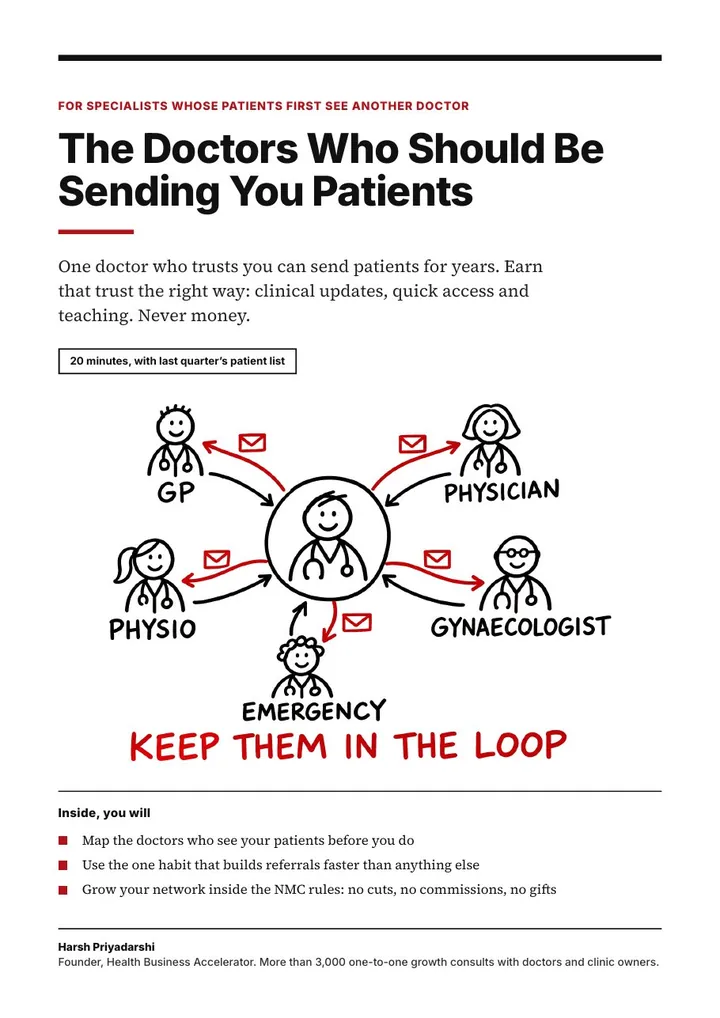
| GP, physician and physiotherapist referrals (trust) | Many joint patients see another clinician before a surgeon | A one-page "when to refer" guide and a direct WhatsApp line |
| Corporate and society talks (trust) | Back, neck and knee pain are common in offices and senior citizens' groups | One thirty-minute talk with a simple pain questionnaire |
| Database reactivation (free) | Old enquiries and past patients with a second knee already trust you | Message only people who agreed to hear from you |
Meta ads and short video come later for most surgeons, when you want to create demand among families or build up to a launch like a robotic system. We cover that in detail on our orthopaedics page.
What should a new orthopaedic patient cost you?
Use the benchmark from Good Doctors Go Broke: acquisition cost of roughly 10 to 20% of a patient's first-year value.
Say your all-inclusive knee replacement plan is ₹2,50,000, and a typical patient also comes back for reviews and some physiotherapy. Call the first-year value ₹2,70,000. Ten to 20% of that is ₹27,000 to ₹54,000. So if your Google ads, content and agency fees together cost ₹3,00,000 in a quarter and produce 9 surgeries, your cost per new patient is about ₹33,333. That is inside the range.
Now notice what the maths hides. Surgery decisions are slow. Some patients go ahead within a week. Others take months. So measure how many patients you advised surgery for actually went ahead, over a 60 to 90 day window, not in the week the ad ran.
What has to be fixed before you spend more on ads?
Ads amplify whatever your practice already is. Before a joint replacement practice spends more, we check these, in order:
- Every enquiry lands in one CRM, tagged with its source.
- A human calls every new enquiry within five minutes during working hours, and the answer rate is at least 95%.
- The front desk asks who the patient is, who else is deciding, and why now.
- Families can join a short video call with the surgeon before the decision.
- You have a written fee sheet with one all-inclusive plan and three options.
- Insurance and cashless status is clear, with one person owning pre-authorisations.
- Your Google profile and knee and hip pages are live when someone searches your name.
If any answer is no, fix it first. We once worked with an orthopaedic practice that felt its ads had stopped working. The ads were fine. Many leads were being called the next day, and some were never called at all. Once the front desk system was rebuilt, appointments rose without spending a rupee more on ads.
What does the first 90 days look like?
Month one: become the obvious choice. Pick your problem, map the patient and the family, set up the Google profile properly and name your method. On day one, reactivate your database. Past patients often have a second knee, and their spouses and siblings often have knee pain of their own.
Month two: switch on free and paid. Build the knee and hip replacement pages in the local language, add a tracked phone number, and launch Google ads with negatives built before the first rupee is spent.
Month three: add trust. Run your first teaching session for local GPs and physiotherapists, or your first office talk on desk-related back and knee pain. If rehab is half of your outcome, link the work to your physiotherapy and rehab team, so referrals flow both ways.
At week 13, look at your weekly numbers and your cost per treated patient by channel. Then decide what to add next. If you want a second pair of eyes on that order, a free growth call is where we start.
The short version
- In orthopaedics, the patient is afraid and the family decides. Market to both.
- Lead with one problem, usually joint replacement, and give it its own identity and a named method.
- Start with three channels: Google profile, Google ads and one trust channel like GP referrals or corporate talks.
- Keep cost per new patient near 10 to 20% of first-year value, measured over a 60 to 90 day decision window.
- Fix the five-minute callback and the family conversation before you buy more leads.
Frequently asked questions
Should an orthopaedic surgeon run Google ads or Instagram ads first?
For knee and hip replacement, Google ads usually come first, because families already search for the treatment and its cost by name. Instagram and Meta work better later, to create demand among families, explain recovery and build up to launches. Read your recent enquiry logs: if people name the surgery, start with Google.
How much should a knee replacement patient cost to acquire?
A useful benchmark is 10 to 20% of the patient's first-year value. If a patient is worth about ₹2.7 lakh in their first year, that is roughly ₹27,000 to ₹54,000. Count everything: media, agency, content and the people handling leads, and measure across a 60 to 90 day decision window.
My ortho practice is inside a multispecialty hospital. How do I stand out?
Give your joint replacement unit its own identity at the same address: a name, a Google Business Profile with the most specific category, its own pages and its own Instagram. The hospital can still treat everything. Your marketing simply leads with one problem, so families start linking your name with knees.
Do doctor referrals still matter for orthopaedic surgeons?
Yes. GPs, physicians, physiotherapists and sports clinics often see joint patients before any surgeon does. Make referring easy with a WhatsApp line and a one-page guide, send the referring doctor an update after every consultation and surgery with the patient's consent, and never pay for referrals.
On a free growth call, my team traces your last month from enquiry to treatment and shows you your biggest leak in rupees.