The hairline drawing is often the moment a hair transplant patient decides. Run it as a set piece: prepare the mirror and light, draw slowly while explaining why it sits where it does for his age and donor area, let him react, handle requests to go lower honestly, then photograph it for his file and move straight to the written plan and a date.
There is a moment in almost every hair transplant consultation where the room goes quiet. The surgeon picks up the marker, stands behind the patient, and starts drawing on his forehead. The patient watches in the mirror. For the first time in years, he sees a version of his own face he had stopped imagining.
That is where he decides. Not at the price. Not at the brochure. At the mirror.
Most surgeons do this part well clinically and badly as a conversation. They draw, say "something like this", and move on to the fees. The single most powerful moment in the consultation is over in forty seconds.
Why is the hairline drawing the deciding moment?
Because it turns an idea into his face. Everything before it is explanation. Everything after it is logistics. The drawing is the only time he sees the outcome, on himself, designed for him.
In Known Doctors Get Booked, I call this demonstration proof. A patient who sees the result on his own face does not need to be convinced by anything else. He needs to understand it, trust the reasoning behind it, and know what happens next.
So give this moment the time and structure it deserves. Five to ten minutes, not forty seconds.
How should you set up the room for it?
Small things make a big difference here:
- A mirror he can see clearly while seated, not one he has to twist towards.
- Good, even light, so the drawn line and his existing hair are both visible.
- A hand mirror so he can see the side view and temples.
- Someone ready to take photos of the drawn hairline, for his private record and his written plan, with his consent.
- The family seated where they can see, if they came with him. They will want to see it too.
Do the drawing after the scalp examination and the diagnosis, and after you have repeated his "why now" back to him. By then he understands his hair loss. The drawing shows him the plan for it.
How do you explain age and donor limits in plain words?
This is the part most surgeons rush, and it is the part that protects you for the next ten years. As you draw, explain why the line sits where it does. Plain words, short sentences. For example:
Doctor: "I'm placing it here, not lower, for two reasons. First, your face will keep ageing, and a hairline that looks right at 26 should still look natural at 45. Second, your donor area at the back is limited. Every graft we use today is one we can't use later. So I'm designing this to look good now and to leave you options in the future."
And then the softer edges:
Doctor: "See how the line isn't straight? A natural hairline has small irregularities. That's what stops it looking done."
You are not lecturing. You are narrating your thinking, so he trusts the design instead of just looking at it. The clinical judgement is entirely yours. The business job is to say it out loud.
What do you do when he wants it lower?
He often will. "Thoda aur neeche, doctor. Like when I was 18." This is the most important conversation in the room, and how you handle it decides whether he is happy in five years.
Use the same steps as any objection:
- Listen fully. Let him say exactly what he wants and why.
- Acknowledge it. "I understand. You want the face you remember."
- Find the real concern. Often it is a specific photo, or a friend's look, or fear that it will not be noticeable enough.
- Answer honestly, with the reasons. Age, donor limits and the long view. If you believe a lower line is wrong for him, say so clearly.
- Check. "Does that make sense to you?"
- Move forward. Adjust within what you believe is right, or agree to think about it together at a follow-up.
If he insists on something you believe will harm his result, it is fine to say you will not do it. That honest no costs you one surgery and protects your name for a decade. Write the agreed design and any disagreement into his notes.
How do you move from the drawing to a written plan and date?
Do not let the moment fade. Right after the drawing, while he is still looking in the mirror, connect it to the plan:
Doctor: "So this is the hairline I'm recommending for you. To get here and protect it, this is the plan I'd choose." Then the method, the three options, the recommendation.
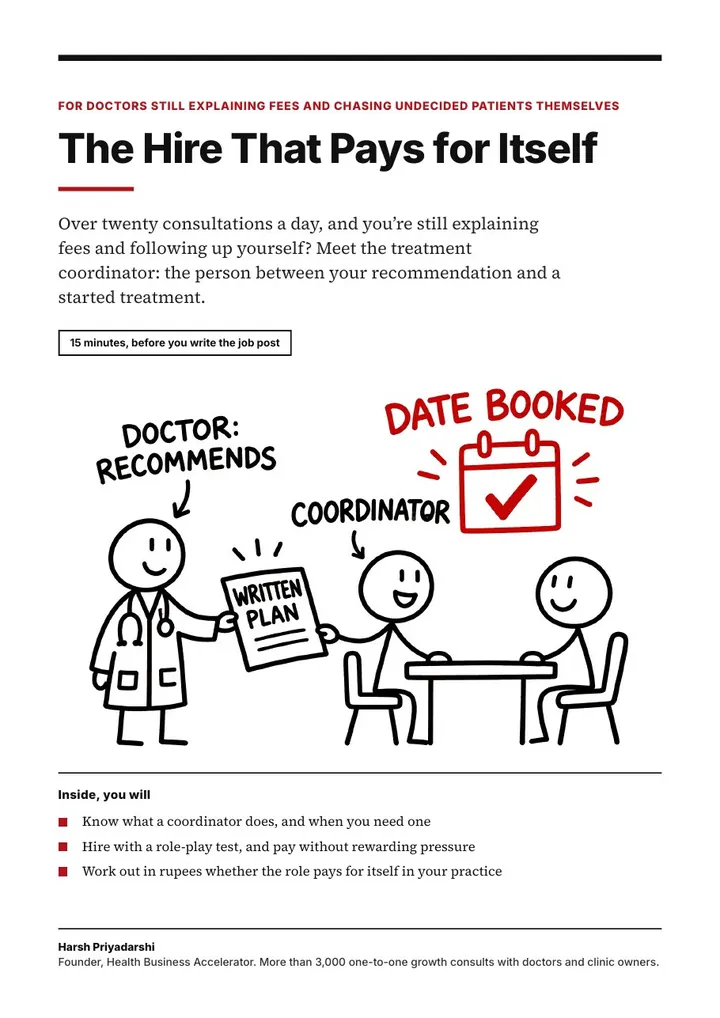
Then hand over to the coordinator with the photo of the drawing printed or added to his written plan. Here is what that plan page should carry:
| On the written plan | Why it matters |
|---|---|
| A photo of the drawn hairline, with his consent | He shows it at home. Families decide on this page. |
| The design reasons in two lines | Age, donor area, long-term planning |
| The recommended option, with the other two | So he sees the choice, not just the price |
| The fee and payment options | Next to each other, from the fee sheet |
| The proposed surgery date and review dates | The definite next step |
The photo is for him and his family only. It never goes into marketing. Under the NMC guidelines of 6 October 2026, patient photos in promotion are out, and you should read those guidelines yourself.
How do you know if this moment is working?
Track it. Your coordinator can log one extra field: was the hairline drawn in this consultation, yes or no. Then compare consult conversion for the two groups over a quarter.
Here is the kind of thing you might see, as an example. Say 60 consultations in a quarter. In 25 the hairline was drawn and explained properly, and 13 went ahead. In 35 it was skipped or rushed, and 9 went ahead. That is 52% versus about 26%. The numbers in your clinic will be different, but the test is the same, and it takes no extra cost.
If drawing helps and some doctors in your team skip it, you have found your cheapest growth lever. More on running the full consultation is in our conversion systems work, the authority side is in doctor authority, and the rest of the hair journey is on our hair transplant page.
The short version
- The patient decides at the mirror, not at the price. Give the drawing five to ten minutes.
- Prepare the mirror, light, hand mirror and photo before you start.
- Narrate why the line sits where it does: his age, his donor area, the long view.
- Handle "go lower" like any objection, and say no if it would harm him.
- Put the drawing photo, the reasons and the date on his written plan, and track conversion.
Official sources
Rules change. Check the current version at the source before you act.
Frequently asked questions
When should the hairline be drawn in a hair transplant consultation?
After the scalp examination and diagnosis, and after the doctor has repeated the patient's reason for coming back to him. By then he understands his hair loss, so the drawing shows him the plan for it. Move straight from the drawing to the recommendation and the written plan.
What should I do when a patient wants a lower hairline than I recommend?
Treat it like any objection: listen, acknowledge, find the real concern, then explain your reasons honestly, especially his age and his limited donor area. Adjust only within what you believe is right. If he insists on something you think will harm his result, it is fine to decline.
Can I post photos of hairline designs drawn on patients?
No. Those photos are patient photos and should stay in the patient's record and written plan only, with consent. The NMC guidelines on advertising of 6 October 2026 rule out patient photos in promotion. Read the current guidelines yourself before posting anything involving patients.
Does drawing the hairline really increase hair transplant conversions?
You can test it in your own clinic. Log whether the hairline was drawn and explained in each consultation, then compare consult conversion for both groups over a quarter. If it helps and some doctors skip it, making it standard is one of the cheapest changes you can make.
On a free growth call, my team traces your last month from enquiry to treatment and shows you your biggest leak in rupees.