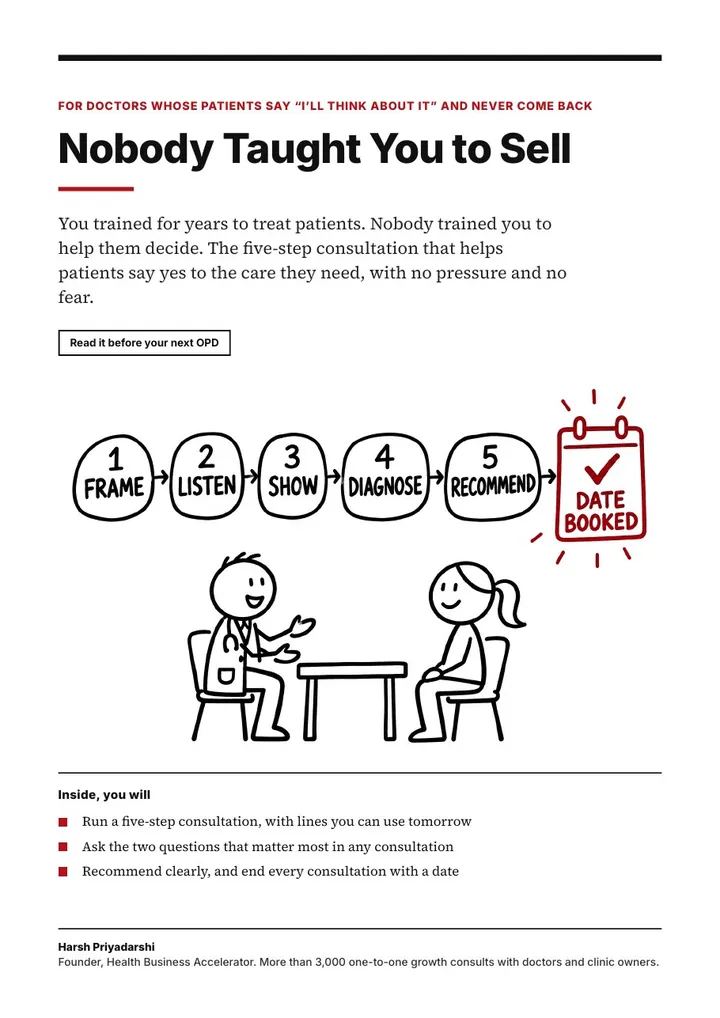
Narrating the examination means telling the patient, in simple words, what you are checking and what you are finding while you examine them, and showing them whenever you can: the scalp under magnification, the X-ray next to a healthy one, the scan on the screen. A patient who sees their own problem understands it, and a patient who understands it takes it seriously.
One of the stories in my book is about a dermatologist with excellent skills. He examined every patient in complete silence, then gave the diagnosis in medical terms. Patients nodded politely. And most of them didn't book.
We didn't change his medicine. We changed what the patient heard and saw during those ten minutes. He started narrating the examination in simple words, showing patients their own skin under magnification, and repeating their goal back to them before recommending.
Same doctor, same skills. He started converting far more consultations, because patients finally understood what he was seeing.
Why does a silent examination lose patients?
Because from the patient's side, nothing is happening.
You are thinking hard. You are noticing a dozen things. But the patient only sees a doctor looking, pressing, nodding. Then they hear a diagnosis they can't picture, in words they don't use.
So when you recommend a plan, they are being asked to trust a conclusion they never saw you reach. Many won't. They go home, search the diagnosis, and get confused by what they find.
The examination is the one part of the consultation where the patient can see your skill with their own eyes. Silence wastes it.
Narration also helps the person sitting next to the patient. In India, a spouse, a parent or an adult child is often in the room, and they are frequently part of the decision. When they hear what you are finding, in words they understand, they go home as an ally instead of a sceptic.
What does narrating the examination sound like?
Say what you are checking, what you are finding, and what it means, in the words you would use with a smart friend who isn't a doctor. Here are some examples by speciality.
| Speciality | Silent version | Narrated version |
|---|---|---|
| Hair restoration | Looks at the scalp, writes notes | "I'm checking the density at the front. See this area? The hair here is getting thinner, and that's why the hairline keeps moving back." |
| Orthopaedics | Moves the knee, makes a note | "When I bend your knee like this, can you feel that? That's where the cartilage is wearing down." |
| Dermatology | Looks at the skin under a light | "Let me show you on the screen. These marks are deeper than the surface, which is why creams alone haven't changed them." |
| Dental | Examines, then reads the X-ray alone | "Look at this X-ray with me. This dark area here is what's been causing the pain when you chew." |
| Urology | Reviews the scan quietly | "Here's your scan. This white spot is the stone, and this is where it's sitting." |
These lines are examples of how to talk, not clinical scripts. Your own findings decide what you say.
What should you show the patient?
Wherever you can, show rather than tell.
- Magnification. The scalp, the skin or the gums on a screen, so the patient sees what you see.
- Side by side. Their X-ray or scan next to a healthy one. The difference explains itself.
- The scan on screen, turned towards the patient, with your finger on the problem.
- Drawing on the patient. A hair surgeon drawing the planned hairline on the forehead, so the patient sees the result before deciding.
- A simple diagram of the problem and of your method, phase by phase, on one page.
This is what I call demonstration proof. A patient who sees their own problem doesn't need to be convinced it is real.
If you capture photos or images to compare progress later, take written consent first, and never use them outside the patient's own care without it.
Set the room up for it. A screen the patient can see, the magnifier within reach, a healthy comparison image ready. If you have to hunt for them, you won't use them.
How do you explain the diagnosis afterwards?
Once the examination is done, name the problem clearly. Explain what it is, what is causing it and, honestly, where it is heading if nothing is done.
Not to scare them. Because they deserve to know. Something like: "Hair loss like this is progressive. It won't reverse with oils, and every year we wait, there's less to work with."
Then connect it to what they told you at the start. "You said you want to stop wearing a cap at your wedding. Let's talk about how we get you there."
When the patient says "yes, exactly", you have earned the right to recommend.
Here is a useful test. Could the patient explain their problem to their family tonight, in two sentences, without you there? If not, simplify until they could.
What should you avoid?
- Jargon. If you need a medical word, explain it in the same sentence.
- Exaggeration or fear. Be honest about where the condition is heading. Never inflate it to push a decision.
- Talking to the screen. Turn the screen towards the patient, then look at them, not it.
- Rushing. Narration adds a minute or two. Those minutes do more for trust than anything else in the room.
- Promising results. Explain what you see and what the realistic outcome is. Never guarantee.
How do you build the habit?
- For each of your core treatments, write three or four narration lines in plain words.
- Decide what you will show for each: magnification, a comparison image, a scan or a drawing.
- Set up the room so the screen faces the patient and the tools are in reach.
- Practise with an associate or your coordinator playing the patient.
- Ask your coordinator what patients repeat back after the consultation. If they can explain their own problem, the narration is working.
Narrating the examination is one step in the consultation structure in Chapter 7 of Good Doctors Go Broke. We work on the full consultation with doctors in our conversion systems work, and the proof side, including demonstration proof, connects to doctor authority. Dermatology and orthopaedics are two specialities where showing the patient their own problem changes the room fastest.
The short version
- A silent examination wastes the one moment patients can see your skill.
- Say what you are checking, what you are finding and what it means, in plain words.
- Show wherever you can: magnification, side-by-side images, the scan on screen, a drawing.
- Explain the diagnosis honestly, then connect it to the patient's own goal.
- Write narration lines for each core treatment and set up the room so showing is easy.
Frequently asked questions
How do I explain a diagnosis so patients understand it?
Explain it the way you would to a smart friend who isn't a doctor: what it is, what is causing it, and honestly where it is heading if nothing is done. Use one medical word at most, and explain it in the same sentence. Then connect it back to the goal the patient told you at the start.
Does talking during the examination make the consultation longer?
A little, usually a minute or two. But those minutes replace much longer conversations later, when a confused patient asks the same questions again or goes home undecided. A patient who saw their problem and understood it decides faster, so narration often saves time across the whole journey.
What can I show patients during a consultation?
Anything that lets them see their own problem: the scalp or skin under magnification, their X-ray next to a healthy one, the scan on a screen turned towards them, or a drawing of the planned result. A one-page diagram of your method also helps them see the journey ahead.
Is narrating the examination the same as selling?
No. Narration is explaining what you see, honestly and in plain words, so the patient understands their own body. It never means exaggerating the problem or promising a result. Patients who understand their condition make better decisions, whether that decision is to go ahead, wait or seek a second opinion.
On a free growth call, my team traces your last month from enquiry to treatment and shows you your biggest leak in rupees.