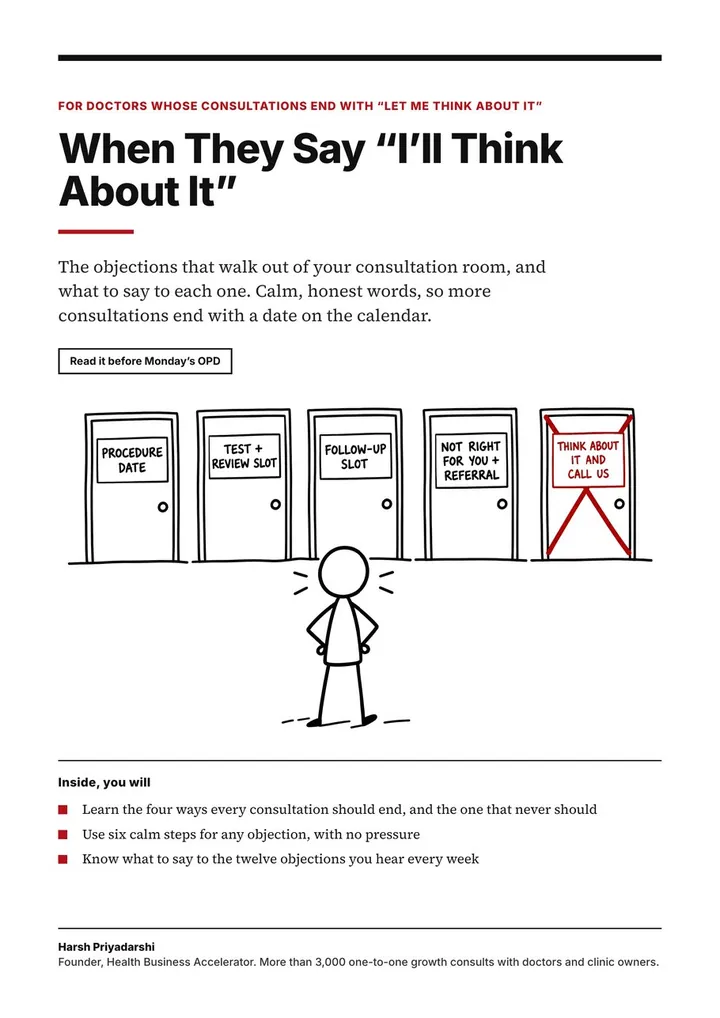
Every consultation should end with one of four definite next steps on the calendar: a procedure or surgery date booked before the patient leaves, a test with a date and a review slot, a follow-up slot for patients who need to try something first or bring family, or an honest "this isn't right for you" with a referral. "Think about it and call us" should never be an ending.
"Theek hai, aap soch lijiye, phir batana." (Fine, think it over and let us know.)
It sounds kind. It sounds respectful. And it is where most surgeries are lost.
A patient who leaves with a date in their phone is still in your journey. A patient who leaves with "call us" has to remember, decide and pick up the phone on their own, at home, with nobody to answer the new questions that come up on the drive back. Most of them never call.
So here is the rule I ask every doctor we work with to follow from today: no consultation ends without a definite next step on the calendar.
Why does "think about it" lose so many patients?
Because the patient came to you for help with a decision, and you sent them home alone with it.
At home, the doubts get louder. A relative has an opinion. Someone on a WhatsApp group knows a cheaper clinic. The "why now" that brought them in starts to fade. A week later, the problem is still there, but the urgency is gone.
Here is an example of what that costs. Say a surgeon sees 15 consultations a week and 6 of them end with "think about it." That is 24 patients a month leaving with nothing booked. Say just one in four of them would have gone ahead with a date in their phone and a coordinator calling the next day. That is 6 patients a month. At an example plan value of ₹1 lakh, that is ₹6 lakh a month walking out of the door.
What are the four definite endings?
Every consultation should end behind one of these four doors.
| Ending | When it fits | What is booked before the patient leaves |
|---|---|---|
| A procedure or surgery date | The patient is suitable and ready | The date itself, plus pre-procedure instructions |
| A test or investigation | You need more information to decide | The test date and time, and a review slot to go through results |
| A follow-up slot | The patient genuinely needs to try something first, or come back with family | A specific date and time, not "next month" |
| An honest "not right for you" | The patient doesn't need it, or isn't suitable | A referral or a clear alternative |
Notice that three of the four doors are not a yes. That is the point. The rule is not that every patient must agree to surgery today. The rule is that every patient leaves with something specific on the calendar, so nobody falls through the gap between your consultation room and their kitchen table.
The fourth door matters as much as the first. When someone doesn't need a procedure, tell them. That one honest no will bring you more patients over the years than any closing line.
How do you ask for the decision without sounding pushy?
The ending is easy when the start was right. Three things set it up.
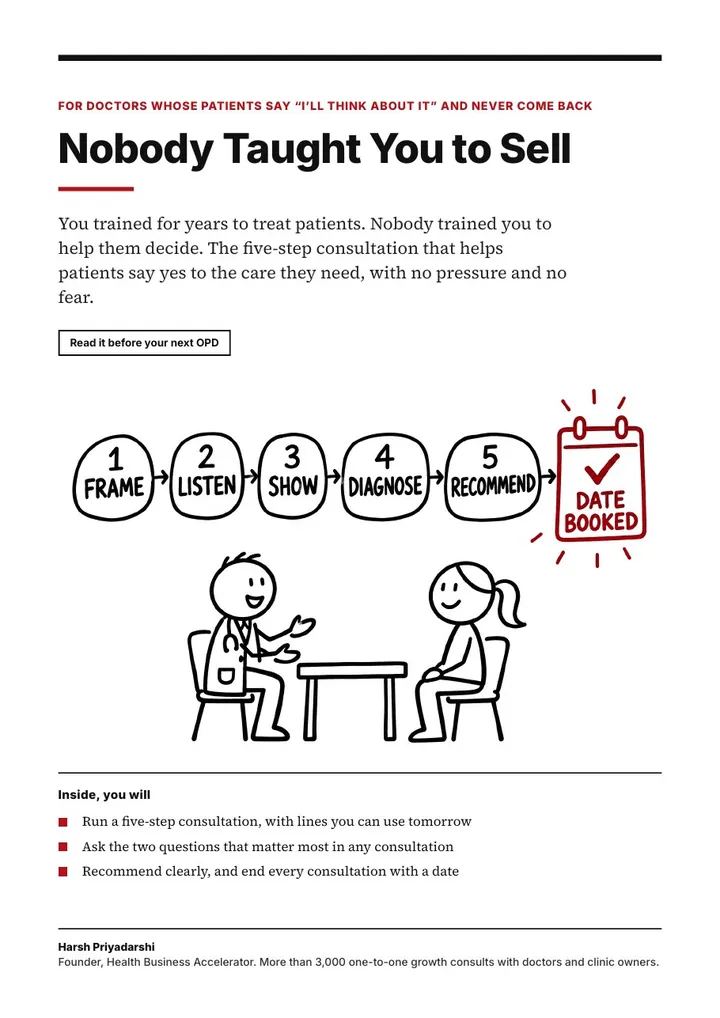
Frame it in the first two minutes. Tell the patient how the consultation will go: "First I'll understand what's been happening, then I'll examine you, and by the end you'll know what's going on, your options and what I recommend." Now the recommendation is expected, not a surprise.
Recommend one plan. Present your options, then say clearly which one you would choose for this patient, and why. Don't hand over a menu.
Ask directly, then be quiet. "Shall we go ahead and book your date?" Then stop talking. The silence after the question is where the patient decides. Don't fill it.
What do you do with each answer?
There are only three ways it goes.
- Yes. Book it right there. Not "the front desk will call you." The date goes into the calendar before the patient stands up.
- "I need to discuss it with my family." Completely reasonable, especially in India. Book the family session or a video call with the family before they leave.
- An objection. Cost, fear, timing. Handle it: listen, acknowledge, find the real concern, answer honestly, check it landed, then come back to the next step.
Whatever the answer, the patient leaves with one of the four doors booked.
How does the handover keep the ending definite?
In a busy OPD, the doctor cannot do all of this alone. So build the handover.
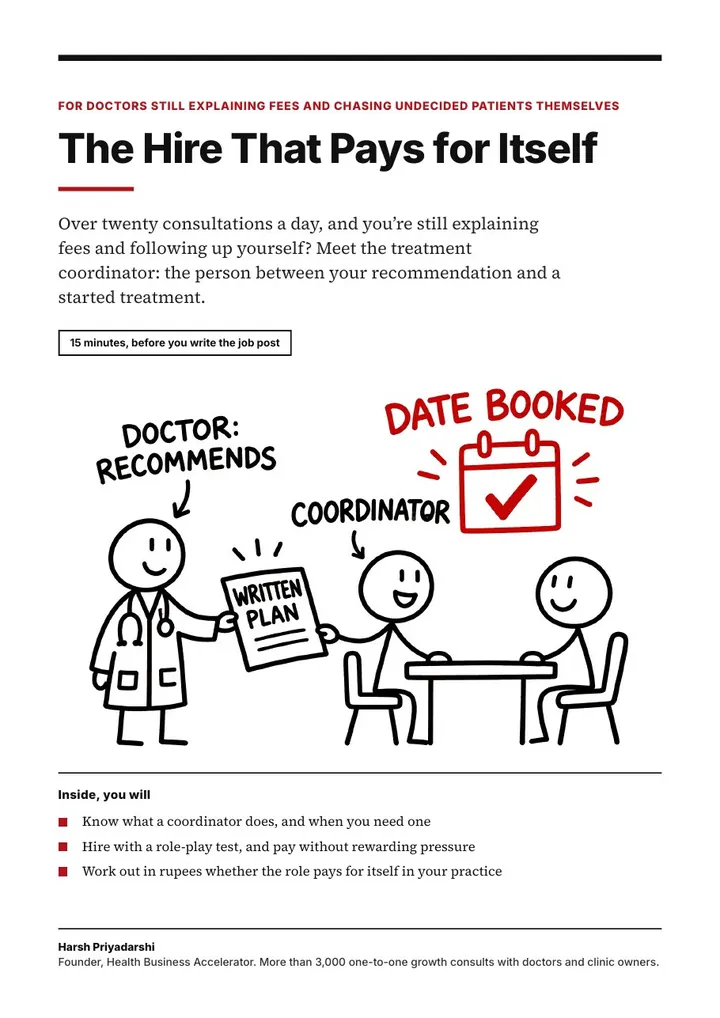
When you finish, introduce your treatment coordinator by name, in front of the patient: "Anjali will take you through the plan and she'll be your contact from here." The coordinator then sits with the patient, goes over the written plan, the fee and the payment options, and books the next step.
Then make the system enforce it. In your CRM, a consultation cannot be closed until the next step and its date are filled in. If a consultation has no next step logged, someone asks why the same day.
How do you start this week?
- Write your framing line for the first two minutes, in your own words.
- Write one recommendation sentence for each of your core treatments.
- Practise "Shall we go ahead and book your date?" until you can say it and stay silent.
- Agree the four endings with your team, and ban "think about it and call us."
- Set up the handover to your coordinator or front desk for fees and booking.
- Add a required "next step and date" field to every consultation in your CRM.
- Count, every Monday, how many consultations ended without one.
One of the client stories in my book is an orthopaedic surgeon who ended almost every consultation with "think about it and let us know." We changed one thing: a definite ending every time. His surgeries rose within weeks, and his patients said they felt more looked after, not less. If you run an orthopaedic practice, where families often take time to decide, this rule matters even more.
The full consultation structure is in Chapter 7 of Good Doctors Go Broke. We build it with clinics as part of our conversion systems work, and you can see how we work before deciding anything.
The short version
- "Think about it and call us" is where most surgeries are lost.
- Every consultation ends with a procedure date, a test with a review slot, a follow-up slot, or an honest "not right for you."
- Frame the consultation at the start, recommend one plan, ask directly, then stay quiet.
- Book the family session there and then when the family decides.
- Make the CRM refuse to close a consultation without a next step and a date.
Frequently asked questions
How do I close a consultation without sounding like a salesperson?
Tell the patient at the start that you will give a recommendation, so it never feels like a sudden pitch. Then recommend the one plan you would choose for them, explain why, and ask, "Shall we go ahead and book your date?" Helping a patient make a clear decision is care, not selling.
What if the patient really does need time to decide?
Then the next step is a follow-up slot with a specific date and time, booked before they leave. Send the written plan home with them, and have your coordinator message the same day and call the next day. Time to decide is fine. Leaving with nothing on the calendar is not.
Should the doctor or the front desk book the surgery date?
The doctor recommends and asks for the decision. Booking the date, explaining the fee and payment options, and handling the details belong to the treatment coordinator, or a well-trained front desk if you don't have one yet. The doctor introduces them by name so the patient's trust carries over.
Is it okay to tell a patient they don't need treatment?
Yes, and you should. An honest "this isn't right for you", with a referral or an alternative, is one of the four definite endings. It protects the patient, and it builds the kind of trust that brings referrals and returning patients for years. Never sell a treatment someone doesn't need.
On a free growth call, my team traces your last month from enquiry to treatment and shows you your biggest leak in rupees.