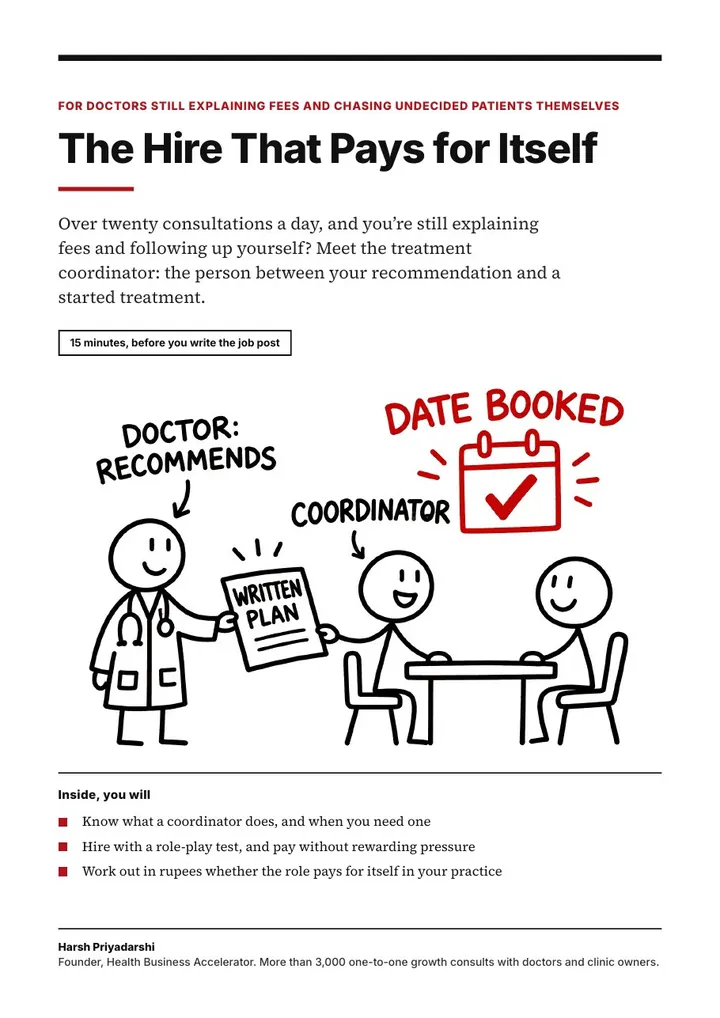
A treatment coordinator takes the patient from the doctor's recommendation to a treatment that is booked, paid for and started. They walk the patient through the written plan, explain the options, fees, EMI and insurance, book the date, speak to the family and follow up anyone who didn't decide. In my framework, you need a dedicated coordinator once you do more than twenty consultations a day.
You finish a good consultation. Clear diagnosis, clear recommendation, the patient is nodding. And the next patient is already outside the door.
So what happens to all the questions? The fee. The EMI. The date. The insurance. What the family should know. In most clinics, they get squeezed into the last two minutes, or pushed onto a front desk that is also answering the phone.
That gap, between "the doctor recommended it" and "the patient started it", is where a lot of good consultations quietly die. A treatment coordinator is the person whose job is to close it.
What is a treatment coordinator?
The treatment coordinator is the bridge between the doctor's recommendation and the patient's decision.
Think of a clinic's conversion system as three handoffs. The front desk turns enquiries into appointments. The doctor turns consultations into a clear recommendation. And the coordinator turns that recommendation into a treatment that is actually paid for and started.
The doctor stays the doctor. The coordinator handles the money, the dates and the follow-up. That split matters, because patients trust a doctor who sticks to medicine, and they feel far more comfortable asking a coordinator about money.
What does a coordinator actually do all day?
Right after the consultation, the coordinator sits with the patient in a quiet space and:
- Walks them through the written treatment plan.
- Explains the three options again, slowly, and answers the questions the patient was too shy to ask the doctor.
- Explains the fee, milestone payments and EMI, and helps with insurance paperwork where it applies.
- Books the procedure date, the test or the follow-up, so every consultation keeps a definite ending.
- Talks to the family, on the phone, on a video call or in person.
- Follows up every patient who didn't decide on the day: a message the same day, a call the next day, and check-ins on day three, seven and fourteen.
They also become the patient's single point of contact. One person who knows their name, their case and their next step, from the first plan to the last review visit.
When does your clinic need one?
Here is my framework. If you are doing more than twenty consultations a day, you need a dedicated treatment coordinator.
Below that, the doctor and a well-trained front desk can usually share the job, with a clear handover. Above it, the cost of not having one shows up every day, in patients who walked out undecided and were never followed up.
Here is an example of the hidden cost. Say you see 25 consultations a day and spend about six minutes at the end of each one on fees, payment options and dates. That is 150 minutes, two and a half hours of your day, spent on work someone else could do better. Your OPD runs late, patients wait, and the undecided ones still go home with nobody calling them.
Even below twenty a day, watch for the warning signs. Your OPD regularly runs late because fee conversations spill over. Patients ask the front desk about EMI while the phone keeps ringing. And nobody can tell you how many undecided patients were called back this week. Any one of those means the last step has no owner.
As you grow, the role grows with you. One coordinator can usually handle the patients from one doctor's busy clinic. When you add doctors or locations, you add coordinators.
What should a coordinator never do?
The role works only if the boundaries are clear.
Never negotiate the price. A coordinator negotiates the plan: the option that fits, the payment structure that works, the date that suits the patient's life. The fee on the fee sheet stays the fee. If budget is the issue, they move to a smaller scope or spread the payment.
Never give clinical advice. Medical questions go back to the doctor. The coordinator explains the plan the doctor made, not a new one.
Never pressure. A coordinator who pushes patients into plans they regret will cost you far more in reputation than any target they hit.
Never become a second front desk. If they are answering the phone and handling walk-ins, they are not sitting with the patient who just finished a consultation.
How do you know the coordinator is working?
Track every coordinator on five numbers, every week.
| Number | What it tells you |
|---|---|
| Share of consultations that start treatment | Whether recommendations are turning into real starts |
| Days taken to decide | Whether follow-up is moving patients or just waiting |
| Average plan value | Whether patients understand the value of the Recommended option |
| Which option patients choose | Whether Basic is being pushed to close quickly |
| Undecided patients brought back by follow-up | Whether the follow-up cadence is actually being run |
Alongside the numbers, review a few recorded conversations every week. The numbers tell you what is happening. The conversations tell you why. And track refund requests and complaints, so you catch pressure early.
What changes for the doctor?
The biggest change is one sentence. When you finish the consultation, introduce the coordinator by name, in front of the patient: "Anjali will take you through the plan and the details, and she'll be your contact from here."
That sentence transfers your trust to her. Then you go back to medicine.
One story from my book: a busy hair transplant surgeon was seeing more than twenty-five consultations a day and personally explaining every fee. We hired and trained a coordinator, built the handover and set up the follow-up routine. His day ran on schedule again, and more consultations turned into procedures, because someone finally owned the last step.
Another: a cosmetic surgery practice had a coordinator who kept offering small discounts to close patients, and margins were quietly shrinking. We retrained her to negotiate the plan instead: the right option, a payment schedule or a better date. The discounts stopped, patients stayed just as happy, and the average plan value went up.
The full role is in Chapter 9 of Good Doctors Go Broke, and we set it up with clinics as part of our conversion systems work.
The short version
- A treatment coordinator turns the doctor's recommendation into a treatment that is paid for and started.
- They handle the written plan, fees, EMI, insurance, dates, the family and every follow-up.
- Past twenty consultations a day, you need a dedicated one. Below that, share the role with a clear handover.
- They negotiate the plan, never the price, and never give clinical advice.
- Track five numbers weekly, with recorded conversations and complaints alongside.
Frequently asked questions
Is a treatment coordinator the same as a receptionist?
No. The receptionist or front desk turns enquiries into booked appointments. The treatment coordinator works after the consultation, turning the doctor's recommendation into a treatment that is paid for and started. Combining both jobs in one person usually means the phones suffer or the undecided patients never get followed up.
How many consultations a day before I need a coordinator?
In my framework, more than twenty consultations a day means you need a dedicated treatment coordinator. Below that, the doctor and a well-trained front desk can share the work with a clear handover. As you add doctors or locations, add coordinators, since one usually handles one busy doctor's patients.
Should a treatment coordinator be allowed to give discounts?
No. A coordinator negotiates the plan, not the price. They help the patient find the option that fits, a payment structure that works and a date that suits them. Giving coordinators discount authority quietly shrinks your margins and teaches patients that your fees can be bargained down.
What does a treatment coordinator do after the patient leaves?
They run the follow-up for everyone who didn't decide on the day: a message the same day, a call the next day, and check-ins on day three, day seven and day fourteen. Each touch answers a question or shares something useful. They stay the patient's single contact through treatment.
On a free growth call, my team traces your last month from enquiry to treatment and shows you your biggest leak in rupees.