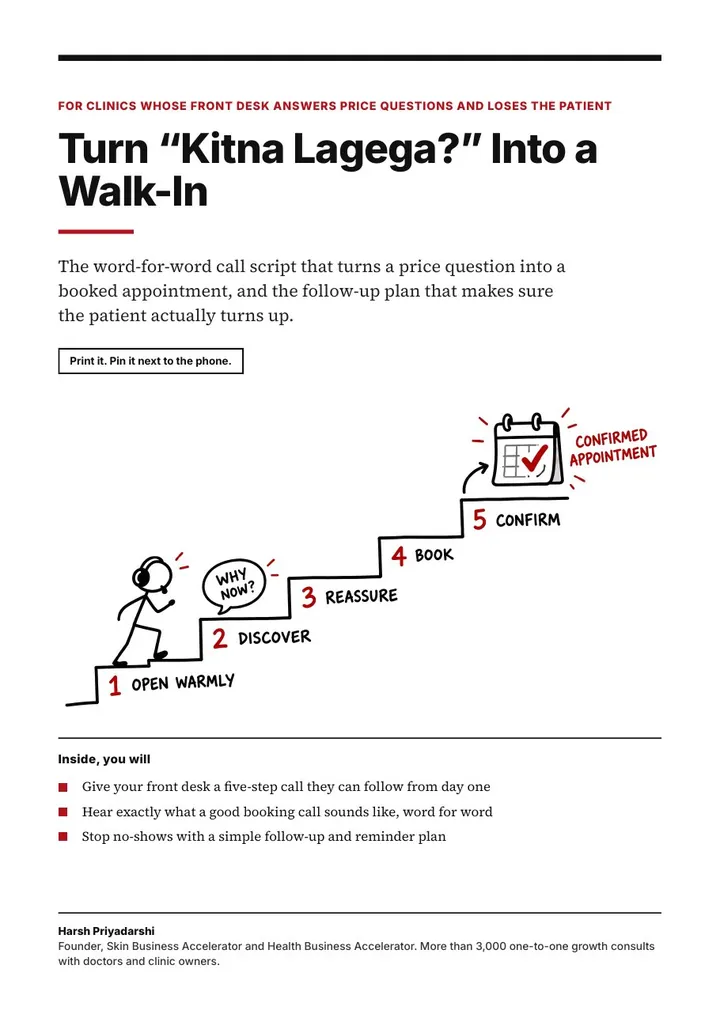
When a patient asks "kitna lagega?", never refuse to answer and never just read out a number. Give an honest range, explain what the final figure depends on, and say the doctor will give an exact plan in writing after the examination. Before that, ask about the problem, what they have tried and why now. Then offer two specific consultation slots and confirm on WhatsApp.
"Hello, implant ka kitna lagega?"
Your front desk hears some version of this twenty times a day. And in most clinics, the call goes one of two ways. Either the staff member reads out a number and the patient says "okay, I'll let you know", or they say "you'll have to come in for that" and the patient hangs up feeling dodged.
Both lose the patient. Here is the script we train clinic teams on instead, and why each line is there.
Why is "kitna lagega?" not really a price question?
When a patient opens with the price, it is usually the only question they know how to ask. They have a problem, they don't know what the treatment involves, and the price feels like a safe place to start.
What they actually want to know is: can this clinic fix my problem, will it be worth it, and can I afford it? A number on its own answers none of those. It just gives them something to compare with the next clinic on their list.
So the goal of the call is not to win the price argument. It is to turn a price question into a conversation, and the conversation into a consultation.
Why should you never refuse, and never just say a number?
Refusing feels like hiding something. "Aap aaiye, phir batayenge" (come in, then we will tell you) makes a cautious patient more cautious.
Reading out a full price before any diagnosis has the opposite problem. It is a number without context, and a number without context always sounds expensive.
The middle path is an honest range. You give a real range, you explain what moves the figure up or down, and you explain that the doctor will give the exact plan in writing. That respects the patient's question and keeps the door open.
The script, line by line
Here is a full call for a dental implant enquiry. The name, the fee and the range are examples only. Use your own fee sheet, and adapt the words to your patients' language.
- Open warmly. "Good morning, thank you for calling the clinic, this is Neha. How can I help you?"
- Acknowledge the question, then ask permission to understand. "Of course, I'll help you with the cost. Can I ask your name, and a little about what's happening, so I give you the right information?"
- Discover. "Which tooth is it, and how long has it been missing? Have you tried anything so far, like a denture? And is there something that made you look into it now?"
- Listen for the why now. The patient says, "My son's wedding is in March, and I can't chew properly on that side."
- Reassure. "That's very common, and the doctor treats exactly this every week. With a March wedding, planning now really helps."
- Give the honest range. "For example, a single implant at our clinic usually falls between ₹35,000 and ₹55,000. It depends on the bone, the type of implant and whether anything else is needed first. The doctor will examine you and give you the exact plan and price in writing."
- Offer two slots. "I have Thursday at 11 in the morning or Saturday at 5 in the evening. Which is better for you?"
- Confirm. "Done, Saturday at 5 with the doctor. The consultation fee is ₹700. I'm sending the location and details on WhatsApp now. Please bring any X-rays or reports you have."
Notice what happened. The patient asked one question and got an answer, but they also got a name, a reason, a plan and a booking.
Notice what is missing, too. No reading out the full price list. No medical advice on the phone. And no ending the call without offering a slot.
What should the front desk say when the patient pushes back?
Four pushbacks come up again and again. Give your team a ready answer for each.
"Bas rate bata do." (Just tell me the rate.) Don't argue. Repeat the range, repeat what it depends on, and go straight to the slots. "The exact figure depends on your case, so the doctor will write it down for you. Thursday or Saturday?"
"Main baad mein call karta hoon." (I'll call you back.) Ask what they'd like to think over and answer it. Then offer to hold a slot: "Shall I keep Saturday at 5 for you, and you confirm by tomorrow?"
"Consultation ke paise kyun?" (Why pay for a consultation?) Explain what it includes: time with the specialist, a proper examination and a written plan. It is not a sales meeting.
"Doosri clinic free consultation de rahi hai." (Another clinic offers a free consultation.) Never criticise the other clinic. Explain calmly what this consultation includes, and let the patient choose.
How do you make the whole team use the script?
A script on paper changes nothing. Three things make it stick.
One fee sheet. Every range your team quotes must come from one written fee sheet, so the patient hears the same figure from the front desk, the doctor and the coordinator. Three different numbers from three people destroy trust faster than a high price.
Weekly role-play. Ten minutes, once a week. One person plays a difficult "kitna lagega?" caller, one person handles it, then swap. Repeat until the steps come out naturally and nobody sounds like they are reading.
Call scoring. Record calls with the caller's knowledge, then score three a week out of five: opened warmly, discovered the why now, reassured, offered two slots, confirmed. Celebrate the best call in front of the team.
This is the core of the front desk and conversion systems we build with clinics. The full call structure and a second sample script are in Chapter 6 of Good Doctors Go Broke. If you run a dental practice, the implant call above is a good one to start practising tomorrow. And if you want us to listen to a few of your real calls, book a free growth call.
The short version
- "Kitna lagega?" is the patient's way of starting a conversation, not a final question.
- Never refuse and never just say a number. Give an honest range and what it depends on.
- Ask about the problem, what they have tried and why now, before you talk money.
- Always end with two specific slots and a WhatsApp confirmation.
- Quote every range from one fee sheet, and practise the script in a weekly role-play.
Frequently asked questions
Should clinics share prices on WhatsApp when patients ask?
Share an honest range, not a full price list. Explain in one or two lines what the final figure depends on, and that the doctor gives an exact plan in writing after the examination. Then offer two consultation slots in the same message. A bare number on WhatsApp just becomes something to compare.
What if the patient refuses to book until they hear the exact price?
Stay calm and repeat the honest range, then explain clearly why the exact figure needs an examination. Most patients accept that once they hear a real range. If they still won't book, thank them warmly, send the details on WhatsApp, and add them to your follow-up cadence instead of losing the lead.
How do I train a new receptionist to handle price calls?
In the first week, have them learn the fee sheet, listen to good and bad recorded calls, and practise the script in role-plays until it feels natural. After that, review three recorded calls a week together and score each step. Hire for warmth and persistence first, because the words can be taught.
Is it okay to say "come to the clinic, we will tell you there"?
On its own, no. It sounds like the clinic is hiding the price, and many patients simply call the next clinic. Answer the question with an honest range first, explain what changes it, and only then invite them in for the consultation, where the exact plan is given in writing.
On a free growth call, my team traces your last month from enquiry to treatment and shows you your biggest leak in rupees.