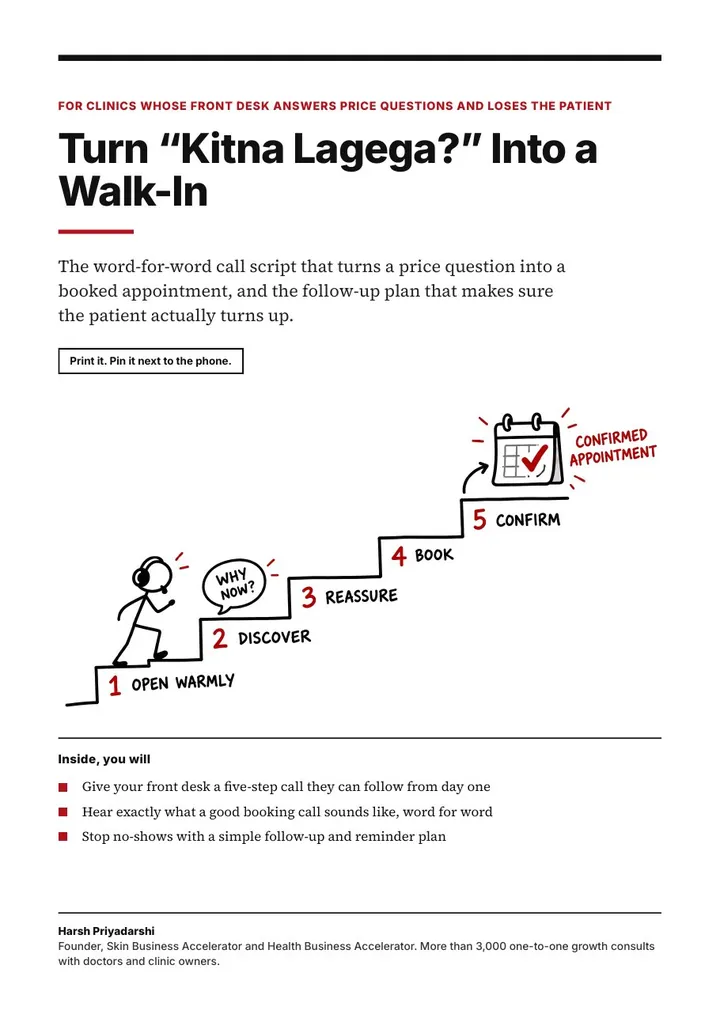
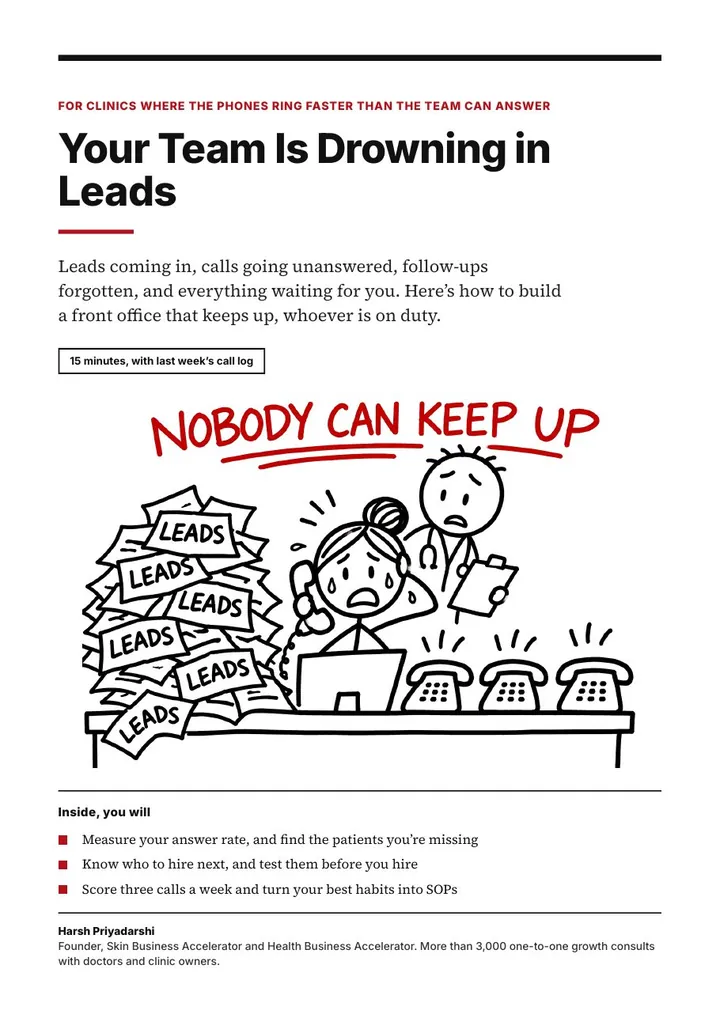
Mystery calling your own clinic means having someone call, message or fill in a form as a patient would, then scoring what happens. Score whether the call was answered, how fast a missed call or form was returned, the warm opening, discovery of the problem and why now, reassurance, two specific slots offered, a full confirmation and the WhatsApp follow-up. Test inside and outside working hours.
Here is an uncomfortable truth. The front desk you see is not the front desk your patients hear.
When you are standing nearby, calls get answered on the second ring, and every caller is offered a slot. At 1:45 pm on a Tuesday, or 7:30 pm on a Saturday, with you in the OT, it can be a very different clinic.
The only way to hear what patients hear is to become one. That is mystery calling. I ask every clinic we work with to do it, and the first round almost always surprises the doctor.
Why should you mystery call your own clinic?
Because most doctors have never heard their own front desk from the outside.
You have numbers, if you track them: answer rate, booking rate, show rate. Those tell you what is happening. A mystery call tells you why. You hear whether the staff member gave their name, asked why the patient was calling now, read out a price and hung up, or forgot to confirm the location.
It also tests the parts nobody watches. The missed call that should have been returned in five minutes. The website form that should have triggered an instant WhatsApp. The evening enquiry that should have had a morning callback.
What should you score?
Use the same ten-point scorecard every time, so results can be compared week to week.
| What to score | What good looks like | Points |
|---|---|---|
| Answered | A human picks up during working hours | 1 |
| Missed call or form returned | Within five minutes during working hours | 1 |
| Warm opening | The clinic's name, the staff member's name and a genuine "How can I help?" | 1 |
| Discovery | Asked the problem, how long, what has been tried | 1 |
| Why now | Asked what made the patient call now | 1 |
| Reassurance | Reflected back what they heard, explained the doctor treats this often | 1 |
| Price handled well | An honest range and what it depends on, no refusal, no bare number | 1 |
| Two slots offered | "Thursday at 11 or Saturday at 5?" not "when would you like to come?" | 1 |
| Full confirmation | Name, number, date, time, fee, location and what to bring | 1 |
| WhatsApp follow-up | Confirmation sent at once, or follow-up messages if the caller didn't book | 1 |
Eight or above is a strong call. Five or below means the call structure has not been trained, or has not stuck.
Keep a simple log for every test: the date, the time, the scenario, who answered, the score and one line on what to fix. After three or four rounds, patterns jump out. Maybe the morning shift scores eight and the evening shift scores four. Maybe calls are strong but WhatsApp replies take two hours. That pattern is worth more than any single score.
Which scenarios should you test?
Don't just make one friendly call. Test the situations where clinics really lose patients.
- The price-only caller. "Just tell me the rate." Does the team give an honest range and still offer slots?
- The "I'll call you back" caller. Does anyone ask what they want to think over, or offer to hold a slot?
- The missed call. Ring, hang up after a few rings, and time how long the callback takes.
- The lunch-hour and evening call. Call between 1 and 2 pm, and after 7 pm.
- The WhatsApp enquiry. Send a message and time the first human reply.
- The website form. Fill it in and see whether an instant reply and a call follow.
- The comparison caller. "Another clinic is giving a free consultation." Does the team argue, or explain calmly what your consultation includes?
- The Sunday enquiry. Send a message on a day the clinic is closed and see what happens by Monday morning.
Here is an example of what one month might show. Say you make eight test contacts. Six calls in working hours score well. But the evening call goes unanswered and the website form never gets a callback. Your front desk is fine. Your system has two holes.
How do you run it fairly?
Mystery calling can build a team up or break its trust. Do it the right way.
- Tell the team it will happen. Not when, just that it is part of how the clinic checks its process, the same way calls are recorded with the caller's knowledge.
- Use someone they won't recognise. A friend, a relative in another city, or a colleague's family member.
- Score the process, not the person. The question is "which step did our system miss?", not "who messed up?"
- Review it together. Play the recording, score it with the front desk, and celebrate what went well first.
- Never use it to shame. A team that feels trapped will start performing for the test instead of for the patient.
What do you do with the scores?
Pick the lowest-scoring step and work on that one thing for the next two weeks. If "why now" is missing on most calls, practise it in the weekly role-play. If missed calls aren't returned, fix the alert or the rota.
Then test again. Change one thing at a time, so you know what actually moved.
If you want this every week without the effort, call recording with AI transcription and scoring can check every real call against the same structure. We set that up as part of our CRM, WhatsApp and AI work, and the training side sits in our conversion systems work.
Should you mystery call your competitors too?
Yes. When you set your prices, call the ten options your patient compares you with. Note how fast they respond, how they quote, what they include and how hard they push. Their gaps are your opportunities.
The call structure behind this scorecard is in Chapter 6 of Good Doctors Go Broke, and the competitor research is in Chapter 4. If you would like us to run the first round with you, book a free growth call.
The short version
- Mystery calling shows you what patients hear when you're not standing nearby.
- Score ten things, from answering and speed to two slots, a full confirmation and WhatsApp follow-up.
- Test price callers, missed calls, lunch and evening calls, WhatsApp, forms and Sundays.
- Tell the team it happens, score the process not the person, and review it together.
- Fix the lowest step for two weeks, then test again, one change at a time.
Frequently asked questions
How often should I mystery call my own clinic?
Start with a full round of six to eight test contacts across calls, WhatsApp and forms, inside and outside working hours. After that, two or three test contacts a month is usually enough, alongside a weekly review of real recorded calls. Re-test the weakest step two weeks after you start fixing it.
Is it fair to secretly test my front desk staff?
It is fair if the team knows mystery calls are part of how the clinic checks its process, even if they don't know when. Score the system rather than blaming the person, review results together and celebrate good calls. Used to shame people, it damages trust and teaches staff to perform for the test.
What is a good score on a front desk mystery call?
On a ten-point scorecard covering answering, speed, opening, discovery, why now, reassurance, price handling, two slots, confirmation and follow-up, eight or more is a strong call. Five or below usually means the call structure was never trained properly. Focus on the lowest step first.
Who should make the mystery calls for my clinic?
Someone your team won't recognise by voice, such as a friend, a relative in another city or a colleague's family member. Give them a short brief for each scenario, like a price-only caller or an evening enquiry, and ask them to note the time of every reply so speed can be scored accurately.
On a free growth call, my team traces your last month from enquiry to treatment and shows you your biggest leak in rupees.