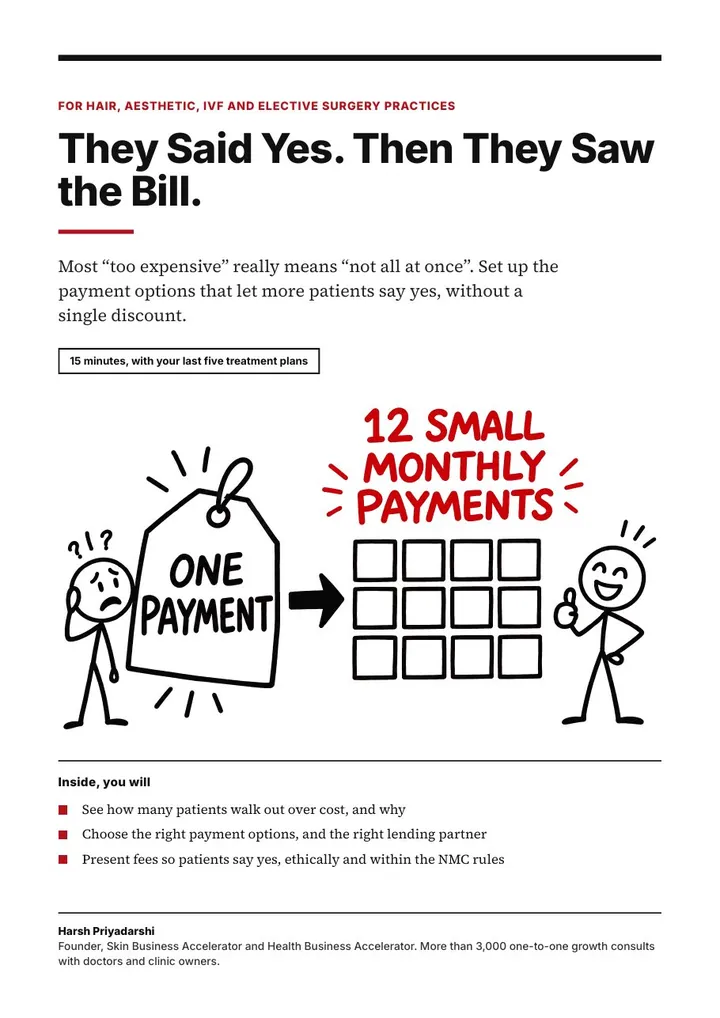
To offer patient financing properly, give every patient more than one way to pay: full payment, milestone payments, EMI through two or three healthcare lending partners, credit card EMI and insurance where it applies. Print the monthly figure next to the total in every written plan. Let the coordinator explain it, offer it to everyone, and build any no-cost EMI fee into your pricing.
A patient sits through a brilliant consultation. She understands the problem. She trusts the doctor. She wants the treatment.
And she still says no.
Not because the treatment isn't worth it. Because she can't pay the whole amount today. That is not a price problem. It is a payment problem. And payment problems have solutions.
Why does financing raise conversions?
When a clinic gets payment options right, three things happen.
More patients say yes. The monthly figure fits their life, even when the total doesn't.
More patients choose the right plan. The difference between Basic and Recommended per month is small, so fewer patients drop to the smallest option just because of cash.
Fewer patients delay. Without options, people go away to "save up" for a few months. Many lose the motivation, or go somewhere else.
And here is the part doctors usually miss: you still get paid. With most lending partners, the clinic receives the money upfront or on a fixed schedule, while the patient repays the lender over time.
Which payment options should a clinic offer?
Here is the full menu, and where each one fits.
| Option | How it works | Watch out for |
|---|---|---|
| Full payment | The patient pays once, by card, UPI or bank transfer | Nothing, just make it easy |
| Milestone payments | A part at booking, a part on the procedure day, the rest during aftercare | Tie milestones to the named phases of your plan |
| EMI through lending partners | A healthcare lender pays you, and the patient repays in monthly instalments | Approval rates, speed and the fee you pay |
| Credit card EMI | The patient converts a card payment into EMIs with their bank | Your card machine must support it, and staff must explain it |
| Insurance and TPA | Your TPA desk handles pre-authorisation and claims, so cashless is just another way to pay | Panel rates that pay below your real cost |
| Corporate tie-ups | An employer covers part or all of the cost for staff | Only where it fits your speciality |
One option I would be careful with: in-house instalments, where the clinic itself lends to the patient. It can work for small amounts with patients you know well. But chasing monthly payments is not your business, and it puts your cash flow at risk. You are a doctor, not a collections agency. Let a lending partner carry that.
How do you choose a lending partner?
Shortlist two or three lending partners that work with healthcare providers in your city. Why more than one? Because if one declines a patient, another might approve.
Then compare them on these questions:
- What share of your patients do they approve?
- How fast is approval? Ideally, while the patient is still sitting in your clinic.
- What interest does the patient pay, and are there hidden charges?
- What fee do you pay as the clinic?
- When does the money reach your account?
- How much paperwork does the patient need?
- How good is their support when something goes wrong?
Once you choose, sign a clear agreement, set the process up digitally at the clinic, and train your coordinator until they can explain EMI simply and process an application in minutes. Review every partner each quarter, and drop the ones that decline too many patients or take too long to pay you.
What does "no-cost EMI" really cost you?
The interest doesn't disappear. Somebody pays it. In a no-cost EMI, that somebody is usually you, as a fee to the lender.
Here is an example. Say your plan is ₹2,00,000 and the direct cost of delivering it is ₹90,000. Your profit is ₹1,10,000. Now say the lender charges you ₹12,000 to offer it as no-cost EMI. Your profit on that patient drops to ₹98,000.
That can still be a smart choice if it wins patients who would otherwise delay. But one story in my book is an aesthetic clinic that offered no-cost EMI on everything for months without realising the fee was coming straight out of its margin. Some plans were barely profitable. We built the financing cost into the pricing, kept no-cost EMI only where the margin could carry it, and offered standard EMI everywhere else.
So build that cost into your margins and your fee sheet. Never let it quietly eat your profit.
How should you present EMI to patients?
The way you talk about payment matters as much as the options.
Put it on the same page as the fee. Every written plan shows the payment options right next to the total, so the patient sees a way to say yes beside the number.
Show the monthly figure. As an example, a ₹1,80,000 plan spread over 12 months is ₹15,000 a month. Same treatment, but "₹15,000 a month" feels very different from "₹1,80,000".
Let the coordinator handle it. The doctor recommends. The coordinator walks through payment. That keeps the doctor's role clinical.
Offer it to everyone. Not as a favour for patients who look like they can't afford it. Nobody likes to feel judged. A simple line works: "Most of our patients choose one of these ways to pay. Which suits you best?"
How do you keep financing ethical?
Financing is powerful, so use it responsibly.
- Explain the total cost clearly, including any interest and charges.
- Never push someone into a loan they are uncomfortable with or can't realistically afford.
- Never use financing to sell a bigger plan than the patient needs. Your recommendation stays clinical. Financing only makes it reachable.
Then track four numbers every quarter: what share of patients use financing, what share of applications are approved, how financing affects consult conversion and the options chosen, and what it costs you in fees.
Milestone plans work especially well for families facing large one-time costs, like knee replacement patients whose children are sharing the bill. Setting up payment options is part of our conversion systems work, and the full chapter is Chapter 10 of Good Doctors Go Broke. To check your own setup, book a free growth call.
The short version
- Most "too expensive" is really "not all today". Fix the payment, not the price.
- Offer full payment, milestones, EMI, credit card EMI, insurance and corporate tie-ups where they fit.
- Use two or three lending partners, compared on approvals, speed, patient cost, your fee and payout time.
- No-cost EMI is never free. Build the lender's fee into your pricing.
- Print the monthly figure beside the total, offer it to everyone, and never push a loan.
Frequently asked questions
Should my clinic offer EMI for treatments?
Yes, especially for plans that many patients can't comfortably pay in one go. Many patients who want the treatment simply can't pay it all at once, and EMI through a healthcare lending partner lets them say yes while you still get paid upfront or on a fixed schedule. Offer it to every patient as a normal option.
Who pays the interest in a no-cost EMI?
Usually the clinic, through a fee charged by the lender. The patient pays no interest, but the cost doesn't disappear. Work out exactly what each no-cost EMI costs you on each plan, build it into your pricing, and keep it only where the margin can carry it. Offer standard EMI elsewhere.
How many lending partners should a clinic work with?
Two or three. If one declines a patient, another may approve, and you can compare their approval rates, speed and fees over time. Review them every quarter and drop any partner that declines too many patients or pays you too slowly. More than three usually adds paperwork without adding approvals.
Is it a good idea for clinics to give patients their own instalment plans?
Be careful. In-house instalments can work for small amounts with patients you know well, but your clinic becomes the lender, chasing monthly payments and carrying the risk. For larger plans, milestone payments tied to treatment phases, or EMI through a lending partner, are far safer for your cash flow.
On a free growth call, my team traces your last month from enquiry to treatment and shows you your biggest leak in rupees.