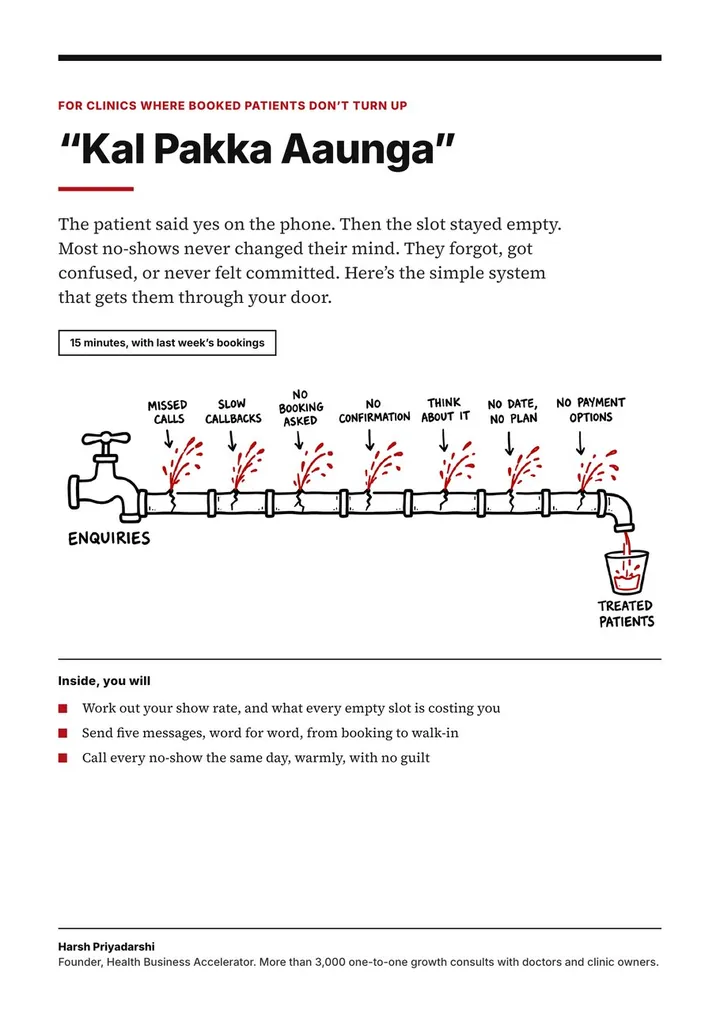
Show rate is the share of booked patients who actually arrive for their consultation. In my framework, a healthy show rate is 60 to 75%. You raise it without discounts by confirming every booking on WhatsApp the moment the call ends, sending one useful message before the visit, reminding the day before and a couple of hours before, and calling every no-show warmly the same day.
"Kal pakka aaunga." (I'll definitely come tomorrow.)
Every front desk has heard it. And every front desk has watched that slot sit empty the next day.
When no-shows pile up, many clinics reach for the wrong fix. A free consultation. A "book today, save 20%" offer. A cheaper first visit. It feels like it should work. In my experience it attracts less committed patients and trains people that your fee was never real.
The fix is not a discount. It is what happens between the booking and the visit.
What is a healthy show rate for a clinic?
Show rate = patients who arrived ÷ patients who booked × 100
Say 30 people booked this week and 20 walked in. That is a show rate of about 67%.
In my framework, a healthy show rate is 60 to 75%. Below 60%, something between the booking and the appointment is broken. Many clinics we audit have never measured it at all. They just feel that "a lot of people don't come."
Why do booked patients not turn up?
Most no-shows are not patients who changed their mind. In my experience they fall into three groups.
- They forgot. The booking was made on Monday for Saturday, and nothing reminded them.
- They got confused. Wrong time, wrong branch, couldn't find the location, didn't know what to bring.
- They never felt committed. The call was rushed, nobody asked why they wanted help, and the booking felt like a casual "theek hai."
All three are fixable, and none of them need a discount.
What should happen between the booking and the visit?
Here is the sequence I ask every clinic to run, for every single booking.
- The moment the call ends: a WhatsApp confirmation with the date, time, doctor's name, a location pin and what to bring.
- In between: one short, useful message. A video of the doctor explaining what happens in the consultation, or a note on what to expect. The patient should feel the relationship has already started.
- The day before: a reminder that asks the patient to reply to confirm.
- A couple of hours before: another short reminder, with the location pin again.
- If they don't arrive: a warm call the same day to reschedule. No guilt, just care.
A day-before reminder can be as simple as this: "Hi Meena, this is Neha from the clinic. Just a reminder of your consultation with the doctor tomorrow at 5 pm. Here is the location pin. Please reply YES to confirm, or tell us if you need another time." Short, friendly, and it asks for a reply, which turns a passive booking into an active one.
The second step is the one most clinics skip, and it is the one that builds commitment. A patient who has already seen the doctor on video is far less likely to treat the appointment as optional.
How do you cut no-shows without giving discounts?
Beyond the sequence, three choices make a big difference.
Charge for the consultation. A paid consultation signals value and brings in patients who are serious. If you want to soften it, adjust the consultation fee against the plan when the patient goes ahead. That rewards commitment instead of rewarding a no-show risk.
Make the booking call a real conversation. When the front desk asks about the problem, what the patient has tried and why now, the patient leaves the call with a reason to come. "Why now" is what turns "theek hai" into a commitment.
Pay the front desk on shows, not bookings. A fair fixed salary plus an incentive for patients who book and actually walk in. That one detail stops people from booking anyone just to hit a number.
How much is a better show rate worth?
Here is an example. Say your clinic books 40 consultations a week and only 20 arrive. That is a 50% show rate.
Lift it to 70% and 28 arrive. That is 8 more consultations a week from the same bookings.
Say 40% of those start treatment. That is about 3 more patients a week. At an example average ticket of ₹60,000, that is roughly ₹1.8 lakh a week, or around ₹7 lakh a month, without a single new enquiry.
And those 8 slots were already in the doctor's diary. They were just sitting empty.
What are the common mistakes?
| Mistake | Why it hurts | What to do instead |
|---|---|---|
| Free or discounted first visits | Attracts less committed patients and cheapens your fee | Keep a paid consultation, adjust it against the plan |
| One reminder only, on the day | Too late to fix a clash or confusion | Confirm at once, then remind the day before and on the day |
| Reminders with no location pin | Patients get lost or go to the wrong branch | Send the pin every time |
| Nobody calls the no-show | The patient feels awkward and never rebooks | A warm same-day call to reschedule |
| Show rate never measured | You can't fix what you can't see | Put it on the Monday sheet next to booking rate |
How do you make it run without someone remembering?
Do it by hand and it will slip on the first busy Saturday. So put it in a system. Your booking calendar should send the confirmation and reminders automatically from approved WhatsApp templates, and any no-show should create a task for the front desk to call the same day.
Then track it. Show rate goes on the Monday sheet with answer rate, speed to first contact and booking rate. When it drops, check whether the reminders actually went out.
The confirmation and reminder flow is part of our CRM, WhatsApp and AI setup, and the booking call that builds commitment is part of our front desk and conversion work. The full sequence is in Chapter 6 of Good Doctors Go Broke. If your show rate is below 60% and you want a second pair of eyes, book a free growth call.
The short version
- A healthy show rate is 60 to 75%. Below 60%, the gap between booking and visit is broken.
- Most no-shows forgot, got confused or never felt committed. None of that needs a discount.
- Confirm at once, send one useful message, remind the day before and on the day, and call no-shows the same day.
- Keep a paid consultation and pay the front desk on shows, not bookings.
- Automate the reminders, and read show rate every Monday.
Frequently asked questions
What is a good show rate for a clinic in India?
In my framework, 60 to 75% of booked patients should arrive for their consultation. If you are below 60%, review everything that happens after the booking: the confirmation, the reminders, the location details and whether anyone calls the patients who didn't come. Measure it every week, not just when the diary feels empty.
Will a free consultation reduce no-shows?
Usually not. A free consultation lowers the commitment it takes to book, so more people book casually and fewer turn up. It also makes your fee look negotiable. Keep a paid consultation and, if you want to soften it, adjust the fee against the treatment plan when the patient goes ahead.
How many reminders should a clinic send before an appointment?
Send a confirmation the moment the booking is made, one useful message in between, a reminder the day before that asks the patient to reply, and a short reminder a couple of hours before. That is enough to remove forgetting and confusion without feeling like nagging.
What should we say when calling a patient who didn't show up?
Keep it warm and free of guilt. Say you missed them, ask if everything is okay, and offer two new slots. Something like: "We had your slot ready today and wanted to check you are fine. Would Thursday at 11 or Saturday at 5 work better?" Then confirm on WhatsApp straight away.
On a free growth call, my team traces your last month from enquiry to treatment and shows you your biggest leak in rupees.