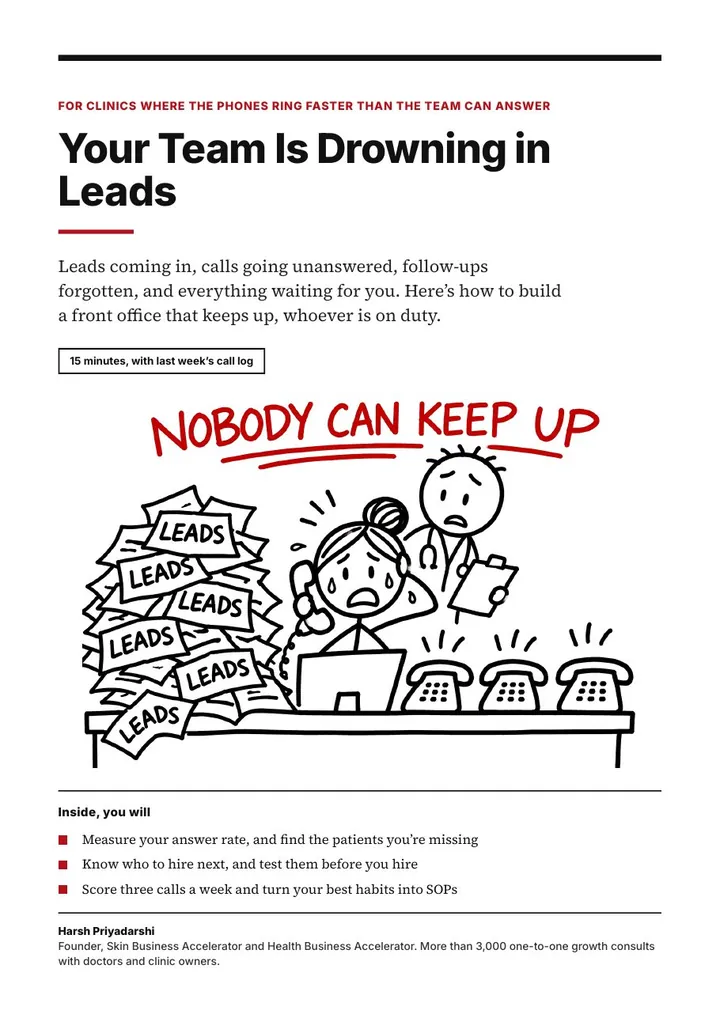
Speed to lead is the time between a patient's enquiry and the first human contact from your clinic. Ideally it is thirty seconds, and the healthy benchmark is under five minutes during working hours. Above thirty minutes, you are burning the money you spent on that lead. The patient has usually enquired with other clinics too, and the first one to call back with care usually wins.
Picture the patient for a second. She has had a problem for two years. Tonight she finally decides to do something about it. She searches, opens three clinic pages, and fills in all three forms in ten minutes.
Then she waits.
The first clinic calls her in four minutes. The second calls the next morning. The third never calls. Who do you think gets her?
That is speed to lead. In my framework it is the single biggest metric in the whole front end of a clinic, bigger than your ad creative, bigger than your website.
Why does the first clinic to call back usually win?
Because nobody enquires with only you. Patients compare doctors now. They compare setups. They message two or three clinics at once.
In that race, the first touchpoint does two jobs. It catches the patient while the problem is still on their mind. And it tells them something about you before you have said a word: this clinic cares enough to call.
Wait an hour and the moment has passed. She is cooking, or at work, or already talking to the clinic that called first.
The first clinic to call back is usually the clinic that gets the patient.
How fast is fast enough?
Here are the bands I use with clinics.
| Time to first human contact | What it means |
|---|---|
| Under 30 seconds | Ideal. The patient is still holding the phone |
| Under 5 minutes | The healthy benchmark during working hours |
| 5 to 30 minutes | You are losing patients you paid for |
| Over 30 minutes | You are burning enquiries. Fix this before spending another rupee on ads |
That last row is the one doctors don't like hearing. If your team cannot reach every lead within thirty minutes, more ad spend just means more enquiries going cold. The honest move is to pause or cut the budget until the response is fixed.
How do you measure your speed to lead?
Most clinics have never measured it. They assume the team calls quickly because the team says so. Here is how to find the real number.
- Make sure every enquiry, from calls, WhatsApp, forms and your Google profile, lands in one CRM with a time stamp.
- Make your team log the time of the first human contact against each lead. If it isn't in the CRM, it didn't happen.
- Pull last week's leads and work out the gap for each one.
- Count the share of leads reached within five minutes. That number matters more than the average, because one fast callback can hide ten slow ones.
- Split it by time of day and by staff member. The slow patches will jump out.
Here is an example of what it costs. Say you spend ₹60,000 a month on ads and get 150 leads. That is ₹400 a lead. If 50 of those leads are only called the next morning, that is ₹20,000 of your budget spent on enquiries that went cold before anyone spoke to them. And that is before you count the treatment those patients went elsewhere for.
Why is your team slow, even when they care?
In most clinics I audit, slow callbacks are not a laziness problem. They are a design problem.
One person is sitting at reception, managing walk-ins, doing billing and handling the pharmacy. And that same person is expected to call every new enquiry within five minutes. Nobody could.
The clinic thinks it is saving a salary. In reality it is losing far more through the enquiries it never converts.
So if you cannot hit the five-minute mark, look at the team first:
- Is there one person, or one line, whose only job is new enquiries?
- Do they get an alert the moment a lead arrives, or do they check a sheet twice a day?
- Are lunch breaks and the evening rush covered?
- Have they been trained, and is speed one of the numbers reviewed every week?
How do you set up a five-minute response?
The setup is simple once someone owns it.
- Instant reply. Every new lead gets an automatic WhatsApp message within seconds, with the doctor's name and a line saying someone will call shortly.
- Instant alert. The front desk gets a notification at the same moment, on a screen or phone they actually watch.
- The call. A human calls within five minutes and follows a proper call structure: open warmly, discover the problem and the "why now", reassure, offer two slots, confirm.
- The second try. If the patient doesn't pick up, try again. My rule of thumb is three attempts on day one, then day two, day four, day seven and day fourteen, mixing calls with short, useful messages.
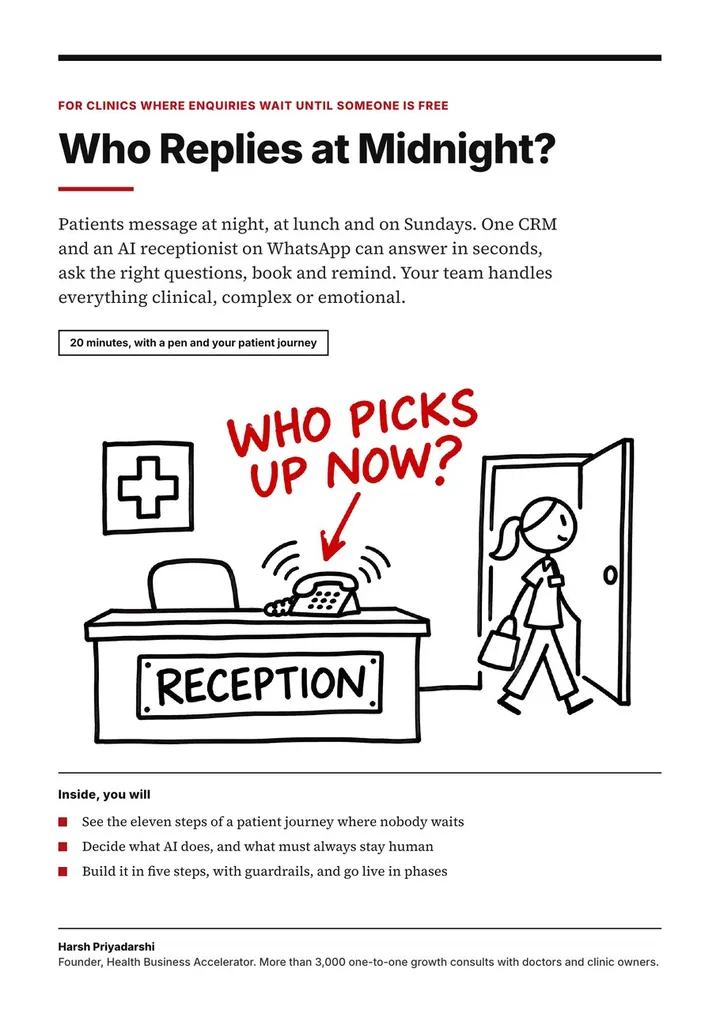
For enquiries that arrive when nobody is free, an AI assistant on WhatsApp or a voice agent can make that first contact in seconds, ask a few simple questions and offer real slots. It must say it is the clinic's assistant, never give medical advice, and hand anything complex to a human. We build these setups in our CRM, WhatsApp and AI work.
What should you do this week?
Pull ten leads from last week and check the time of first contact against each one. Then ask yourself one question: if a patient enquired at 1:30 pm or 8 pm today, who would call them, and how fast?
If the answer is "nobody" or "tomorrow", that is your first job. Fix it before you touch your patient acquisition budget, because every rupee you add lands in the same leak. The front desk side of this, from the call script to the follow-up cadence, is what our conversion systems work covers, and Chapter 2 of Good Doctors Go Broke explains why I treat speed as the biggest number of all.
The short version
- Speed to lead is the time from enquiry to the first human contact. Aim for thirty seconds, with five minutes as the benchmark.
- Above thirty minutes, stop adding ad spend until the response is fixed.
- Measure it from CRM time stamps, and look at the share reached within five minutes, not just the average.
- Slow callbacks are usually a design problem: one person doing four jobs with no alerts.
- Instant WhatsApp, an instant alert and a call within five minutes, then follow up on days one, two, four, seven and fourteen.
Frequently asked questions
How quickly should a clinic call back a new lead?
Ideally within thirty seconds, while the patient is still holding the phone. The healthy benchmark is under five minutes during working hours. Between five and thirty minutes you start losing patients you paid for, and above thirty minutes you are simply burning enquiries. Fix the response time before increasing your ad budget.
Does sending an automatic WhatsApp reply count as first contact?
It helps, and every lead should get one within seconds. But I count speed to lead as the first human touchpoint or a real conversation, not a template. The automatic reply holds the patient's attention. The call within five minutes is what turns that attention into a booked consultation.
Why are my Facebook leads not picking up the phone?
Often the problem is timing, not the patient. Paid leads go cold fastest, because the patient enquired with other clinics in the same few minutes. Call within five minutes, and if they don't answer, try three times on day one, then on days two, four, seven and fourteen, with short useful WhatsApp messages in between.
Should I hire another receptionist just to call leads?
If one person is handling reception, walk-ins, billing and enquiries, they cannot call every lead in five minutes. A dedicated person or line for new enquiries usually costs far less than the patients you lose through slow callbacks. Check your numbers first: if speed is above thirty minutes, the team design is the problem.
On a free growth call, my team traces your last month from enquiry to treatment and shows you your biggest leak in rupees.