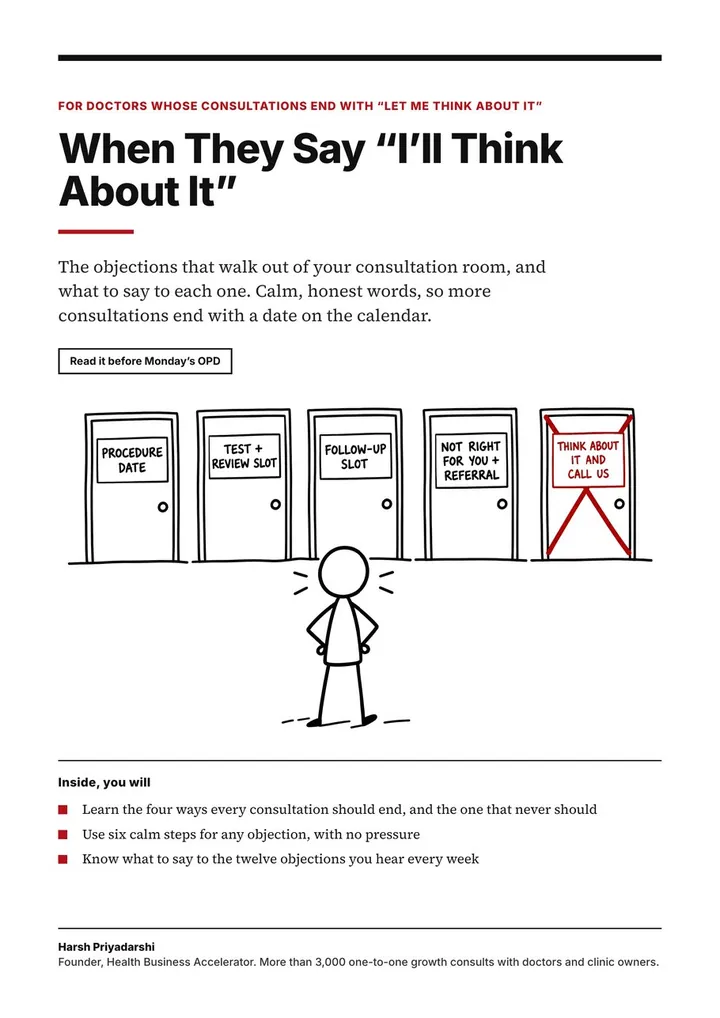
When a patient says "I'll think about it", it rarely means they simply need time. Usually there is a specific concern behind it: cost, fear or family. Ask with genuine curiosity, "Can I ask what you'd like to think over?", then "Apart from that, is anything else holding you back?" Handle that concern. If they still want time, book a follow-up slot before they leave.
"Soch ke batata hoon, doctor." (I'll think and let you know, doctor.)
It is the most common sentence in any consultation room in India. It is also the politest way a patient disappears.
Here is what I have learned from sitting through thousands of these conversations with doctors: the patient almost never means it literally. They are not going home to think. They are going home with one unanswered worry, and nobody to answer it.
What does "I'll think about it" really mean?
Underneath almost every "I'll think about it" is one of a few hidden concerns. The words patients use often give a clue.
| What they say | What it often hides | The clue to listen for |
|---|---|---|
| "Ghar pe baat karke batata hoon." (I'll discuss at home and tell you.) | Family | Someone else is the real decision-maker |
| "Thoda soch ke batayenge." (We'll think a little and tell you.) | Money | They went quiet when the fee came up |
| "Abhi thoda time chahiye." (I need a little time now.) | Fear | Questions about pain, recovery or what could go wrong |
| "Dekhte hain." (Let's see.) | Not convinced it will work for them | They asked about results for "people like me" |
| "Agle mahine dekhte hain." (Let's see next month.) | Timing | A work, family or money event in the way |
These are patterns, not rules. The only way to know for sure is to ask.
What should you say in the moment?
Two questions, asked with genuine curiosity rather than pressure.
First: "Of course. Can I ask what you'd like to think over? Maybe I can help with it right now."
Then, once they answer: "That makes sense. Apart from that, is there anything else holding you back?"
The second question is the one most people skip, and it matters because the first concern is often not the real one. A patient might say "the cost" when the real worry is what their wife will say. Ask until there is nothing left.
Here is how it sounds in practice.
Coordinator: Of course. Can I ask what you'd like to think over?
Patient: It's a lot of money right now.
Coordinator: That's completely fair. Is it the total amount, or paying it all at once?
Patient: All at once, really. And honestly, my husband hasn't heard any of this.
Coordinator: That makes sense. Would it help if he joined a short call with the doctor this week, so he can ask his own questions? I can also show you how the payment can be spread monthly.
Two hidden concerns, money timing and family, both found in under a minute.
How do you handle each real concern?
Family. Don't fight it. Invite them in. Offer a family session at the clinic or a short video call with the doctor, and book it before the patient leaves. Send the written plan home so the family can read it.
Money. Separate the total from the timing. If it is timing, show the milestone payments and EMI options with the monthly figure. If it is the total, go back to the outcome they described. If it is truly beyond them, move to the Basic plan.
Fear. Explain exactly what they will feel at each step, how pain is managed and what recovery looks like. The unknown is always scarier than the truth.
Doubt that it will work. Be honest about the realistic outcome. Show proof from patients similar to them, shared with consent. Never promise a guaranteed result.
Timing. Go back to their "why now." If there is a wedding or a deadline, show the timeline honestly. If there is a genuine reason to wait, respect it.
What if they still want time?
Then give it to them, but never let the conversation end with nothing.
- Book a follow-up slot before they leave, with a specific date and time.
- Hand over the written plan, with the diagnosis, the options, the fee and the payment choices.
- Message the same day, answering any question they might think of on the way home.
- Call the next day, then check in on day three, day seven and day fourteen.
Every one of those touches should be genuinely useful: an answer, a relevant video, a patient story shared with consent. Never "just checking in."
And for the ones who still don't decide, don't delete them. They go into your patient database, which is one of the cheapest sources of patients any clinic has. That is what our retention and reactivation work is built on.
How do you hear it less often?
Most "I'll think about it" is created earlier in the consultation. It shows up more when the doctor didn't ask why the patient came in now, explained without showing, listed options without recommending one, or gave the fee without the payment options next to it.
So build the consultation in the right order. Listen first and ask why now. Show the patient their own problem. Repeat their outcome back in their own words. Recommend one plan and say why. Then share the fee with the payment options printed right beside it. When a patient has said "yes, exactly" to their own outcome, and seen a monthly figure they can manage, there is far less left to go home and think about.
One hair clinic in my book was losing most undecided patients this way. The team learned one question, "Can I ask what you'd like to think over?", and found the answer was usually the payment or the family. Handling those on the spot, and booking a follow-up for everyone else, meant far fewer patients disappeared. If you run a hair transplant clinic, that one question is worth practising with your team tomorrow.
We train teams on this in our conversion systems work, and the full objection method is in Chapter 8 of Good Doctors Go Broke.
The short version
- "I'll think about it" rarely means time. It usually hides cost, fear or family.
- Ask: "Can I ask what you'd like to think over?" Then: "Apart from that, is anything else holding you back?"
- Handle the real concern on the spot, and invite the family in when they decide.
- If they still want time, book a follow-up slot and send the written plan home.
- Follow up the same day, next day, then day three, seven and fourteen.
Frequently asked questions
How do I follow up with a patient who said they'll think about it?
Book a follow-up slot before they leave, then message the same day with anything useful they might need. Call the next day, and check in again on day three, day seven and day fourteen. Each touch should answer a question or share something relevant, not just ask whether they have decided.
Is "I'll think about it" the same as a no?
Usually not. Most patients who say it are still interested but have one concern they haven't voiced, often money, fear or what the family will say. Treat it as a request for help. If you find and answer that concern, many of these patients go ahead.
What should the doctor say when a patient wants to ask their family first?
Agree warmly, because in India health decisions are usually family decisions. Offer to have the family join a short call with the doctor or come in with the patient, and book that session before they leave. Send the written plan home so everyone reads the same information.
How do I stop sounding pushy when I ask what they want to think over?
Ask with real curiosity and then listen without rushing to answer. Your tone should say "I want to help you decide well", not "I want you to decide now". If there is a genuine reason to wait, respect it, and simply agree a date to speak again.
On a free growth call, my team traces your last month from enquiry to treatment and shows you your biggest leak in rupees.