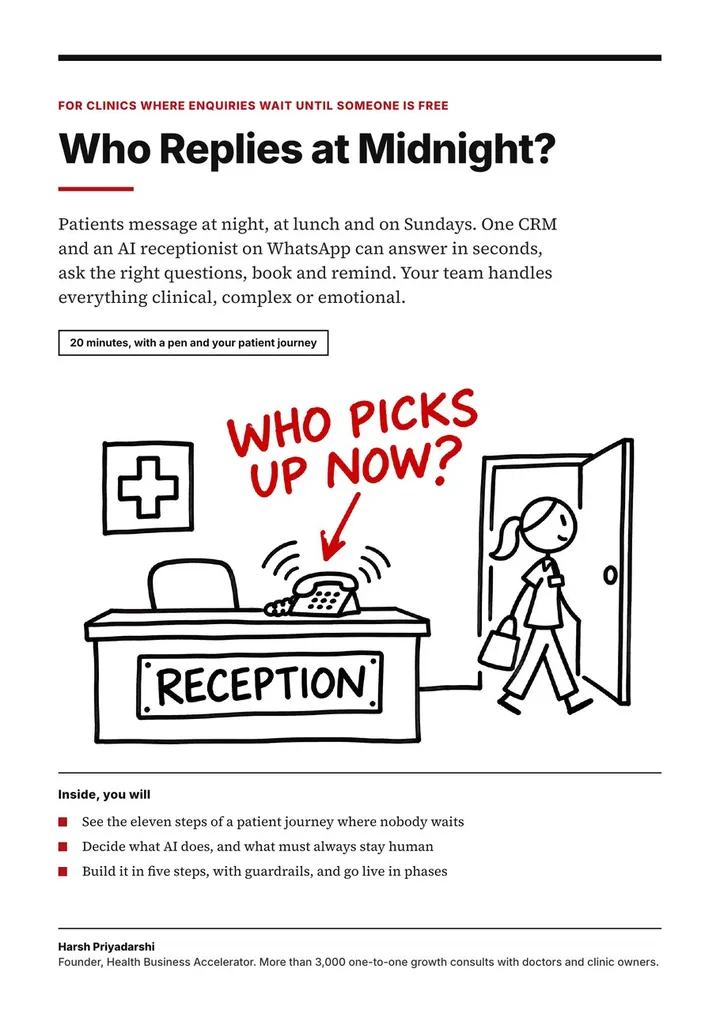
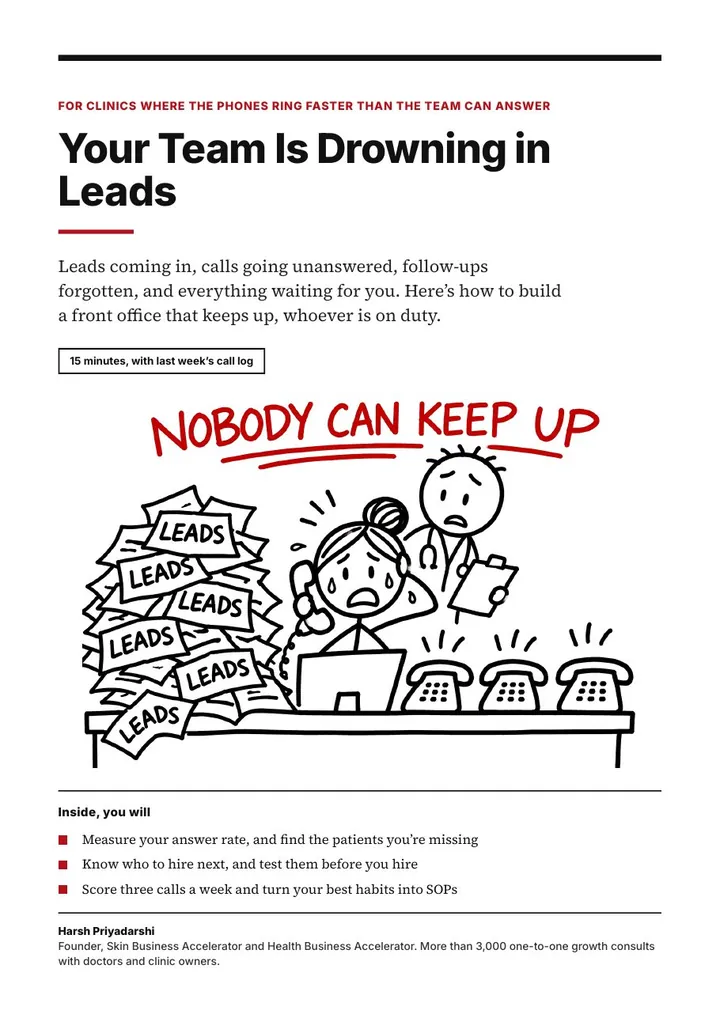
Clinics lose evening and weekend enquiries because nobody is there to reply, and by morning the patient has moved on. Find out when your enquiries arrive from CRM time stamps. Then extend front desk cover into the evening with staggered shifts, give every after-hours enquiry an instant WhatsApp reply or an AI assistant that offers real slots, and make calling every overnight enquiry the first job of the morning.
Here is a story from my book that I see repeated in clinic after clinic.
A clinic closed its phones at seven in the evening. Nobody had ever checked how many calls came in after that. When we looked at the call logs, the evening turned out to be one of their busiest times. That is when working patients finally had a free moment.
So every day, a whole group of patients called, heard nothing, and quietly booked somewhere else.
If your clinic shuts its lines when the doctor leaves, the same thing may be happening to you right now.
Why do so many enquiries arrive after hours?
Think about your patients' day. The office worker can't discuss her skin treatment at her desk. The shop owner is busy until closing. The young mother finally gets a moment after the children are asleep.
For many patients, the only time to think about their own health is in the evening, late at night or on a Sunday. That is when they scroll, search and fill in forms. And that is exactly when most clinics have nobody watching.
The patient doesn't know your timings. They just know they reached out and nobody answered.
How do you find out when your enquiries arrive?
Don't guess. Look.
Pull a month of enquiries from your CRM and your call log, with the time stamp of each one. Then group them by time of day and day of the week. Here is an example of what one clinic might find.
| When the enquiry arrived | Enquiries | Reached within five minutes |
|---|---|---|
| Weekday, 10 am to 1 pm | 70 | 52 |
| Weekday, 1 pm to 3 pm | 30 | 12 |
| Weekday, 3 pm to 7 pm | 60 | 41 |
| Weekday, after 7 pm | 55 | 0 |
| Sunday | 35 | 0 |
| Total | 250 | 105 |
In this example, 90 of 250 enquiries, more than a third, arrive when nobody is there. Not one of them is reached in five minutes. That is not a marketing problem. It is a coverage problem.
Your own split will be different. But until you look, you are making staffing decisions blind.
What happens to a 9 pm enquiry in most clinics?
Walk through it from the patient's side.
She fills in your form at 9 pm. Nothing happens. She messages on WhatsApp. No reply. She fills in two other clinics' forms. One of them replies within a minute with a friendly message and offers a slot for the next evening. She books it.
At 10:30 the next morning, your front desk calls her. "Oh, I've already booked somewhere, thanks."
You paid for that lead. Someone else got the patient.
How do you cover evenings without burning out your team?
You don't need people working sixteen-hour days. You need the hours that matter covered.
Stagger the shifts. Instead of everyone working the same hours, have one front desk person start later and stay later, so the line is covered into the evening rush.
Here is an example. Say your clinic runs from 10 am to 7 pm with two front desk staff, both working 10 to 7. Move one of them to 12 to 9. Same hours each, same salaries. But now the enquiry line is covered through lunch and two hours into the evening, which is exactly where the gaps were.
Extend the enquiry line, not the whole clinic. The doctor doesn't need to stay. Someone answering the enquiry line and booking consultations does.
Cover weekends on a rota. Even a few hours of Sunday cover, or a person checking the shared WhatsApp inbox on a phone, can catch the enquiries that would otherwise wait until Monday.
Look at the numbers first. If your data shows the evening is busy, the extra hours can pay for themselves through the patients you stop losing.
What can automation handle after hours?
For the hours nobody can cover, AI has changed what a small clinic can do. One of the stories in my book is a hair clinic that got a big share of its enquiries late at night. We set up an AI assistant on WhatsApp to reply within seconds, ask a few qualifying questions and offer real consultation slots. Late-night enquiries started turning into booked appointments before the clinic had even opened.
A good after-hours setup does this:
- Replies on WhatsApp within seconds, greeting the patient by name.
- Asks a few simple questions: the problem, how long, and when they would like to start.
- Offers real slots from your calendar, and sends the confirmation and location.
- Introduces itself honestly as the clinic's assistant, never as a person.
- Never gives medical advice, never promises results, never quotes outside your fee sheet.
- Hands anything complex or anxious to a human first thing in the morning, with the conversation attached.
We build these setups in our CRM, WhatsApp and AI work. The guardrails matter as much as the speed.
What must happen the next morning?
Automation keeps the patient warm overnight. A human still has to finish the job.
- Before walk-ins, open the overnight list. Every enquiry that came in after closing.
- Call the unbooked ones first, starting with the oldest.
- Check every conversation the AI handed over, and reply to those patients personally.
- Confirm every booking made overnight with a short, warm call or message.
- Log everything in the CRM, so Monday's numbers show the evening and weekend picture honestly.
If the first hour of the day goes to setting up the desk and paperwork, the overnight patients wait another three hours. Make them the first job.
The front desk side of this is part of our conversion systems work. The tools chapter, with both stories above, is in Rich Doctors Walk Away, and the front desk system is in Good Doctors Go Broke. If you want to see your own evening and weekend split, book a free growth call.
The short version
- For many patients, evenings and Sundays are the only time to think about their health.
- Group a month of enquiries by hour and day to see how many arrive when nobody is there.
- Stagger shifts to cover the evening rush, and add a weekend rota for the enquiry line.
- After hours, an AI assistant can reply in seconds and offer real slots, with strict guardrails.
- Make calling every overnight enquiry the first job of the morning.
Frequently asked questions
Should my clinic answer patient enquiries at night?
Someone or something should. Patients who enquire at night have often contacted other clinics too, and the first to reply usually wins. If you can't staff the evening, set up an instant WhatsApp reply or an AI assistant that offers real slots, then have a person call every overnight enquiry first thing in the morning.
Can an AI assistant book appointments for my clinic after hours?
Yes, if it is set up carefully. It should reply in seconds, ask a few simple questions, offer real slots from your calendar and send the confirmation. It must say it is the clinic's assistant, never give medical advice or promise results, and hand anything complex to a human the next morning.
How do I know if my clinic is losing weekend enquiries?
Pull a month of enquiries from your CRM and call log, with their time stamps, and group them by day of the week. Then check how many Sunday enquiries were reached within five minutes, or at all, before Monday afternoon. If the answer is close to zero, you are losing them.
Do I need to keep the whole clinic open in the evening?
No. The doctor doesn't need to stay. What needs to stay open is the enquiry line, so someone can answer calls, reply on WhatsApp and book consultations during the evening rush. Staggered front desk shifts usually solve this without extending anyone's working day.
On a free growth call, my team traces your last month from enquiry to treatment and shows you your biggest leak in rupees.