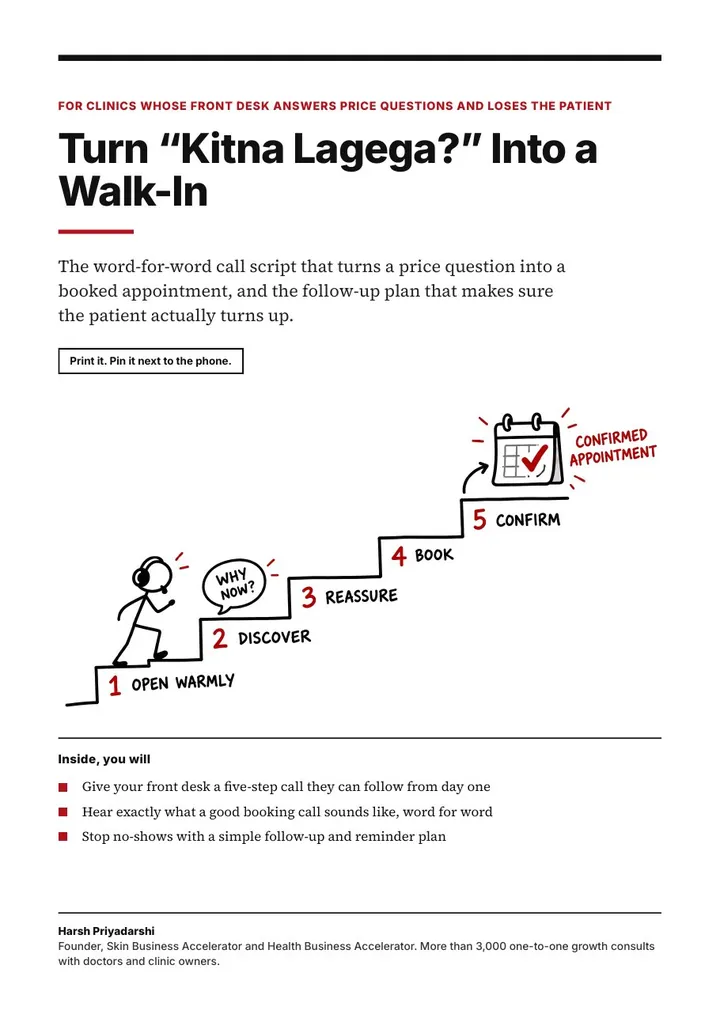
Run a short role-play with your front desk every week. One person plays the patient, one handles the call and one scores it against the five steps: open warmly, discover the problem and why now, reassure, offer two slots, confirm. Then swap. Pick scenarios from last week's real calls, such as price-only callers or "I'll call you back", and repeat the hard ones until they feel natural.
Most clinics train their front desk the same way. Day one, they get a printed script. Day two, they are on the phones. By week three, the script is in a drawer and every call sounds the way that person naturally talks.
A script on paper doesn't change behaviour. Practice does. That is why I ask every clinic we work with to run a role-play with the front desk every single week. It takes twenty minutes, it costs nothing, and it improves calls faster than anything else I know.
Why does role-play work better than a script?
Because a call is a conversation, not a reading.
When a patient says "bas rate bata do" (just tell me the rate), the staff member has about two seconds to respond. If the right answer only lives on paper, they will fall back on habit: read out a number, or say "come to the clinic." If they have practised it six times out loud, the right answer comes out on its own.
Role-play also makes the hard calls less scary. The angry patient, the one comparing you with a cheaper clinic, the one who keeps saying "I'll call you back." Once your team has handled them in practice, they stop dreading them on the real phone.
How do you run a twenty-minute role-play?
Keep the format the same every week, so the team knows what to expect.
- Pick two scenarios from last week's real calls, ideally the ones that went badly.
- Assign three roles. One person plays the patient. One handles the call. One scores it.
- Run the call for about three minutes, standing or sitting back to back so nobody reads faces.
- Score it against the five steps, one point each: opened warmly, discovered the problem and the why now, reassured, offered two specific slots, confirmed the details.
- Ask the caller to score themselves first. People are usually harder on themselves than you would be.
- Give two pieces of feedback only: one thing that was good, one thing to try next time.
- Swap roles and run it again, so everyone plays the patient once.
- Replay the best version at the end, so the last thing the team hears is the right way.
Which scenarios should you practise?
Make a set of scenario cards and rotate them. Here are the ones every clinic needs.
| Scenario card | What the "patient" says | What good looks like |
|---|---|---|
| The price-only caller | "Just tell me the rate, I'm calling five clinics." | An honest range, what it depends on, then two slots |
| The "I'll call you back" | "Let me check and call you back." | Asks what they'd like to check, offers to hold a slot |
| The consultation fee doubter | "Why should I pay for a consultation?" | Explains what the consultation includes, without defending |
| The free-consult comparer | "The other clinic is giving a free consultation." | No arguing, calmly explains the difference, lets them choose |
| The anxious patient | "I'm really scared, it's been hurting for months." | Slows down, listens, reassures before any booking |
| The medical question | "Can I take this tablet before coming?" | No advice on the phone, books the doctor, offers to note the question |
| The family caller | "I'm calling for my father, he won't call himself." | Asks about the father, invites the caller to come with him |
| The unhappy returning caller | "Last time I waited two hours." | Listens fully, apologises sincerely, explains what's different, books |
The medical question card matters more than it looks. The front desk should never give medical advice on the phone, and practising how to say so kindly prevents a lot of trouble.
How do you play the patient well?
The person playing the patient makes or breaks the session.
- Be realistic, not impossible. A patient who refuses everything teaches nothing.
- Use your patients' real language. If your callers speak Hinglish, play it in Hinglish.
- Have a "why now" ready, like a wedding, a fall or a family function, and only reveal it if the staff member asks.
- Reward good discovery. If they ask a good question, give a fuller answer, the way a real patient opens up.
- Use real objections from last week's recordings, word for word where you can.
- Keep a timer. About three minutes per call keeps the session moving and stops anyone giving a speech.
How do you score without making people defensive?
Score the call, not the person. The question is "which step did we miss?", never "why are you so bad at this?"
Do it with your front desk, not about them. Keep the scores in a simple sheet, week by week, so the team can watch the line go up. Celebrate improvement out loud. When someone nails the scenario that tripped them up last month, tell the whole team.
And join in yourself. A doctor who plays the patient, laughs at their own over-acting and takes a turn on the phone side sends a clear message: this matters, and nobody is above practising.
How do role-plays fit with real call reviews?
They work as a loop. Every week, score three recorded calls, recorded with the caller's knowledge. Those recordings show you the gap. The role-play practises the fix. The next week's recordings show whether it stuck.
Role-play is also how you hire. Before you offer anyone a front desk role, play a worried patient asking about the price and watch how they handle it. The best candidates ask questions and listen. The weakest read out information.
And if you are setting up an AI assistant for WhatsApp, use the same scenario cards to test it before a real patient ever sees it.
We build this training rhythm into our front desk and conversion systems work. The call structure and the four phone objections are in Chapter 6 of Good Doctors Go Broke, and the twelve wider objections are in Chapter 8. If you would like a set of scenario cards built from your own calls, book a free growth call.
The short version
- A script on paper doesn't change behaviour. Weekly practice does.
- Run twenty minutes a week: two scenarios, three roles, score the five steps, swap, replay the best.
- Use scenario cards from real calls, including price-only, "I'll call back", free-consult comparers and medical questions.
- Play the patient realistically, in your patients' language, with a hidden "why now".
- Score the call, not the person, and use recorded calls to choose next week's scenarios.
Frequently asked questions
How often should a clinic run front desk role-plays?
Once a week, for about twenty minutes, at the same time every week. Short and regular beats a long training day once a quarter. Pick scenarios from the previous week's recorded calls so the practice always targets a real gap, and repeat the hardest ones until the team handles them naturally.
What scenarios should I use to train my receptionist?
Start with the calls clinics lose most: the price-only caller, "I'll call you back", "why pay for a consultation?", "another clinic is free", an anxious patient, someone asking for medical advice, a family member calling for a parent and an unhappy returning patient. Rotate them weekly using cards.
How do I score a role-play call?
Give one point for each of the five steps: a warm opening, discovering the problem and why now, reassuring, offering two specific slots and confirming the details. Ask the staff member to score themselves first, then share one thing that worked and one thing to try. Keep the focus on the call, not the person.
Should the doctor take part in front desk role-plays?
Yes, at least sometimes. When the doctor plays the patient or takes a turn handling the call, the team sees that the practice matters and nobody is above it. It also helps the doctor understand what patients ask before they ever reach the consultation room.
On a free growth call, my team traces your last month from enquiry to treatment and shows you your biggest leak in rupees.