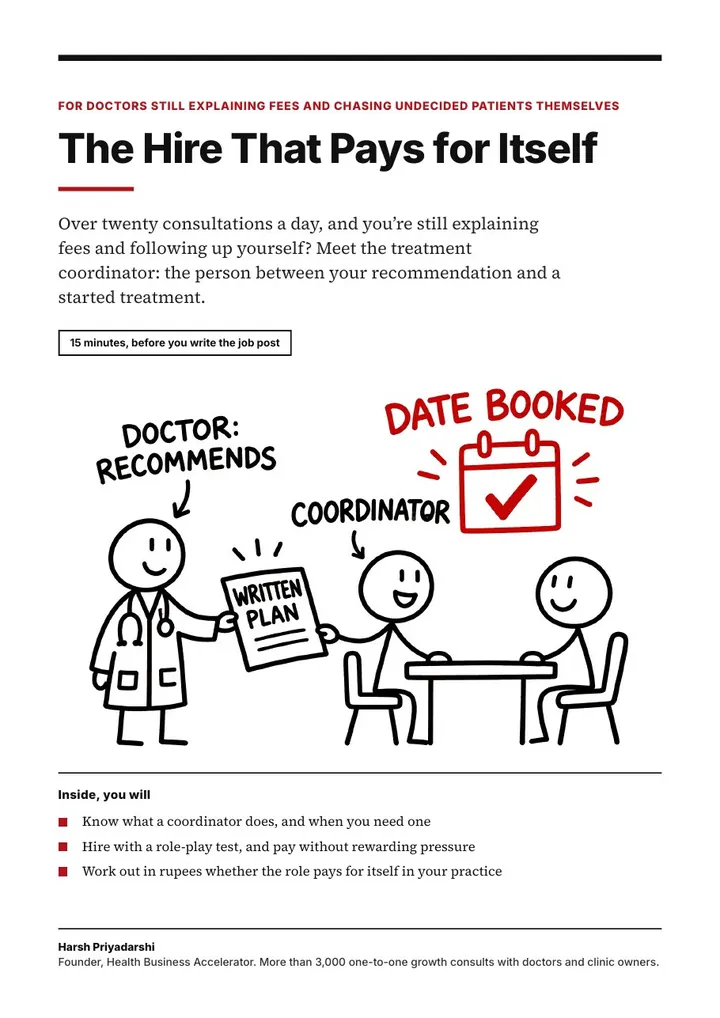
To hire a treatment coordinator, look among patient counsellors, nurses, people from hospitality, airlines, banking or insurance, and your own front desk. Hire for warmth first, then calm confidence about money, clear explaining, listening and follow-up discipline. Test every candidate with a role-play and a shadow day. Pay a fixed salary plus an incentive on treatments started, with guardrails, and train them for four weeks.
Most clinics hire their first treatment coordinator the wrong way. They look for someone "good at sales", hire on a CV and a pleasant interview, hand over a price list and hope.
Within two months, one of two things happens. Either the coordinator is too pushy and patients complain, or they are too nervous about money and patients still leave undecided.
Here is how we help clinics hire and train this role so it works from the first month.
Where do you find a good treatment coordinator?
The best coordinators usually come from places where people already deal with anxious customers and important decisions.
| Where to look | What they bring | What to watch for |
|---|---|---|
| Patient counsellors at other hospitals and clinics | They already know the job | Habits from a place that discounted or pressured |
| Nurses ready to move out of clinical work | They understand the medicine and the fear | Comfort with money conversations |
| Hospitality and airlines | Service skills and calm under pressure | Learning your treatments at a patient's level |
| Banking and insurance sales | Comfort explaining EMI and paperwork | A pushy style that worries patients |
| Your own front desk | They know your clinic and your patients | Whether you can replace them at the desk |
Ask your team and your network for referrals, post the role on job portals, and look at people already in your patients' world.
One story from my book stays with me. A hospital's joint replacement unit could not find a coordinator. Candidates from sales felt too pushy. Then they trained one of their own nurses, already known for how much patients trusted her. The unit's conversions became the steadiest they had ever been.
What should you hire for?
Warmth comes first. Patients must feel cared for, never sold to. After that, look for:
- Calm confidence about money. A coordinator who gets nervous discussing fees makes patients nervous too.
- Clear explaining. They should make a plan, an EMI or an insurance process sound simple.
- Listening. They should listen more than they talk.
- Follow-up discipline. Every patient, every time, without being reminded.
- Your patients' language. If your patients speak Hindi, Marathi or Kannada at home, so should your coordinator.
You won't find any of this on a CV. You find it by testing.
How do you test candidates before you hire?
Run every shortlisted candidate through the same steps.
- A phone conversation first. Before any interview, call them for a short chat. Listen for warmth in the voice.
- The money role-play. You play a patient who loved the doctor, but says the fee is more than expected and you need to ask your husband. Watch how they listen, what they ask, and whether they move gently to a next step.
- The fear role-play. You play a patient scared of pain and recovery. Watch whether they rush to reassure or ask what exactly worries you.
- A shadow day. Let your best candidate spend a day in the clinic. Watch how they speak to the front desk, to patients in the waiting area, and to you.
In the money role-play, a strong answer sounds something like this: "I completely understand. Can I ask, is it the total amount, or paying it all at once? And would it help if your husband joined a short call with the doctor, so he can ask his own questions?" Notice that the candidate asks before answering, finds two concerns, and offers a next step. Nobody taught them a script. They just listened.
The best candidates ask questions, listen and naturally try to help. The weakest read out information or start talking about discounts.
How should you pay a treatment coordinator?
Pay a fair fixed salary for your city, plus an incentive based on treatments actually started, not on consultations seen or verbal yeses.
Then add guardrails, because any incentive can be gamed:
- Never reward pressure. Make it clear that a regretted plan counts against them, not for them.
- Track refund requests and complaints for every coordinator.
- Review a sample of their conversations every week.
An incentive without guardrails can create the exact pushiness you were trying to avoid.
What does the first month of training look like?
Here is a four-week plan most clinics can follow.
| Week | Focus |
|---|---|
| Week 1 | Learn your core treatments at a patient's level, from the doctor. Sit in on consultations and watch procedures where possible |
| Week 2 | Learn every plan, the three options, the fee sheet and every payment option until they can explain each one without notes |
| Week 3 | Practise objections in daily role-plays: money, family, timing and comparison. Learn the six steps: listen, acknowledge, find the real concern, answer, check, next step |
| Week 4 | Learn the follow-up cadence and the CRM. Start handling real patients with the doctor or manager reviewing every conversation |
By the end of week four, they should be able to take a patient from the doctor's handover to a booked date, a family session or a follow-up slot, without help.
How do you keep them good after month one?
Training never really stops.
Every week, review their five numbers: the share of consultations that start treatment, days taken to decide, average plan value, which option patients choose, and undecided patients brought back by follow-up. Then listen to a few of their recorded conversations together.
Every week, run one role-play on the hardest objection they heard. Celebrate their best conversation in front of the team.
And protect the role. A coordinator who is pulled back to the front desk every time it gets busy is not a coordinator. The patient who just finished a consultation is the one who needs them most.
Hiring and training this role is part of our conversion systems work, and building the wider team around you is what growth consulting covers. The role and its training plan are in Chapter 9 of Good Doctors Go Broke, and the bigger team picture is in Rich Doctors Walk Away.
The short version
- Look among patient counsellors, nurses, hospitality, airlines, banking, insurance and your own front desk.
- Hire for warmth first, then money confidence, clear explaining, listening and follow-up discipline.
- Test with a phone call, two role-plays and a shadow day, never just a CV.
- Pay a fixed salary plus an incentive on treatments started, with guardrails against pressure.
- Train for four weeks, then review numbers and conversations every week.
Frequently asked questions
What qualifications does a treatment coordinator need?
No specific degree is required. What matters is warmth, calm confidence about money, clear explaining, listening, follow-up discipline and your patients' language. Nurses and patient counsellors bring medical understanding, while people from hospitality, banking or insurance bring service and payment skills. Test the behaviour with role-plays, because a CV won't show it.
Should I promote my receptionist to treatment coordinator?
It can work very well, because they already know your clinic and patients. Test them with the same role-plays as outside candidates, and make sure you hire and train a replacement for the front desk first. If they keep covering the phones, they won't have time for the patients who just finished a consultation.
How should a treatment coordinator's incentive work?
Pay a fair fixed salary plus an incentive on treatments actually started, not consultations or verbal agreements. Add guardrails: track refunds and complaints, review sample conversations every week, and make it clear that pressuring patients counts against them. The goal is steady conversions without regret.
How long does it take to train a new treatment coordinator?
Plan for about four weeks. Week one is learning treatments and sitting in on consultations, week two is plans, fees and payment options, week three is objection role-plays, and week four is follow-up, the CRM and supervised work with real patients. Weekly reviews continue after that.
On a free growth call, my team traces your last month from enquiry to treatment and shows you your biggest leak in rupees.