Consult conversion rate is the share of patients seen in consultation who go on to start treatment. Divide treatment starts by consultations and multiply by 100. For elective care, a healthy range is 30 to 50%. For medically necessary surgery, measure how many patients you advised surgery for actually went ahead. A low number usually points to the consultation itself, your pricing or the patients your marketing brings.
You can have a full waiting room and still have a flat month.
I have seen it many times. The phones ring, the front desk books, patients turn up. And then most of them walk out, say they will think about it, and never come back. The doctor is busy all day and the bank account doesn't move.
That gap has a name: consult conversion rate. Of all the numbers in a clinic, it is the one the doctor controls most directly. And it is the one most doctors have never measured.
What is consult conversion rate?
Consult conversion = patients who started treatment ÷ patients seen in consultation × 100
Say 20 new patients came in for a consultation this week and 10 started treatment. That is a 50% consult conversion rate.
Two rules make the number honest. First, count a treatment start only when the treatment is booked and paid for, or actually begun. "Yes doctor, we'll do it" is not a start. Second, count new consultations only. Review visits for patients already on a plan don't belong here.
Why does this number decide your revenue?
Because every stage before it has already cost you money. The ads, the front desk time, the doctor's hour in the room. Consult conversion decides whether all of that turns into revenue.
Here is an example. Say your clinic sees 60 new consultations a month and converts 30%. That is 18 treatment starts. Lift conversion to 40% and you get 24. That is 6 more patients a month from the same consultations. At an example average ticket of ₹1.5 lakh, that is ₹9 lakh more revenue every month.
And your cost per new patient drops at the same time, because you are dividing the same marketing spend by more treated patients. Nothing else in the clinic moves revenue and acquisition cost in the right direction at once like this.
What is a healthy consult conversion rate?
For elective care, such as aesthetics, hair restoration, cosmetic surgery or many dental treatments, a healthy range in my framework is 30 to 50%.
Medically necessary surgery works differently. The decision window is longer. Some patients go ahead straight away. Others keep putting it off for months. So measure it as the share of patients you advised surgery for who actually went ahead, and look at it over a longer period than a week.
Either way, track it by doctor and by treatment. A clinic-wide average can hide one doctor converting 55% and another converting 20%.
Why is my consult conversion low?
When this number is low, the problem usually sits in one of three places. Here is how to tell which.
| What you notice | Likely cause | Where to look |
|---|---|---|
| Patients seem happy but leave saying "we'll let you know" | The consultation has no definite ending | How the consultation closes, and who follows up |
| Patients look confused about their options | Too many options, or no clear recommendation | Whether the doctor recommends one plan and says why |
| Most patients pick the cheapest option or walk away at the fee | Pricing or payment structure | The three options, and whether EMI and milestones are offered |
| Patients can't afford it or aren't right for it | Targeting | Your ads, your pages, and how the front desk qualifies callers |
| Conversion varies wildly between doctors | Skill and process, not the market | Sit in on consultations and compare structures |
Targeting needs a special word. If the people showing up can't afford the treatment, or aren't right for it, that is a marketing problem first. But it is partly a front desk problem too, because those people should have been gently filtered out before they took up a consultation slot. A front desk that asks about the problem, what the patient has tried and their timeline will spot many poor fits on the phone. So when conversion is low, look at your marketing and your front desk, not just the doctor.
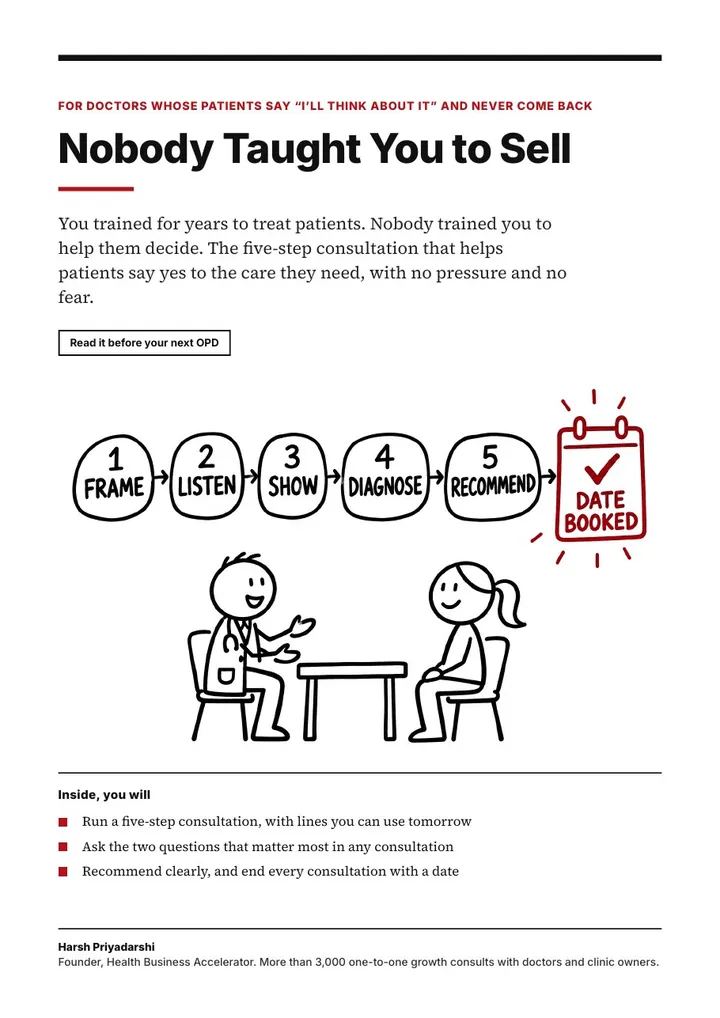
The first culprit, most of the time, is simple. Nobody ever taught doctors how to help a patient decide. So an excellent doctor explains beautifully and then hands over a menu.
What if my consult conversion is above 50%?
Congratulations, but read it carefully. If your conversion has stayed above 50% for a full quarter, the market may be telling you your price is too easy to say yes to.
Look at the other signals too. Is your waiting list getting longer? Are your rooms and your time full? Have you added a new credential, technology or aftercare programme? When several of these show up together, it may be time to review your fees on your next fixed price review date.
Also check which of your three options patients choose. If many pick the Complete option, that is another sign there is room to raise the price or add a higher tier.
How do you track it properly?
Put these in your CRM for every consultation, so the number comes out of one dashboard instead of memory.
- The doctor who saw the patient.
- The treatment discussed.
- The source of the enquiry.
- The outcome: started, follow-up booked, family session booked, test booked, or not suitable.
- Which option the patient chose: Basic, Recommended or Complete.
- How many days the patient took to decide.
- Whether an undecided patient was later brought back by follow-up.
Item six is the one people forget. A patient who takes three weeks to decide is not the same as one who never decides, and your follow-up should treat them differently.
Review it every Monday with the other weekly numbers. When it drops, sit in on a few consultations or listen to the coordinator's calls. The number tells you what is happening. The conversations tell you why.
If you want help with this, our conversion systems work covers the consultation, the coordinator and the follow-up, and growth consulting looks at the full set of numbers. The consultation structure is in Chapter 7 of Good Doctors Go Broke, and you can book a free growth call to go through your own figures.
The short version
- Consult conversion is treatment starts divided by new consultations. For elective care, 30 to 50% is healthy.
- For necessary surgery, measure how many patients you advised actually went ahead, over a longer period.
- A low number points to the consultation, the pricing or the targeting. Check them in that order.
- Above 50% for a full quarter can mean you are underpriced.
- Track it by doctor, treatment, source and option chosen, every week.
Frequently asked questions
What is a good conversion rate from consultation to treatment?
For elective treatments, a healthy range is 30 to 50% of new consultations starting treatment. For medically necessary surgery, measure the share of patients you advised surgery for who went ahead, over a few months. Track it separately for each doctor and each treatment so one strong performer doesn't hide a weak one.
Why do patients like the consultation but not book treatment?
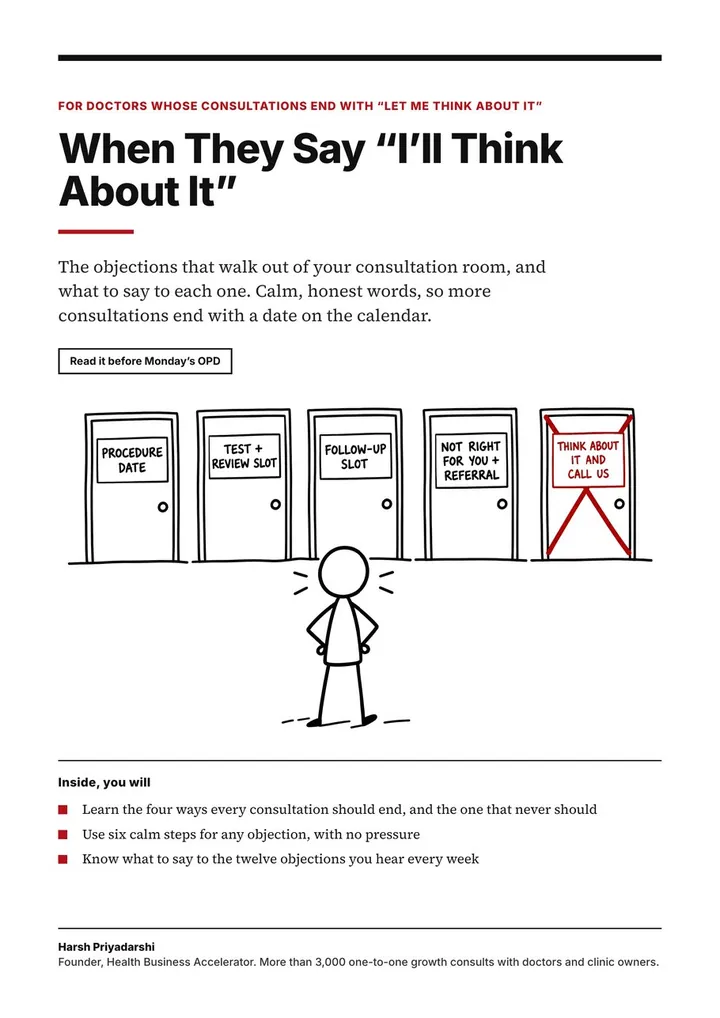
Usually because the consultation ended without a definite next step. The patient leaves with "think about it", no written plan and nobody following up. Other common causes are a doctor who lists options without recommending one, a fee shown without payment options, or patients who were never a good fit to begin with.
Should I count patients who said yes but haven't paid?
No. Count a treatment start only when the treatment is booked and paid for, or has actually begun. A verbal yes that never turns into a date makes your conversion look better than it is. Track those patients separately as follow-ups so your coordinator can bring them to a real decision.
Is my consult conversion low because my prices are too high?
Sometimes, but check the consultation first. If patients understand their problem, hear one clear recommendation, see the monthly payment option and still walk away at the fee, look at pricing. If most choose the Basic option, your Recommended plan may be overpriced or poorly explained. Fix one thing at a time.
On a free growth call, my team traces your last month from enquiry to treatment and shows you your biggest leak in rupees.