Surat clinics should hire front desk staff who are warm, persistent and genuinely comfortable in both Gujarati and Hindi, and test that with a phone call that switches language halfway. Look in hospitals, retail showrooms, hospitality and banking. Pay a fair salary plus an incentive on patients who show up, train for thirty days, and add a treatment coordinator past twenty consultations a day.
A cosmetic surgery practice in Surat hired a coordinator with an impressive sales background. Within weeks, conversions dropped. Patients said she was polite but pushy, and families from the old city found her formal Hindi hard to warm to. Her replacement had spent six years at a jewellery showroom on a busy road, explaining expensive decisions to families in Gujarati, then in Hindi to the next customer, without ever rushing anyone. Patients loved her. Conversions recovered. The right hire in Surat is often hiding in a very different industry.
What should a Surat clinic hire for?
The same four things every clinic needs, plus one that matters more here:
- Warmth you can hear on the phone.
- Empathy for anxious patients and worried families.
- Persistence to follow up without sounding pushy.
- Fluency in your patients' language. In Surat, that usually means both Gujarati and Hindi, spoken naturally, not just understood.
- Comfort with WhatsApp in mixed scripts. Many patients type Gujarati in English letters, or switch languages mid-message. Your front desk should reply the same way, naturally.
Do not hire for a polished CV, a fancy accent or the lowest salary. None of those books patients.
Where should you look for candidates in Surat?
Look where people already handle customers, money and important decisions all day:
- Hospital and clinic front offices and patient counsellors, the obvious first place.
- Nurses who want to move into a non-clinical role. They understand the medicine and the fear.
- Retail showrooms and jewellery stores, where staff explain high-value decisions to families every day.
- Hospitality, for service skills.
- Banking and insurance, for calm money conversations.
- Your own team, and referrals from staff you trust.
How do you test candidates before you hire?
Four tests, in this order:
- The bilingual phone test. Call the candidate before any interview. Start in Gujarati, then switch to Hindi halfway as if you were a different family member taking the phone. Notice whether they switch naturally and stay warm.
- The price role-play. You play a caller asking "kitna thase?" for a parent's treatment. The best candidates ask questions and try to help. The worst read out a number.
- The relative abroad role-play. For coordinator roles, you are a son calling from another country, worried about his mother's surgery and short on time. Watch how they explain the plan, the payment options and the next step clearly, without pressure.
- A shadow day in the clinic, with your team's feedback afterwards.
What pay structure works for the front desk and coordinators?
A fair fixed salary, plus an incentive.
- Front desk: an incentive for patients who book and actually show up, never just bookings.
- Coordinator: an incentive on treatments actually started, not consultations.
Add guardrails: never reward pressure, track complaints and refund requests, and review a sample of every person's calls each week. A coordinator who pushes patients into plans they regret costs you more in reputation than any target is worth.
Here is a worked example. Say a coordinator's follow-up brings back just four undecided patients a month who would otherwise have drifted away, and each is worth ₹80,000 in the first year. That is ₹3.2 lakh of revenue a month from one person doing the follow-up properly. A good coordinator pays for herself many times over.
What should the first thirty days of training cover?
| Week | Front desk | Treatment coordinator |
|---|---|---|
| Week 1 | Your niche, doctors, fee sheet and plans; the five-step call in both languages | Everything the doctor knows about core treatments, at a patient's level |
| Week 2 | Listening to recorded calls; role-plays on the four phone objections | Sitting in on consultations; the three options and every payment option |
| Week 3 | Live calls with a senior listening; WhatsApp templates and cadence | Objection role-plays: money, family, timing, comparison |
| Week 4 | Full shifts, with three calls scored every week | The follow-up cadence and the CRM; first independent handovers |
After the first month, training never stops: weekly call reviews, celebrating great calls in front of the team, and tracking answer rate, speed, booking rate and show rate. We run programmes like this in team training.
At what point does a Surat clinic need a coordinator?
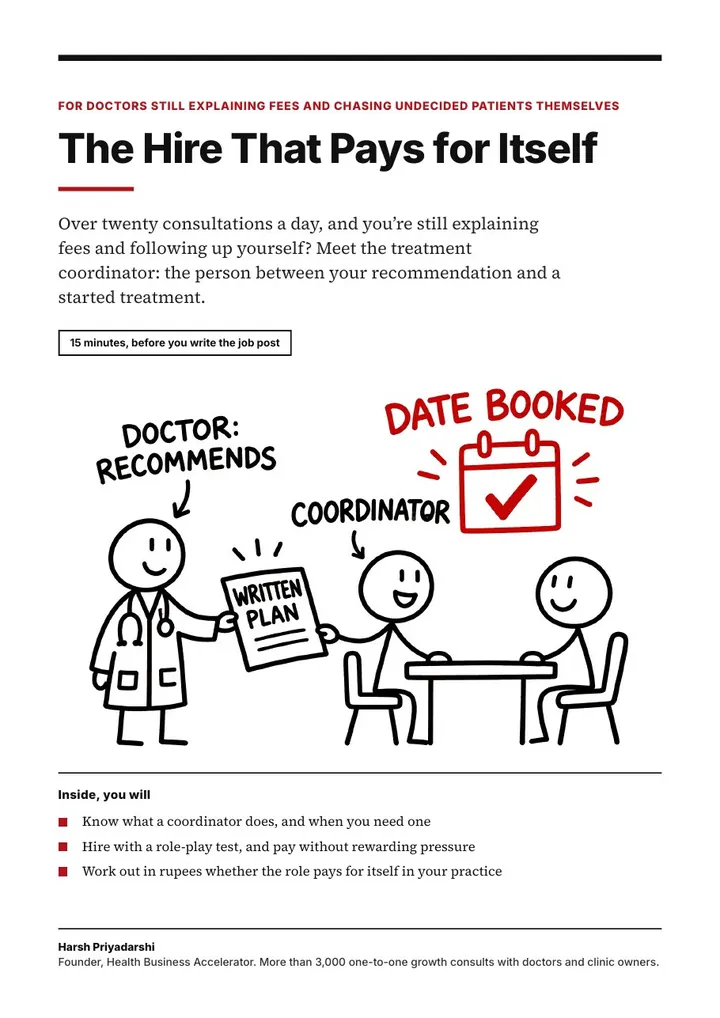
The rule of thumb is twenty consultations a day. Under that, a well-trained front desk and the doctor can split the work, as long as the handover is clear. Over it, the doctor is still explaining EMIs while the next patient waits, and the undecided ones leave without anyone calling them back.
In Surat, the coordinator often handles one extra conversation: the family member abroad. That means a video call to walk the son or daughter through the written plan, an email or WhatsApp copy of the plan, and updates after each visit with the patient's consent. A coordinator who handles this well becomes the reason families choose you over a clinic with similar doctors.
Trust moves at the handover. When the doctor says, in front of the patient, "Hetal will take you through the plan and the payments, and she will be your contact from here," the patient's confidence in the doctor transfers to Hetal. From there, any patient who has not decided hears from her that evening, gets a call the following day, and a helpful check-in on days three, seven and fourteen. She can change the option, the payment schedule or the date. She never changes the price.
How do you keep good people?
Give every role a one-page card: what they own, the numbers they are measured on, and what a great week looks like. Review the numbers together weekly. Give your best people a path, from front desk to coordinator to team lead, so they grow with you instead of leaving for the next clinic down the road.
We help clinics in Surat and across India set this up through conversion systems, and the full team structure is in Rich Doctors Walk Away.
The short version
- Hire for warmth, persistence and natural Gujarati and Hindi.
- Look beyond healthcare: showrooms, hospitality and banking often produce great front desk staff.
- Test with a language-switching phone call, price and relative-abroad role-plays, and a shadow day.
- Pay for show-ups and started treatments with guardrails, train for thirty days, and add a coordinator past twenty consultations a day.
Frequently asked questions
Should my Surat clinic hire front desk staff who speak Gujarati?
Yes, and ideally Hindi too. Many local families feel most comfortable in Gujarati, while much of the workforce prefers Hindi. Test both in a phone call that switches language halfway. If you cannot find one person who does both well, plan shifts so both languages are covered at all times.
Where can I find a good treatment coordinator for my clinic?
Look at patient counsellors in hospitals, nurses ready for a non-clinical role, and people from showrooms, hospitality, banking and insurance who handle important money conversations with families every day. Hire for warmth and calm confidence about money, then test with a role-play where the patient needs to consult family first.
How should I structure incentives for clinic staff?
Pay a fair fixed salary plus an incentive tied to real outcomes: patients who show up for the front desk, and treatments started for the coordinator. Add guardrails, such as weekly call reviews and tracking of complaints and refunds, so nobody is rewarded for pressuring patients.
How long does it take to train a treatment coordinator?
Plan a structured first four weeks: learning the treatments at a patient's level, sitting in on consultations, mastering the plans and payment options, practising objections and learning the follow-up process. After that, keep reviewing a sample of their conversations and numbers every week.
On a free growth call, my team traces your last month from enquiry to treatment and shows you your biggest leak in rupees.