Hire a dedicated lead handler when your front desk can no longer call every new enquiry within five minutes because it is also handling walk-ins and billing. Hire for warmth you can hear on the phone, persistence and fluency in your patients' language, not for hard selling. Test with a phone call and a role-play, pay a fair salary plus an incentive on booked patients who show up.
When doctors tell me they want to hire a "sales executive", I usually ask them to change the title before they post the job.
Not because selling is wrong. Because the word attracts the wrong people. You'll get candidates from loan and credit card desks who know how to push. And a worried patient on the phone, asking about a knee replacement or a hair transplant, can hear a push from a mile away.
What you actually need is a lead handler: one person whose whole job is turning enquiries into confirmed appointments that show up. Warm, quick and persistent. Here's how to hire one.
When does a clinic need a dedicated lead handler?
Usually when one of these is true:
- Your speed to first contact is above thirty minutes, even on normal days.
- Your answer rate is below 95% in working hours, especially at lunch and in the evening rush.
- One person is sitting at reception, billing walk-ins, running the pharmacy counter and expected to call every new lead.
- You're spending on ads and your booking rate is below 25%.
In the way I break practices down, a dedicated person or two for leads and calls, separate from walk-ins and billing, becomes essential somewhere between ₹15 and 50 lakh a month. But if you're running ads at any size, you may need one sooner.
The clinic that keeps one person doing everything thinks it's saving a salary. It's losing far more through the enquiries that never get called.
Is a lead handler worth the salary?
Here's an example to run on your own numbers.
Say you get 25 enquiries a day, about 150 a week, and your stretched front desk books 18% of them: 27 bookings. A dedicated lead handler calls every lead within five minutes and books 28%: 42 bookings. That's 15 more a week. At a 65% show rate, about 10 more consultations. At 40% consult conversion, 4 more patients a week. If each patient is worth ₹40,000, that's about ₹1.6 lakh a week, or over ₹6 lakh a month.
Say the role costs you ₹30,000 a month all in. The maths isn't close.
And there's a second benefit people miss. When one person owns every enquiry, the follow-up actually happens. A lead who doesn't pick up gets three attempts on day one, then calls or short, useful WhatsApp messages on days two, four, seven and fourteen. Only then is the lead marked cold, and even then it goes into your database for reactivation later. A stretched receptionist rarely gets past the first attempt.
What should you hire for?
Not the things most clinics hire for: good English, a nice appearance and low salary expectations.
Hire for these:
- Warmth you can hear in a voice. Patients decide in the first ten seconds whether you care.
- Empathy for people who are anxious, embarrassed or in pain.
- Persistence to keep following up without sounding pushy.
- Fluency in your patients' own language. If your patients speak Kannada, Bhojpuri or Marathi at home, that matters more than polished English.
- Comfort with a CRM. Everything they do has to be logged.
Where do you find them? Front desk staff at other clinics and hospitals, hospitality and airline service roles, and people already on your team who are naturally good on the phone. Be careful with pure sales backgrounds. Some are excellent, but test hardest for warmth.
How do you test candidates before hiring?
Use a three-step test, in this order.
- The phone test. Before any interview, call the candidate and talk for five minutes. That's exactly how your patients will experience them. If they don't sound warm on the phone, stop there.
- The role-play. You play a worried patient who opens with "Just tell me the price." The best candidates ask your name, ask about the problem, listen, and try to help. The worst ones read out a number and wait.
- A trial shift. Let your best candidate spend half a day with your front desk, listening to real calls and handling a few with support.
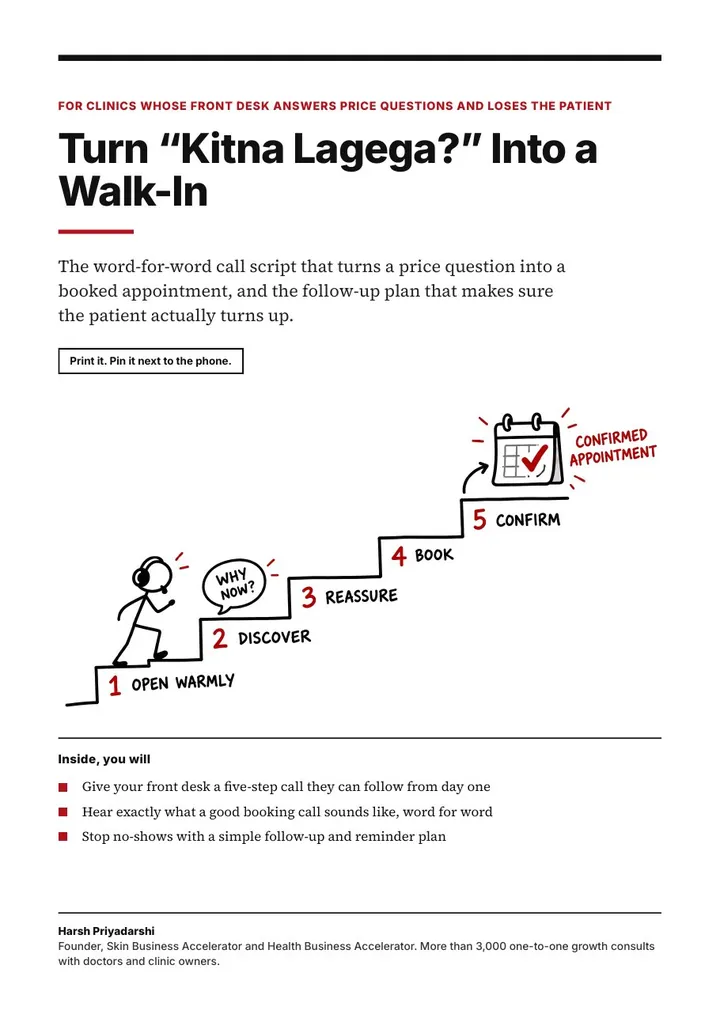
Score each candidate on the five steps of a good call: open warmly, discover the problem and the "why now", reassure, offer two specific slots, and confirm. The person who naturally does three of the five before training is usually the one to hire.
How should you pay a lead handler?
A fair fixed salary, plus an incentive for patients who book and actually show up. Not for bookings alone.
That one detail stops people from booking anyone into any slot just to hit a number. It also makes them care about confirmations, reminders and calling no-shows the same day, because that's where their incentive sits.
Put it in a written employment agreement, and ask your CA how the incentive should be paid and recorded.
What should they be measured on from week one?
Four numbers, every week, on their role card:
| Number | Benchmark | Where it comes from |
|---|---|---|
| Answer rate | At least 95% in working hours | Phone system |
| Speed to first contact | Under 5 minutes; ideally 30 seconds | CRM timestamps |
| Booking rate | 25 to 40% of enquiries | CRM |
| Show rate | 60 to 75% of bookings | CRM and calendar |
Give them the tools to hit those numbers: one CRM where every enquiry lands with its source, a phone system with call recording and missed-call alerts, and a shared WhatsApp inbox with approved templates. Without those, even a great hire will leak leads. We set this up as part of our CRM, WhatsApp and AI work.
Then review a few of their recorded calls with them every week. Score the five steps together. Celebrate the great calls in front of the team.
Hiring and training lead handlers is a core part of our front desk and conversion work. The full front desk system, from the call structure to the follow-up cadence, is in Good Doctors Go Broke. If you're not sure whether you need this hire yet, book a free growth call and we'll look at your speed and booking numbers together.
The short version
- Call the role "lead handler", not "sales executive", and hire for warmth, not push.
- You need one when speed to first contact passes thirty minutes or one person is doing four jobs.
- Test with a phone call, a price role-play and a trial shift before you hire.
- Pay a fair salary plus an incentive on booked patients who show up.
- Measure answer rate, speed to first contact, booking rate and show rate from week one.
Frequently asked questions
Should I hire someone with sales experience for my clinic front desk?
Sometimes, but test hardest for warmth. Patients calling a clinic are often anxious or embarrassed, and a pushy tone loses them quickly. Some of the best lead handlers come from hospitality, airlines or other clinics' front desks. Use a phone test and a role-play, and hire whoever listens best rather than whoever talks most.
Can one person handle leads and the reception desk together?
In a small clinic with few enquiries, yes. But once walk-ins, billing and calls collide, new leads wait, and a lead called back after thirty minutes has usually spoken to another clinic. If your speed to first contact keeps slipping past thirty minutes, that's the sign to separate the roles.
How many enquiries can one lead handler manage?
It depends on how many calls each lead needs and how much is automated. The real test is the numbers: if one person can't keep speed to first contact under five minutes and follow up on days one, two, four, seven and fourteen, you need a second person or more automation, such as instant WhatsApp replies.
What should a lead handler say when a patient asks the price on the first call?
Never refuse and never just read out a number. Ask about the problem first, then give an honest range, explain what it depends on, and offer a consultation where the doctor will give an exact plan in writing. Then offer two specific slots. Every price question is a door back to the consultation.
On a free growth call, my team traces your last month from enquiry to treatment and shows you your biggest leak in rupees.