Train a new clinic front desk in four weeks. Week one: your niche, doctors, plans, fee sheet, scripts and systems, plus listening to good and bad recorded calls. Week two: role-plays and supervised calls. Week three: live calls scored on a five-step scorecard. Week four: full ownership of answer rate, speed to first contact, booking rate and show rate, with weekly call reviews after that.
Most clinic front desks are trained in one afternoon. "Here's the phone, here's the register, here's the price list. Call me if anything happens."
Then everything happens.
The new joiner reads out prices and hangs up. Leads wait till the next morning. Nobody sends reminders. And three months later, the doctor decides the ads "don't work", when the real problem was that nobody ever taught the front desk what the job was.
Your front desk isn't a receptionist. It's the first step of your treatment plan. So train it like one.
What does a new front desk person need to learn first?
Before they take a single call, they need to know five things:
- Your niche. The one problem your clinic is known for, and who you help.
- Your doctors. Their names, credentials, days and what each one treats.
- Your plans and fee sheet. Every plan, the three options, every fee, and the consultation fee. One sheet everyone quotes from.
- Your scripts. The call structure and the answers to the common phone objections.
- Your systems. The CRM, the phone, the shared WhatsApp inbox and the booking calendar.
And they need to hear what good sounds like. Have them listen to recorded calls, good and bad, and talk about the difference. Ten good calls teach more than an hour of explaining.
What does a 30-day front desk training plan look like?
Here's the plan I give clinics building a front desk from zero.
| When | Focus | Done when |
|---|---|---|
| Days 1 to 2 | Niche, doctors, clinic tour, systems login | They can explain what the clinic treats in two sentences |
| Days 3 to 5 | Fee sheet, plans and the call structure; listen to 20 recorded calls | They can name the five steps of a good call |
| Week 2 | Daily role-plays; sit beside the lead handler; make supervised calls | They handle "just tell me the price" without reading a number and hanging up |
| Week 3 | Live calls on their own, each one scored; confirmations and reminders | Average call score of 4 out of 5 |
| Week 4 | Full ownership of their numbers; join the Monday review | Answer rate, speed, booking and show rate tracked under their name |
Don't rush week two. Role-play feels awkward for a day and then it becomes the fastest way to learn. You play the patient: the anxious one, the one who wants a discount, the one calling for her father.
Week three is also when they learn what happens after the call. Every booking gets a WhatsApp confirmation the moment the call ends, one short useful message in between, a reminder the day before asking the patient to confirm, and another a couple of hours before. If someone doesn't show up, they call the same day, warmly, to reschedule. No guilt, just care.
What should a good call sound like?
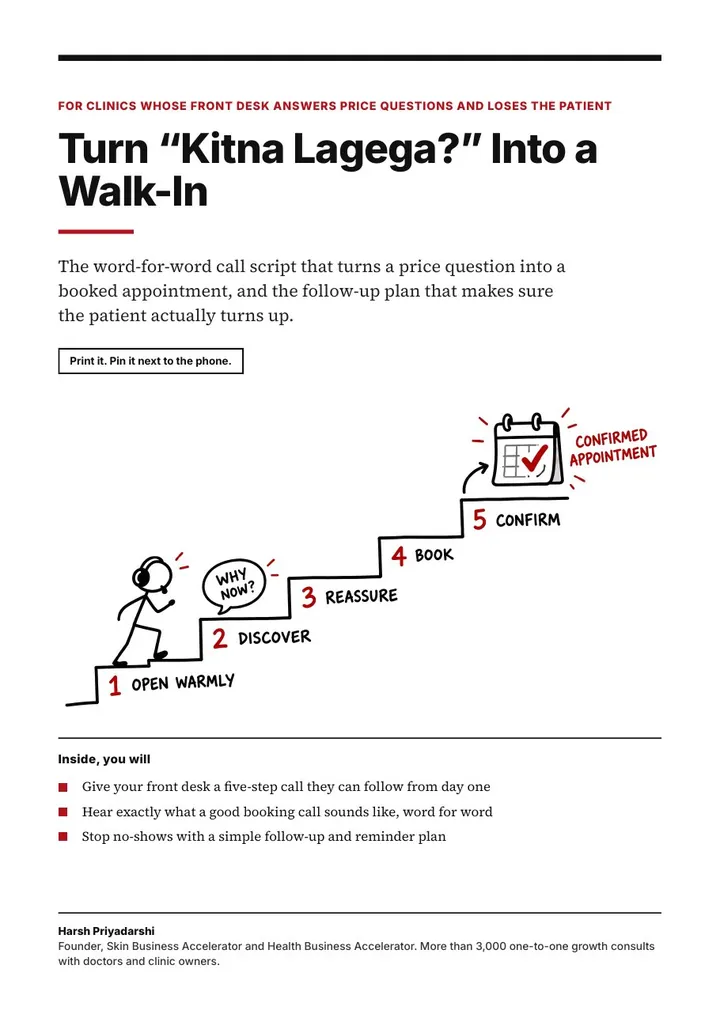
Every call follows five steps, and this is the scorecard you'll use for every recorded call from week three onwards:
- Open warmly. The clinic's name, their own name and a genuine "How can I help you?"
- Discover. What's the problem? How long has it been going on? What have they tried? And why are they calling now?
- Reassure and show authority. Reflect back what they heard, and explain that the doctor sees this every day.
- Book. Offer two specific slots. "Thursday at 11 or Saturday at 4?" Never "When are you free?"
- Confirm. Name, number, date, time, consultation fee, location and what to bring.
One point for each step. Score three calls a week with the person, not about them.
And teach them what's missing from that list on purpose: no reciting the full price list, no medical advice on the phone, and never ending a call without offering an appointment. If they answer the question and the call ends there, that wasn't a call. It was an information leak.
What phone objections should you train for?
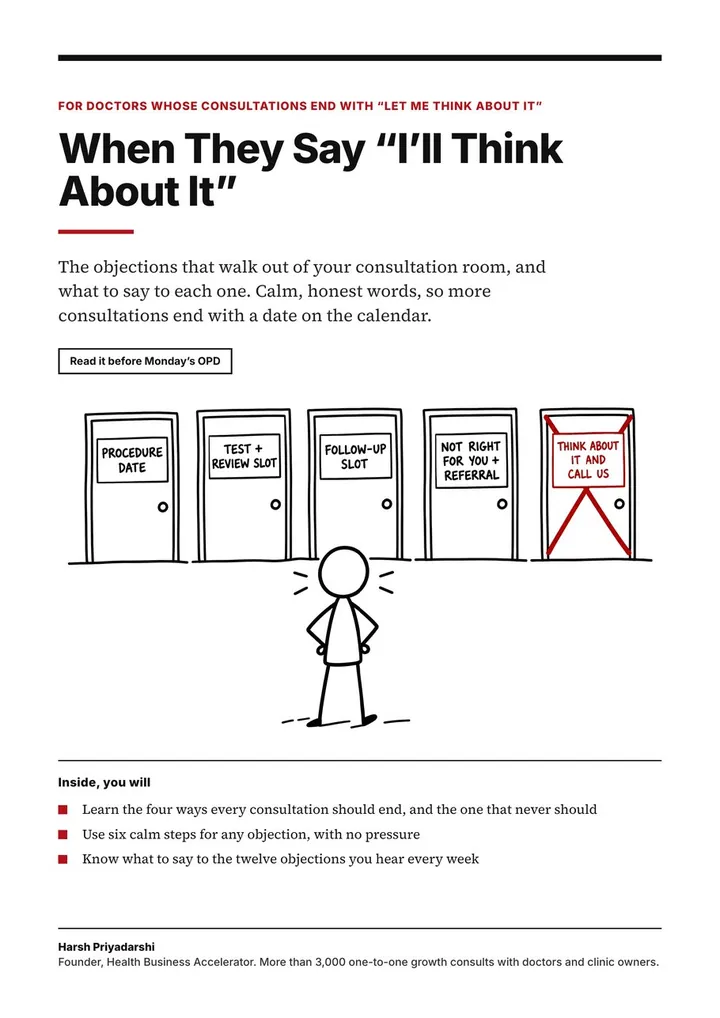
Four come up in almost every clinic. Train an answer for each one:
- "Just tell me the price." Give an honest range, explain what it depends on, and bring it back to the consultation where they'll get an exact plan in writing.
- "I'll call you back." Ask what they'd like to think about, answer it, and offer to hold a slot.
- "Why should I pay for a consultation?" Explain what it includes, and that it's time with the specialist, not a sales meeting.
- "Another clinic offers a free consultation." Don't argue. Explain calmly what's different here, and let the patient choose.
How do you know the training worked?
The numbers tell you. Track four of them every week from week four:
- Answer rate: at least 95% in working hours.
- Speed to first contact: under five minutes.
- Booking rate: 25 to 40% of enquiries.
- Show rate: 60 to 75% of bookings.
Here's an example of what good training is worth. Say your clinic gets 70 enquiries a week, and an untrained front desk books 15% of them: about 11 bookings. After four weeks of proper training, the same person books 25%: about 18. That's 7 more bookings a week. At a 65% show rate and 40% conversion, roughly 2 more patients starting treatment every week, from the same enquiries you were already paying for.
When a number drops, the recorded calls will tell you why.
How do you keep training going after the first month?
Training never stops. It just gets shorter.
Record every call, with the caller's knowledge. Review a few calls together every week in the Monday meeting. Celebrate great calls in front of the team. And refresh the fee sheet training every time a fee changes.
You can also turn your SOPs, scripts and fee sheet into an AI knowledge assistant, so a new joiner can ask "What do we say if someone wants to reschedule a procedure?" and get your clinic's answer instantly. Add AI scoring of calls against the five steps, and you can see who needs help without listening to every recording. We build both as part of our CRM, WhatsApp and AI work, and front desk training sits at the heart of our front desk and conversion work. The full call structure is in Good Doctors Go Broke.
The short version
- Teach the niche, doctors, fee sheet, scripts and systems before the first call.
- Use a 30-day plan: learn, role-play, live calls with scoring, then full ownership.
- Score every recorded call on five steps: open, discover, reassure, book, confirm.
- Train answers for the four common phone objections.
- Keep reviewing calls weekly and track answer rate, speed, booking and show rate.
Frequently asked questions
How long does it take to train a clinic receptionist properly?
About four weeks to become confident, with training continuing every week after that. The first week covers your niche, doctors, fee sheet, scripts and systems. The second is role-play and supervised calls. By weeks three and four they handle calls alone, scored on a five-step scorecard, and own their weekly numbers.
What should a clinic front desk never say on the phone?
They should never give medical advice, never read out the full price list and hang up, and never end a call without offering an appointment. They also shouldn't argue when a patient mentions a cheaper or free consultation elsewhere. Explain calmly what's different, offer two specific slots and let the patient choose.
How do I train front desk staff who don't speak fluent English?
Train them in the language they and your patients actually speak. Write scripts in Hindi, Hinglish, Kannada or whatever fits, and record good calls in that language as examples. Warmth and fluency in the patient's own language convert better than polished English. Keep the five call steps the same in every language.
Should every clinic call be recorded for training?
Yes, with the caller's knowledge. Recorded calls are the fastest training tool you have, because they show exactly where a call went wrong. Review a few each week with the person, score them on the five steps, and play the best ones to the whole team. Keep recordings secure and limit who can access them.
On a free growth call, my team traces your last month from enquiry to treatment and shows you your biggest leak in rupees.