Delhi clinics should hire front desk staff and treatment coordinators who can calmly handle families, not just patients. Look for warmth, persistence, confidence talking about money, and fluency in Hindi, Punjabi and English. Test with a phone call and a family role play. Add a coordinator once you pass twenty consultations a day, pay incentives on started treatments, and review conversations every week.
A Delhi coordinator's hardest conversation is rarely with the patient. It is with the patient's elder son, who has three quotes on his phone, a cousin who works at a hospital, and a firm belief that every price can come down. The person you put in that chair decides whether your best consultations turn into treatment or into "hum ghar pe discuss karke batayenge".
Most clinics hire for this role by accident. They promote whoever is free. In Delhi, that is an expensive mistake.
What should a Delhi clinic hire front desk staff for?
Not for polished English or a nice appearance. For:
- Warmth you can hear in a voice, because the first contact is usually a phone call or WhatsApp.
- Empathy for anxious families, including the patience to talk to an elderly patient slowly and the confidence to talk to a busy son quickly.
- Persistence, to follow up without sounding pushy.
- Fluency in Hindi and English, and Punjabi where your patients need it. Many Delhi callers switch languages mid-sentence, and the front desk should follow without effort.
Ask candidates honestly about the commute. Many Delhi staff rely on the Metro. A candidate who can reach you on one line is more likely to arrive on time for the morning slot and stay through the evening rush.
When does a Delhi clinic need a treatment coordinator?
Once you do more than twenty consultations a day. Below that, the doctor and a well-trained front desk can share the job. Above it, the cost of not having one shows up every day in families who walked out undecided and were never followed up.
In Delhi, there is a second reason. Family decisions take time, and they need a calm, consistent person on the other end. A coordinator who knows the case, the options and the family's worries can hold that conversation over a week. A busy doctor cannot.
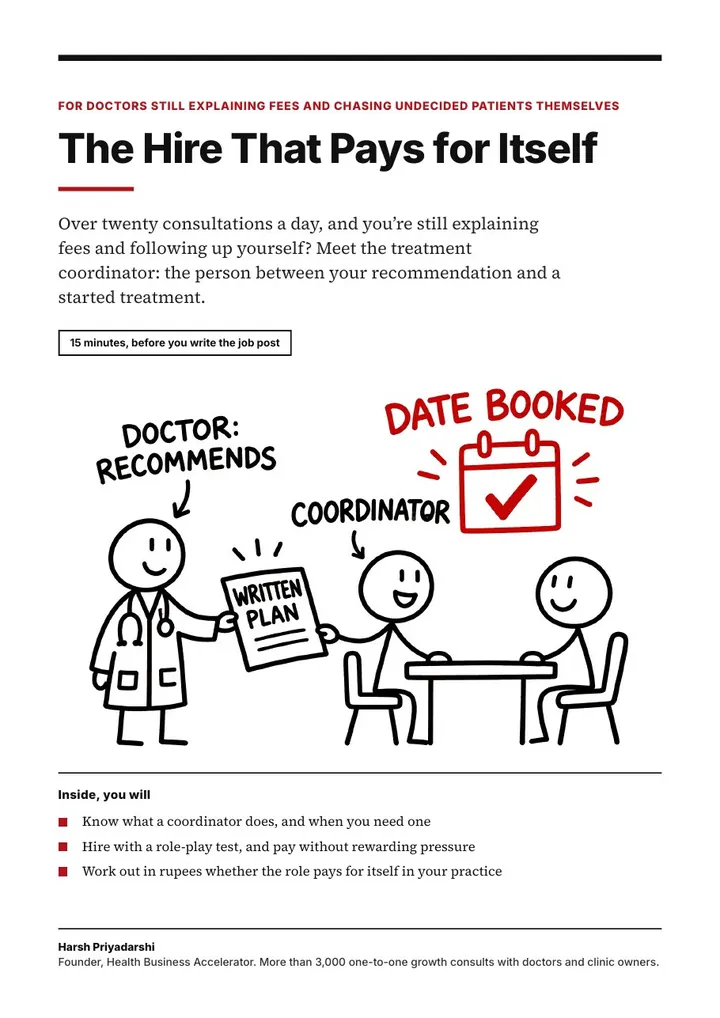
What the coordinator does:
- Sits with the patient and family in a quiet room right after the consultation.
- Walks through the written plan and the three options, slowly.
- Explains the fee, EMI, milestone payments and insurance cover.
- Books the procedure date, the test or the follow-up.
- Calls the family members who were not in the room, with the patient's permission.
- Follows up with everyone who did not decide: same day, next day, then days three, seven and fourteen.
They negotiate the plan, never the price.
Where do good coordinators come from in Delhi?
Delhi has many large hospitals, and with them, people who already do versions of this job:
- Patient counsellors and coordinators at hospitals and clinics.
- People who have worked on hospital patient help desks, including desks that look after patients travelling from other cities.
- Nurses who are trusted by patients and want to move out of clinical work.
- People from hospitality, airlines, banking and insurance, comfortable with service and with money conversations.
- Your own front desk, if someone is ready.
How do you test a coordinator candidate?
Use a role play built for Delhi. You play the son of a 65-year-old patient. You loved the doctor, but you say: "Doosre hospital mein isse kam bata rahe the. Aur mummy ko main ghar pe samjhaunga. Aap thoda kam kar do toh aaj hi book kar dete hain."
Watch what the candidate does.
| A strong candidate | A weak candidate |
|---|---|
| Thanks you, and asks what the other hospital's quote included | Immediately offers a small discount |
| Separates the total from the timing: is it the amount, or paying it all at once? | Repeats the price louder |
| Offers to include your mother in a call, today or tomorrow | Says "theek hai, aap discuss karke bata dijiye" |
| Ends with a specific next step on the calendar | Ends with nothing booked |
Then let your best candidate spend a paid day shadowing the clinic before you decide.
What does a good coordinator add?
Here is an example with illustrative numbers. Say your clinic sees 24 consultations a day for six days, 144 a week, and today 32% start treatment, about 46 patients. A trained coordinator who owns the handover and the family follow-up lifts that to 38%, about 55 patients.
Nine extra patients a week. At an average plan of ₹45,000, about ₹4 lakh more every week. Even half that improvement pays for the role many times over.
How should you pay and train them?
A fair fixed salary plus an incentive on treatments actually started, not consultations. Add guardrails: never reward pressure, track refund requests and complaints, and review a sample of conversations every week. A coordinator who pushes a family into a plan they regret costs far more in reputation than any target they hit.
For the front desk, pay a fair salary plus an incentive for patients who book and actually show up.
Train both properly. In the first four weeks, a coordinator learns your core treatments at a patient's level, sits in on consultations, masters the plans, three options, fee sheet and every payment option, and practises objections in role plays, including the family ones above. After that, training never stops: weekly reviews of recorded calls and conversations, and the numbers on Monday. Our team training work builds these programmes, alongside our conversion systems. Our Delhi page explains how we work with clinics here.
How do you keep good people in a Delhi clinic?
Give every person a one-page role card: what they own, the numbers they are measured on, and what a great week looks like. Stagger shifts so the person who opens is not also closing after the evening rush. Show them the Monday numbers, so they see how their calls and conversations turn into patients. And give them a visible path, from front desk to coordinator to team lead. People stay where they can see themselves growing.
Measure both roles every week. For the front desk: answer rate, speed to first contact, booking rate and show rate. For the coordinator: the share of consultations that start treatment, how long families take to decide, the average plan value, which of the three options people choose, and how many undecided families they bring back. The numbers tell you what is happening. The recorded conversations tell you why.
The short version
- Hire for warmth, persistence and fluency in Hindi, English and Punjabi where needed.
- Past twenty consultations a day, hire a coordinator who can handle the whole family.
- Test with a Delhi family role play, and watch for discounts offered too quickly.
- Pay incentives on started treatments, with guardrails against pressure.
- The full system is in Good Doctors Go Broke.
Frequently asked questions
How do I find a good patient counsellor for my Delhi clinic?
Look first at patient counsellors and help desk staff at hospitals, and at nurses who want to move out of clinical work. People from hospitality, airlines, banking and insurance often do well too. Test every candidate with a family role play about price and a decision at home, and let the best one shadow you for a day.
Should my treatment coordinator talk to the patient's family?
Yes, with the patient's permission. In many Delhi families, the decision involves people who were not in the consultation room. A coordinator who calls them, answers their questions calmly and offers a short family call turns "we will discuss at home" into a booked date far more often.
What incentive should a clinic coordinator get in Delhi?
A fair fixed salary plus an incentive based on treatments actually started, not consultations seen. Add guardrails: track complaints and refund requests, and review a sample of conversations every week. The incentive should reward helping families decide well, never pushing them into plans they regret.
How do I stop my coordinator from giving discounts?
Give them better tools than a discount. Train them to negotiate the plan instead: the right option, a payment schedule, milestones or EMI, and a convenient date. Give them one line to use every time, and review their conversations weekly. Make sure their incentive is tied to plan value and started treatments, not just closing.
On a free growth call, my team traces your last month from enquiry to treatment and shows you your biggest leak in rupees.