Chennai clinics should hire front desk staff and treatment coordinators for warmth, patience with older patients and natural Tamil and English, then test them with a phone call and a role-play before any interview. Pay a fair salary plus incentives on patients who show up or start treatment, with guardrails against pressure, and train for four weeks using recorded calls.
A Chennai orthopaedic surgeon once hired a front desk executive with excellent English, a hotel background and a confident manner. Within a month, his booking rate had dropped. When we listened to the calls, the reason was obvious. Many of his patients were in their sixties and seventies, calling in Tamil about knee pain. She answered politely, in English, quickly, and they felt rushed.
He then hired a woman who had worked at a hospital help desk for years. Her English was simpler. Her Tamil was warm and patient. His bookings recovered within weeks.
Hiring for the wrong things is the most common mistake I see. Here is how to hire for the right ones.
Which roles does a Chennai clinic need?
Start with clear role cards. One page per role: what they own, the numbers they are measured on and what a great week looks like.
- Front desk and lead handling: calls, WhatsApp, bookings, confirmations and reminders. Measured on answer rate, speed to first contact, booking rate and show rate.
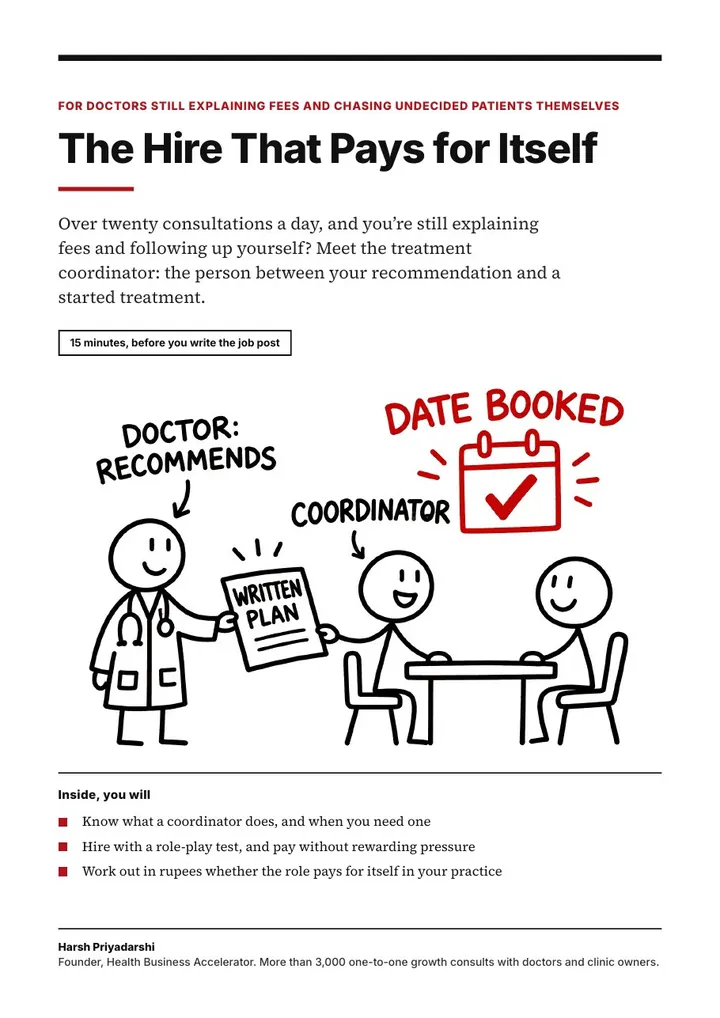
- Treatment coordinator: the written plan, payments and EMI, dates, family conversations and follow-ups for undecided patients. Measured on the share of consultations that start treatment, time to decide and average plan value.
- Practice manager: schedules, SOPs, complaints and the Monday numbers review.
When does a Chennai clinic need a full-time coordinator? A useful line is about twenty consultations a day. Below it, the surgeon can recommend and a well-trained desk can take the fee, EMI and follow-up conversations, as long as the handover is clear and written down.
What should you look for?
| Trait | Why it matters in Chennai | How to test it |
|---|---|---|
| Warmth you can hear | Anxious patients judge the clinic by the first voice | The phone test |
| Natural Tamil | Many patients, especially older ones, prefer it | Part of the role-play in Tamil |
| Comfortable English | Professionals and patients from elsewhere use it | Part of the role-play in English |
| Patience with families | Spouses, parents and children often join decisions | A role-play with a relative on the line |
| Calm about money | Coordinators discuss fees, EMI and insurance daily | A role-play about cost |
| Follow-up discipline | Leads need five or six touches over two weeks | Ask how they would track them |
Notice what is not on the list: polish, appearance and the cheapest salary.
Where can you find good candidates in Chennai?
- Hospital help desks, patient counsellors and coordinators. They already know anxious patients and medical paperwork.
- Nurses who want to move out of clinical work. Chennai trains a large number of nurses, and the best of them make outstanding coordinators because they understand both the medicine and the fear.
- Hospitality and airline staff, who bring service habits.
- Banking and insurance staff, who are comfortable with EMI and documents.
- Your own team, where someone may be ready to step up.
Think about the commute. Chennai stretches a long way north to south, and a long daily journey wears people down. Candidates who live within a reasonable distance of the clinic, or close to a suburban railway or metro line that reaches it, are more likely to stay and to cover evening shifts.
How do you test them before hiring?
First, the phone test. Call each candidate before any interview and talk for five minutes. That is exactly how your patients will meet them.
Then, the role-play. For the front desk: you are a seventy-year-old man calling in Tamil about knee pain, a little hard of hearing, and you ask "evlo aagum?" straight away. Watch whether they slow down, ask your name and the problem, and offer two slots, or rush to a number.
For coordinators: you are a patient who liked the surgeon but says the plan costs more than expected and your son in Bengaluru handles the money. Watch whether they ask if it is the total or paying at once, suggest a call with the son, and end with a next step on the calendar.
Then let your best candidate shadow the clinic for a day.
How should you pay them?
A fair fixed salary, plus an incentive tied to good outcomes.
- Front desk: an incentive for patients who book and actually show up, not for bookings alone.
- Coordinator: an incentive for treatments actually started, with guardrails. Track refunds and complaints, review a sample of conversations every week, and never reward pressure.
Example: say your coordinator earns a fixed salary plus a small amount per started treatment, paid monthly. If complaints or refund requests rise that month, the incentive is reviewed before it is paid. This keeps the coordinator focused on the right plan for each patient, not the biggest one. Check the structure with your accountant.
What does the first month of training look like?
- Week one: learn your speciality at a patient's level, your plans and fee sheet, your scripts in Tamil and English, and your CRM. Listen to recorded calls, good and bad.
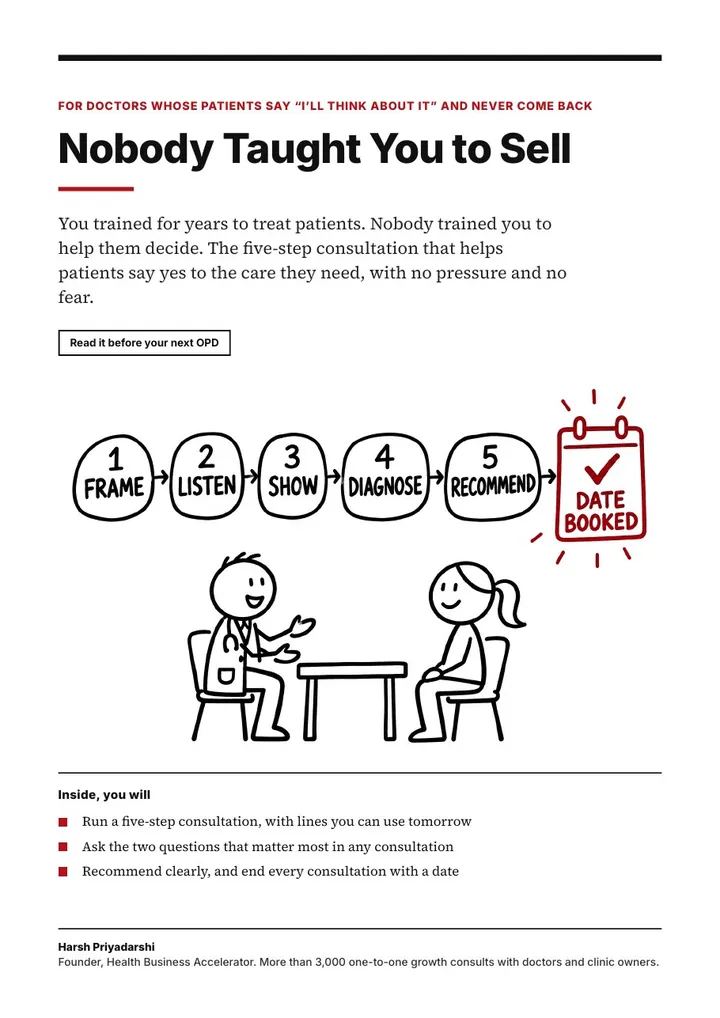
- Week two: daily role-plays of the five-step call and the common objections, in both languages.
- Week three: live calls with a senior person listening. Coordinators sit in on consultations and payment conversations.
- Week four: running their own calls and patients, with three recorded calls scored out of five each week.
Give every new hire one written page for each part of the job: how to answer, how to handle the four phone objections, how to confirm and remind, and how to log every outcome in the CRM. Store these simple SOPs where the whole team can find them, with a short video for anything practical. When something goes wrong, update the SOP rather than blaming the person.
After that, training continues every week. Review calls together, praise good ones in front of the team, and show each person the numbers they own in the Monday review. Our team training work runs these sessions, and our front desk and conversion work provides the scripts and scorecards. For joint and spine practices, see our orthopaedics page.
We work with clinics across India, including Chennai, mostly on video calls. See our Chennai page.
The short version
- Write one role card per role with what they own and how they are measured.
- Hire for warmth, patience, natural Tamil and comfortable English, not polish.
- Test with a phone call and a role-play built around your real patients.
- Pay for show-ups and started treatments, with guardrails, and keep training every week.
Frequently asked questions
Where can I find a good treatment coordinator in Chennai?
Look at patient counsellors and coordinators in hospitals, nurses who want to move out of clinical work, and people from hospitality, banking or insurance. Hire for warmth, calm about money and natural Tamil and English. Test each candidate with a role-play about a patient worried about cost.
Should my clinic front desk be hired for English skills?
Comfortable English matters, but it should not be the main filter. Warmth, patience and natural Tamil often matter more, especially if many of your patients are older or prefer Tamil. Test both languages in a role-play, and judge how the candidate makes a nervous caller feel.
How long does it take to train a clinic receptionist?
Plan for four weeks of structured training: learning the speciality and scripts, daily role-plays, supervised live calls, then independent calls with weekly reviews. After that, keep reviewing three recorded calls a week. Most of the improvement comes from that steady weekly habit.
How do I stop my clinic staff from leaving after training?
Hire people with a manageable commute, pay fairly with incentives for good outcomes, show them how their work turns into treated patients, praise good work in front of others and give them a clear path to grow. Overloading one person with every task is the fastest way to lose them.
On a free growth call, my team traces your last month from enquiry to treatment and shows you your biggest leak in rupees.