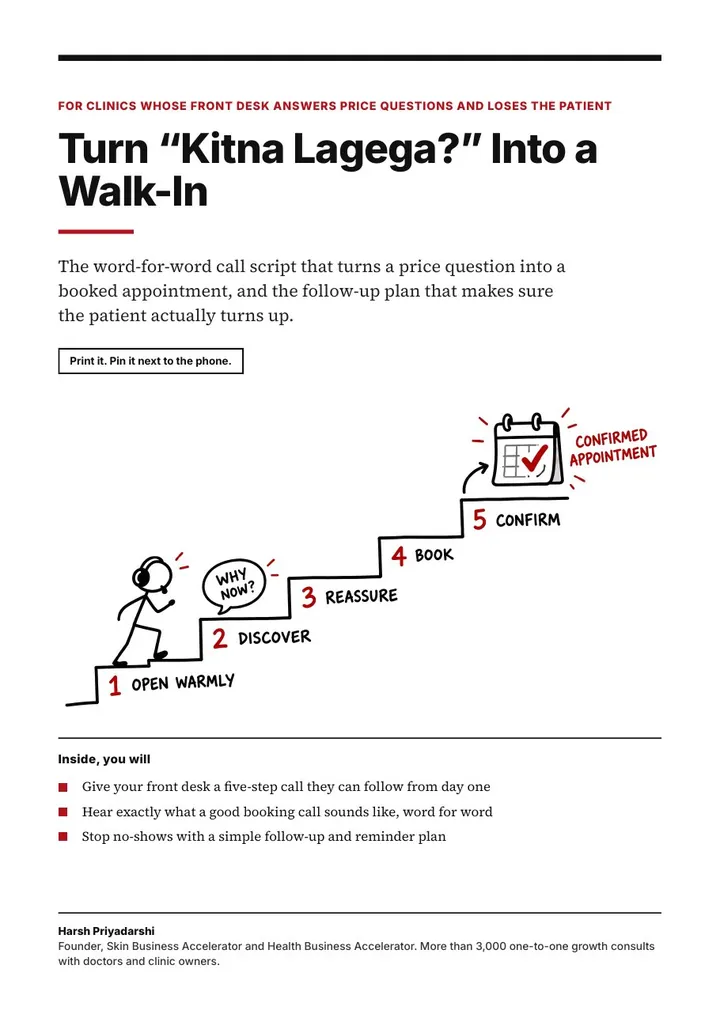
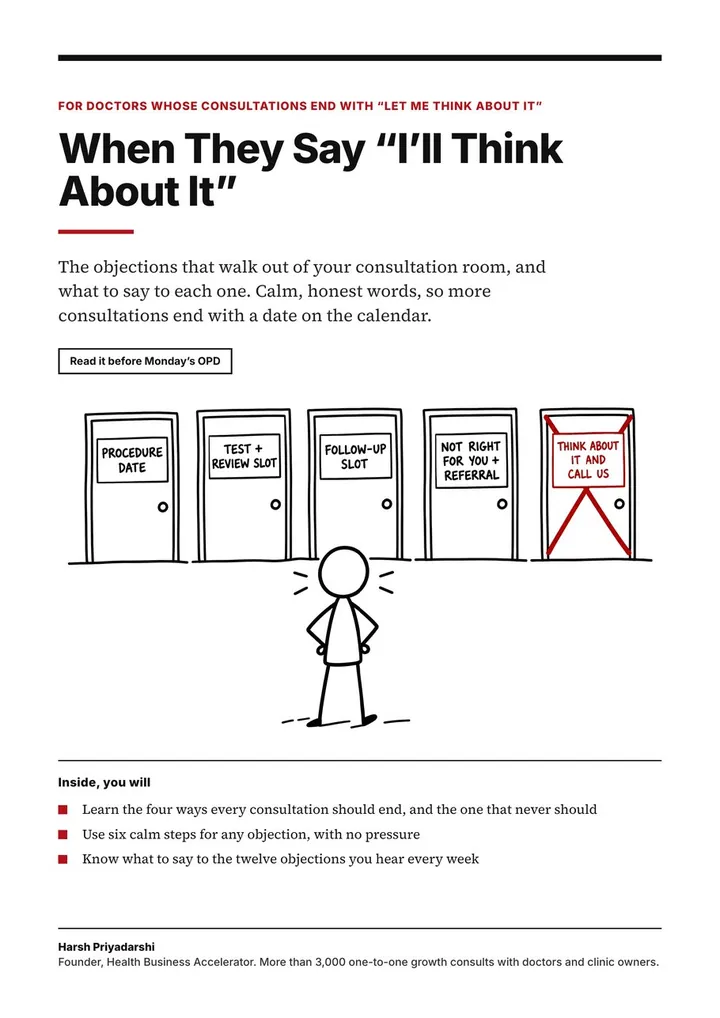
Stay calm and thank the patient for telling you. Ask gently what's changed, because the real reason is usually money, family, fear or logistics, and each has a different answer. If it's a health issue, pass it to the clinical team at once. Offer a fitting next step and two new dates without pressure. Then work your waiting list and ready patients to fill the slot.
It's 4 in the afternoon. Tomorrow's bariatric surgery has the anaesthetist booked, the OT prepared, the bed ready and the dietician's pre-op plan done. Then the patient calls. "Kal nahi ho payega. Sorry." And she's about to hang up.
What the coordinator says in the next minute decides two things: whether this patient ever comes back, and whether tomorrow's OT sits empty.
Most coordinators either panic or get stiff. "But everything is arranged." "You'll lose the booking amount." Both push the patient further away. There's a calmer way.
What should the coordinator say first?
Thank her. Seriously.
Coordinator: "Thank you for letting us know today, Meera ji. I really appreciate you calling instead of just not coming. Is everything okay?"
Three things just happened. You lowered her guard, because she expected to be scolded. You rewarded her for calling, which matters for every future patient too. And you asked an open question that invites the real reason.
Don't mention the booking amount, the OT or the anaesthetist in this call unless she asks. Those are your problems, not hers. Making her feel guilty will only make her stop answering your calls.
How do you find the real reason?
The first reason a patient gives is often not the real one. "Some work came up" can mean work, but it can also mean the husband changed his mind, or she got scared reading something online last night.
Ask once, gently, then listen.
Coordinator: "I understand. Can I ask what's changed since we last spoke? Sometimes there's something we can help with."
Then, if she gives a short answer, one follow-up:
Coordinator: "Apart from that, is there anything else on your mind about the surgery?"
That second question is from the six-step method in my book for any objection: listen, acknowledge, find the real concern, answer, check, and move to the next step. It often brings out the real reason.
What do you say for each reason?
Almost every last-minute cancellation is one of five things.
| Real reason | What it sounds like | What helps | Next step |
|---|---|---|---|
| Health | "I have fever since morning" | Pass to the clinical team immediately. They decide. | A new date after the doctor clears her |
| Fear | "I'm just not sure anymore" | A short call with the surgeon or anaesthetist to go over her worries | Call booked today or tomorrow, then a new date |
| Family | "My husband thinks we should wait" | Offer a call with the doctor for the husband to ask his own questions | Family call within 48 hours |
| Money | "Some expense came up" | The coordinator explains milestone payments or EMI, and whether a different plan fits | Payment discussion, then a new date |
| Logistics | "Can't get leave", "no one to stay with me" | Practical help: a later date, attendant guidance, recovery timeline for work | Two new dates offered on the call |
Health is the one exception to everything else. A fever, a new symptom, or a medicine she forgot to stop is a clinical matter. The coordinator doesn't judge it. She hands it straight to the doctor or nurse, and the clinical team decides what happens.
How do you rebook without pressure?
Offer, don't push. And always offer a specific next step, even if it isn't a new surgery date yet.
For fear, family or money, the next step is usually a conversation, not a date:
Coordinator: "Would it help to speak to Dr Rao for ten minutes tomorrow about what's worrying you? I can set it up at 12 or at 6. Then you can decide the new date after that, with no pressure."
For logistics, offer two dates on the call:
Coordinator: "No problem at all. Would the 22nd or the 29th work better with your leave?"
If she says "I'll let you know," don't let it end there. Agree a time to call back: "Shall I call you on Friday evening to check?" Then put that call in the follow-up schedule, and use the outcome note to make it specific, not "just checking".
And the booking amount? Apply your written terms quietly and fairly. If she has a genuine reason and your terms allow a free reschedule, tell her. "Your booking amount stays with us for the new date" is a kind sentence that often brings people back.
How do you fill the empty slot?
Start within the hour of the cancellation. Here's a simple order.
- Tell the team. Anaesthetist, OT, ward and any supplier, so nobody prepares for a patient who isn't coming.
- Check the waiting list. Keep a short list of patients who wanted an earlier date and are already fully worked up. They're the only ones who can realistically move up at a day's notice.
- Call the next scheduled patient. Someone booked for next week may be happy to come earlier, if all their tests are done.
- Use the time well if nobody can move. Reviews, pre-op counselling for next week's patients, a team training session or catching up on follow-up calls. An empty OT day can still be a useful clinic day.
Never rush a patient's preparation to fill a slot. A patient who isn't ready for surgery tomorrow shouldn't be squeezed in.
Here's an example of why the waiting list matters. Say a practice does 12 bariatric surgeries a month at an example fee of ₹2,50,000, and two are cancelled at short notice. If one of those slots is filled from a ready waiting list, that's ₹2,50,000 of care delivered that month instead of an idle team. If neither is filled, the team still gets paid and the next patient waits longer.
How do you reduce day-before cancellations in the first place?
Most late cancellations had warning signs. A reminder call two or three days before, not the day before, gives time to surface them.
Coordinator: "Your surgery is on Thursday. Is there anything worrying you, or anything you still need from us?"
That call catches fear, family doubts and logistics while there's still time to help, or to fill the slot properly.
We set up these call scripts, the waiting list and the reminder schedule as part of our front desk and conversion work, with reminders running from your CRM and WhatsApp. In bariatric surgery, where the decision is big and family opinions are strong, this matters more than almost anywhere.
The short version
- Thank the patient for calling. Never open with guilt, the booking amount or "everything is arranged".
- Ask what's changed, then "anything else?", to find the real reason.
- Health goes straight to the clinical team. Fear, family, money and logistics each have their own answer.
- Always agree a specific next step: a doctor call, a family call or two new dates.
- Fill the slot from a ready waiting list, and add a reminder call two or three days before every procedure.
Frequently asked questions
Should we keep the booking amount when a patient cancels surgery at the last minute?
Follow the written terms you gave the patient, and apply them the same way to everyone. Many clinics let the amount carry over to a new date when there's a genuine reason. The doctor can be generous in real hardship. Don't raise it as a threat on the cancellation call, because it pushes the patient away.
How do I build a waiting list for surgery dates?
At booking, ask every patient whether they'd like an earlier date if one opens up. Keep the list to patients who are fully worked up, with tests done and consent complete, because only they can move at short notice. Review it weekly so it stays current, and call in the order patients joined.
What if a patient cancels the day before because they're scared of the surgery?
Treat fear with respect. Offer a short call with the surgeon or anaesthetist to talk through exactly what will happen, how pain is managed and what recovery looks like. Then let the patient choose the new date. Pushing a frightened patient to keep tomorrow's slot is wrong, and it rarely works.
Should the doctor call a patient who cancels surgery at the last minute?
Not straight away for most cancellations. The coordinator makes the first call and finds the reason. If it's a health concern, the clinical team calls. If it's fear or doubt about the surgery itself, a short scheduled call with the doctor often helps. That keeps the doctor's time for conversations only the doctor can have.
On a free growth call, my team traces your last month from enquiry to treatment and shows you your biggest leak in rupees.