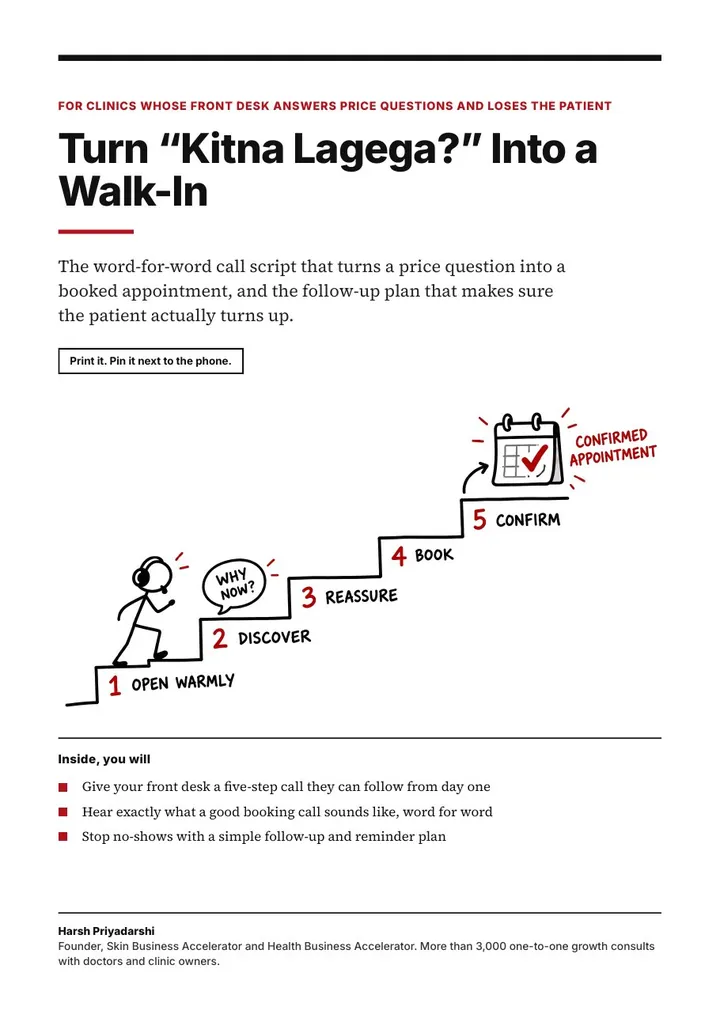
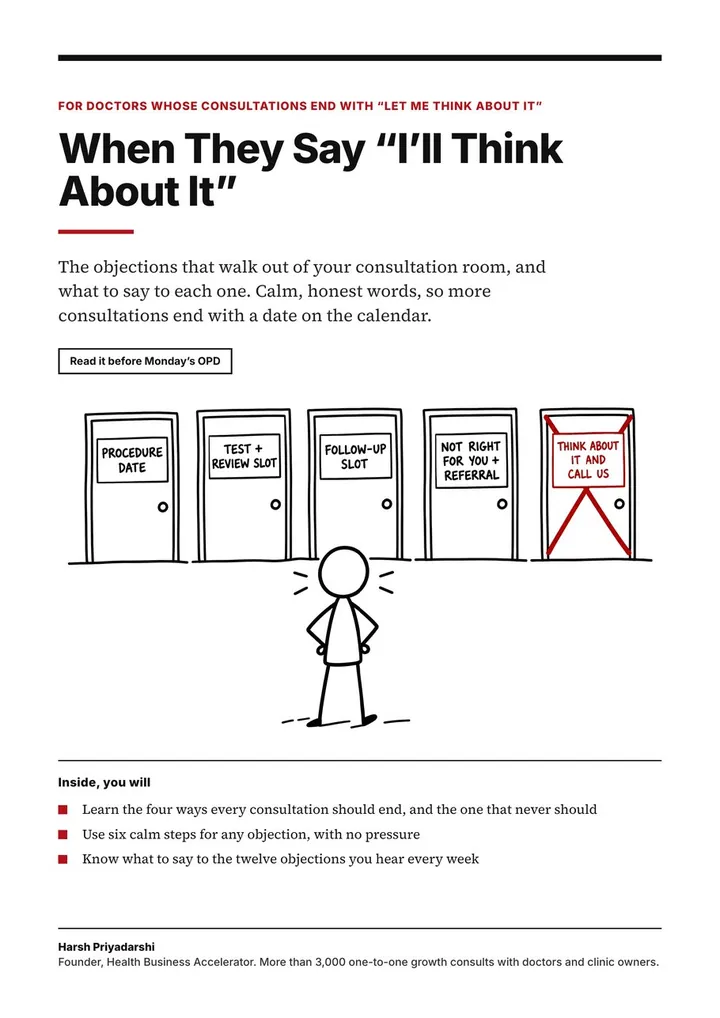
A Mumbai clinic should answer every enquiry within five minutes, in the language the patient is most comfortable in, whether Marathi, Hindi, Gujarati or English. Use WhatsApp for commuters who cannot talk, follow the five-step call structure, and end every conversation with two specific slots, including an after-office option. Confirm on WhatsApp with the nearest station and landmark, and remind before every visit.
The same call comes in three times a day at most Mumbai clinics. A worried voice, a bit of background noise from a platform or a busy road, and a question: "Doctor kab baithte hain? Kitna lagega?" What happens in the next ninety seconds decides whether that person becomes your patient or the next clinic's.
Your front desk is not a receptionist. It is the first step of your treatment plan. In this city, it also has to be quick, multilingual and comfortable on WhatsApp.
Why do Mumbai clinics lose so many enquiries at the front desk?
Three reasons come up again and again in the clinics we audit:
- Nobody owns new enquiries. The same person checks in walk-ins, takes payments and answers the phone, so new callers wait or ring out.
- The evening rush is uncovered. Working patients call after office, often when the front desk is busiest or already closing.
- The conversation stays in one language. A caller who would relax in Marathi or Gujarati gets a formal English script, and the call stays cold.
In my framework, answer rate during working hours should be at least 95%, and every new enquiry should get a human reply within five minutes, ideally within thirty seconds.
How do you cover Marathi, Hindi and Gujarati with a small team?
You do not need three new hires. You need a roster and a habit.
| Shift | Person | Languages | What they own |
|---|---|---|---|
| Morning | Front desk 1 | Marathi, Hindi, English | New enquiries and callbacks |
| Afternoon | Front desk 2 | Gujarati, Hindi, English | New enquiries, WhatsApp inbox |
| Evening | Front desk 1 or 2 | Both, overlapping | The after-office rush and next-day confirmations |
| After hours | Instant WhatsApp reply | All four, as templates | A clear promise of when someone will call |
Ask early in every conversation: "Which language are you most comfortable in?" Note it in the CRM, so the next person who calls or messages starts in the right language. If a Gujarati speaking patient reaches the Marathi speaking colleague, a warm handover with the conversation attached is better than struggling through.
How fast should a Mumbai front desk reply?
Within five minutes, and faster is better. The patient who filled in your form also filled in two others, and whoever replies first, and sounds like they care, usually wins.
But think about who is enquiring. Many Mumbai patients enquire on the move. So the first touch is often a WhatsApp message, not a call: "Hi, this is Neha from the clinic. Thank you for your enquiry about knee pain. Is it okay if I call you now, or would later today suit you better?" If they say they are on the train, ask when to call and call exactly then.
If they do not reply, follow the cadence: three attempts on day one, then day two, day four, day seven and day fourteen, mixing short calls with useful WhatsApp messages. Only then mark the lead as cold. A cold lead goes into your database, not the bin.
What does a good Mumbai booking call sound like?
The same five steps every time: open warmly, discover, reassure and show authority, book with two slots, confirm. Here is an example. The name, slots and fee are illustrations.
Front desk: "Good evening, thank you for calling the clinic, this is Neha. How can I help you?"
Caller: "Mere knee mein bahut dard hai. Doctor kitna lete hain?"
Front desk: "I can help with that. Hindi mein baat karein, ya Marathi?"
Caller: "Marathi chalel."
The conversation moves to Marathi. Neha asks how long the pain has been there, what makes it worse, what has been tried, and the most important question: what made her call now. The caller says she has started avoiding the stairs in her building because the lift is often under repair.
Front desk: (in Marathi) "That's very common, and the doctor sees this every day. The fee for the consultation is ₹800, and the doctor will examine your knee and explain your options in writing. I have Tuesday at 12 or Thursday at 7.30 in the evening. Which is better?"
She picks Thursday. Neha confirms her name, number, date, time and fee, then sends the location on WhatsApp straight away with the station exit and the landmark.
Notice what did not happen. No price list read out. No medical advice on the phone. No call that ended with "okay, call us when you are ready".
How do you reduce no-shows in a monsoon city?
A booking is not an appointment until the patient walks in. Send:
- A WhatsApp confirmation the moment the call ends, with the date, time, doctor, location pin, nearest station and landmark.
- One short, useful message in between, like a video from the doctor about what to expect.
- A reminder the day before, asking the patient to reply to confirm.
- Another reminder two hours before.
- A same-day call for every no-show, warmly, to reschedule.
During heavy rain, add one more step. On mornings when trains are disrupted, call patients booked for that day before they set out. Offer to move the slot, or offer a short video consultation for a follow-up where clinically appropriate. A patient you called before the rain remembers you. A patient who struggled through floods to find you running late does not come back. This kind of automation is part of our CRM and WhatsApp work.
What does a missed call really cost?
Here is an example. Say your clinic gets 250 calls a week and answers 200, an 80% answer rate. That is 50 missed calls. If even a quarter of those were new patients ready to book, and a third of those would have started a plan worth ₹40,000, that is about four patients, roughly ₹1.6 lakh a week, ringing out.
Track four numbers every week: answer rate, speed to first contact, booking rate and show rate. Review three recorded calls with your team every week, with the caller's knowledge, and score each one out of five on the call structure. Our conversion systems and team training work set this up, and our Mumbai page explains how we work with clinics here.
The short version
- Give new enquiries a dedicated owner, and cover the evening rush.
- Build a language roster for Marathi, Hindi, Gujarati and English, and log each patient's language.
- Start with WhatsApp for commuters, and reply within five minutes.
- Book with two slots, confirm with the station and landmark, and plan for rain days.
- The full front desk system is in Good Doctors Go Broke.
Frequently asked questions
Should my Mumbai clinic reply to enquiries on WhatsApp or call?
Do both, in the right order. A quick WhatsApp message first respects patients who are commuting or at work and cannot talk. Then call at the time they choose, because a real conversation books far more appointments than text alone. Never let a WhatsApp enquiry sit unanswered for hours, even after clinic hours.
How do I handle patients who only want the price on the phone?
Never refuse and never just read out a number. Give an honest range, explain that the exact plan depends on an assessment, and that the doctor will give it in writing. Then offer two specific consultation slots. Write this answer in every language your team uses, so everyone says the same thing.
What should the front desk say when a patient says 'I'll call back'?
Ask gently what they would like to think about, and answer it. Then offer to hold a slot: "Shall I keep Thursday at 7.30 for you, and you can confirm by tomorrow?" Note it in the CRM and follow up as promised. Most "I'll call back" patients never call, so the follow-up is yours to make.
Is an AI receptionist a good idea for a clinic in Mumbai?
It can be useful for the instant reply, after-hours messages, reminders and booking from your real calendar, especially when many enquiries come in late. Set clear limits: it says it is an assistant, never gives medical advice, never quotes outside your fee sheet, and hands over to a human the moment a patient needs one.
On a free growth call, my team traces your last month from enquiry to treatment and shows you your biggest leak in rupees.