Answer with facts, not praise. Tell the caller the doctor's qualifications, years in practice, the one problem the doctor focuses on, and exactly how the first consultation runs. Skip words like "best" or "number one", and never share other patients' stories. Then offer two specific slots. Facts calm a worried caller far more than adjectives, and they keep you safe under the NMC guidelines.
"Doctor achhe hain na?" Your front desk hears this ten times a week. Most of them answer the same way: "Haan ji, bahut achhe hain, sabse best hain." The caller says "okay, I'll let you know" and hangs up. Nothing was wrong with the doctor. The answer was the problem.
Here's what I've learned from 3,000+ one-to-one consults with practice owners. This question is never about the doctor's skill in the abstract. It's a worried person asking, "If I come to you, will I regret it?" Praise can't answer that. Facts can.
What is the caller really asking?
Behind "is the doctor good?" there is usually one of three fears.
- Fear of choosing wrong. They found you on Google along with four other names and can't tell you apart.
- A bad experience before. They saw someone for the same problem and it didn't go well.
- Family pressure. Someone at home asked, "Did you check if he's good?" and the caller needs something to repeat at dinner.
None of these fears goes away when someone says "very good". Every clinic says that. The caller knows the receptionist will praise her own doctor. So the sentence carries no weight.
What does carry weight is something the caller can check, picture and repeat.
Why can't the front desk just say "the doctor is the best"?
Two reasons. The first is trust. A superlative sounds like an advertisement, and an advertisement is exactly what a worried caller is trying to see past.
The second is the rules. The NMC guidelines on advertising and public communication dated 6 October 2026 are strict about claims like "best", "No. 1" or promised results, and about using patient stories to promote a practice. A front desk call is a public conversation with a stranger, so treat it with the same care as an ad. Read the current guidelines yourself and keep your desk's answers inside them.
So "sabse best" is out. So is "hundreds of happy patients" and "one of our patients had the same problem and she's completely fine now". Even if it's true, it is a patient's story being used to win a booking. Don't.
The four facts that answer the question
Give your front desk four facts, written down and approved by the doctor. That's the whole answer.
| Fact | Example line (ENT clinic) | What not to say |
|---|---|---|
| Qualifications | "Dr Rao is an ENT surgeon, MS in ENT." | "He's the top ENT in the city." |
| Years in practice | "He has been practising for 14 years." | "He's done thousands of successful surgeries." |
| The one problem he focuses on | "Most of his patients come for sinus and nose blockage problems." | "He treats everything." |
| How the first consult runs | "He'll examine you with a scope, explain what he sees on the screen, and give you your options in writing." | "He'll fix it in one visit." |
The fourth fact is the one most clinics forget, and it's the strongest. A caller who can picture the consultation stops being afraid of it. "He'll show you on the screen" is more reassuring than any adjective, because it tells them they won't be left confused.
If your doctor has a clear focus, say it. If you've worked on positioning around one problem, this is where it pays off on the phone. We cover that side in positioning and doctor authority.
How does the full answer sound on a real call?
Here's an example from an ENT clinic. The names and slots are just examples.
Caller: "Mujhe naak band rehne ki problem hai. Doctor achhe hain na?"
Front desk: "Good that you're checking, that's the right thing to do. Can I ask your name?"
Caller: "Sunita."
Front desk: "Sunita ji, Dr Rao is an ENT surgeon with an MS in ENT, and he's been practising for 14 years. Most of his patients come for exactly this, nose blockage and sinus problems. In the first visit he examines the nose with a small camera, shows you what he sees on the screen, and explains your options in writing, so you know exactly what's going on. How long has the blockage been bothering you?"
Caller: "Almost two years. I've tried sprays."
Front desk: "That's very common. The doctor will want to know what you've tried, so bring the sprays or the prescription. I have Wednesday at 11 in the morning or Friday at 6 in the evening. Which is easier for you?"
Notice the order. A thank-you for checking, which tells her the question is welcome. The four facts in under twenty seconds. Then straight into discovery: how long, what she's tried. Then two slots. The question "is he good?" became the start of a normal booking call.
What if the caller keeps pushing?
Some callers want more. Prepare your desk for the three common follow-ups.
"How many patients has he treated?" Don't throw out a big number to impress. "He's been seeing nose and sinus patients every day for 14 years. In the consult you can ask him anything about your own case."
"Are his patients happy? Can you tell me about someone like me?" "I can't share other patients' details, they trust us with their privacy just like you would. What I can do is make sure the doctor answers every question you have about your case."
That privacy line is honest, and it quietly tells the caller you will protect her too.
"I'll check reviews and call back." Don't argue and don't point her to reviews. "Of course. Shall I hold Friday at 6 for you till tomorrow evening, so you don't lose the slot?" Then send the clinic location and the consult details on WhatsApp.
How do you build this into your front desk?
Do this once and the answer stays consistent forever.
- Write the four facts for each doctor on one card. Qualifications, years, focus, how the consult runs.
- Get the doctor to approve every word. Nothing goes on the card that the doctor wouldn't say in public.
- Add the three push-back lines above, in your desk's own language.
- Role-play it in the weekly team meeting. One person plays the anxious caller, one answers.
- Listen to three recorded calls a week where this question came up, and check two things: did the four facts come out, and did the call end with two slots?
That last check matters most. A great answer that ends with "okay, call us when you're ready" is still a lost patient. In my framework the booking rate for a healthy desk sits between 25 and 40% of enquiries. This one question, handled badly, quietly drags it down.
Say your clinic gets 60 calls a week and 8 of them ask some version of "is the doctor good?" If your desk books two of those eight today and four after the change, that's two more consults a week. At an example consult-to-treatment rate of 40% and an example plan value of ₹30,000, that's around ₹24,000 a week you were leaving on the phone. Your numbers will differ. The direction won't.
If you want help building scripts like this across the whole desk, that's what our front desk and conversion work does. The full call structure is in Good Doctors Go Broke.
The short version
- "Is the doctor good?" means "will I regret coming to you?" Answer the fear, not the words.
- Give four facts: qualifications, years in practice, the one problem the doctor focuses on, and how the first consult runs.
- No "best", no "No. 1", no patient stories, no promised results. Read the current NMC guidelines yourself.
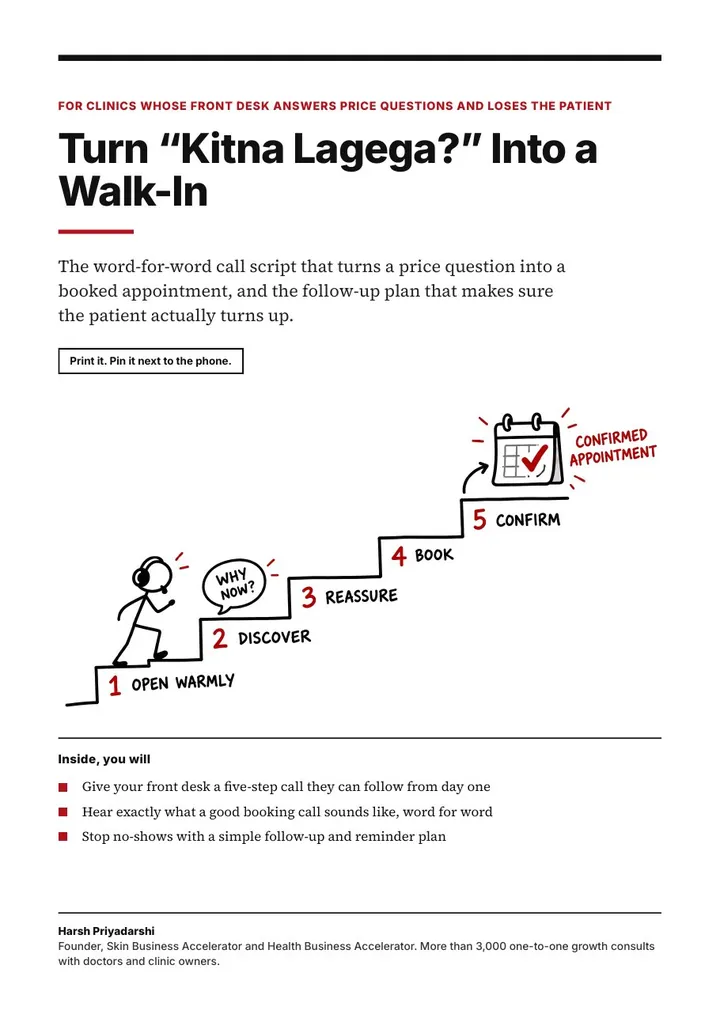
- Move straight into discovery questions, then offer two specific slots.
- Write the answer card once, get the doctor to approve it, and practise it weekly.
Official sources
Rules change. Check the current version at the source before you act.
Frequently asked questions
Can my receptionist mention the doctor's awards or famous patients on the phone?
Keep it to plain, checkable facts like degrees, years in practice and what the doctor focuses on. Famous patients are out completely, because that uses a patient's identity to win business. Awards and titles drift quickly into promotional territory, so check the current NMC guidelines before your desk mentions any of them, and let the doctor approve the exact wording.
What should the front desk say if the caller asks whether the doctor is better than another doctor nearby?
Never compare and never criticise. Say something like: "I can only tell you about our doctor. He's an ENT surgeon with 14 years of practice, and in the consult he'll explain your options in writing so you can decide calmly." Then offer two slots. Comparisons sound defensive and can quickly become a claim you cannot support.
Is it okay to tell callers the doctor has a high success rate?
No. A success rate on the phone is a result promise, it depends on each patient's case, and the NMC guidelines are cautious about such claims. Your front desk should explain how the consultation works and that the doctor will discuss realistic outcomes for this caller's own case. Leave outcome talk to the doctor, inside the room.
How long should the answer to 'is the doctor good' take on a call?
About fifteen to twenty seconds for the four facts, then move straight into a discovery question like "how long has this been bothering you?" If the answer runs longer than half a minute, the desk is selling instead of helping, and the caller usually senses it. Short, factual and then a question back works best.
On a free growth call, my team traces your last month from enquiry to treatment and shows you your biggest leak in rupees.