Beyond the medical history, add five non-clinical questions to your intake form: what the patient has already tried, what worries them most, who else will help decide, how soon they want it sorted and why, and whether they'd like to know about payment options. The doctor then walks in knowing the decision context, and the consult can end with a clear next step instead of "I'll think about it".
Most clinic intake forms were designed for the medical record. Name, age, allergies, past illnesses, current medicines. All necessary. But look at what's missing: nothing on that form tells the doctor how this person is going to make a decision.
So the doctor finds out the hard way, at the end of the consult. "I need to ask my husband." "I've already tried three diets, I don't want another one." "I can't take leave till March." Each of those could have been known before the door opened.
A few extra questions on the form change the whole consult. I've seen this across specialities, and it's one of the cheapest fixes in any clinic.
Why does the intake form decide how the consult ends?
Because a decision has more parts than a diagnosis. The doctor can get the clinical picture right and still lose the patient on something non-clinical: fear, family, timing, money, or a bad past experience.
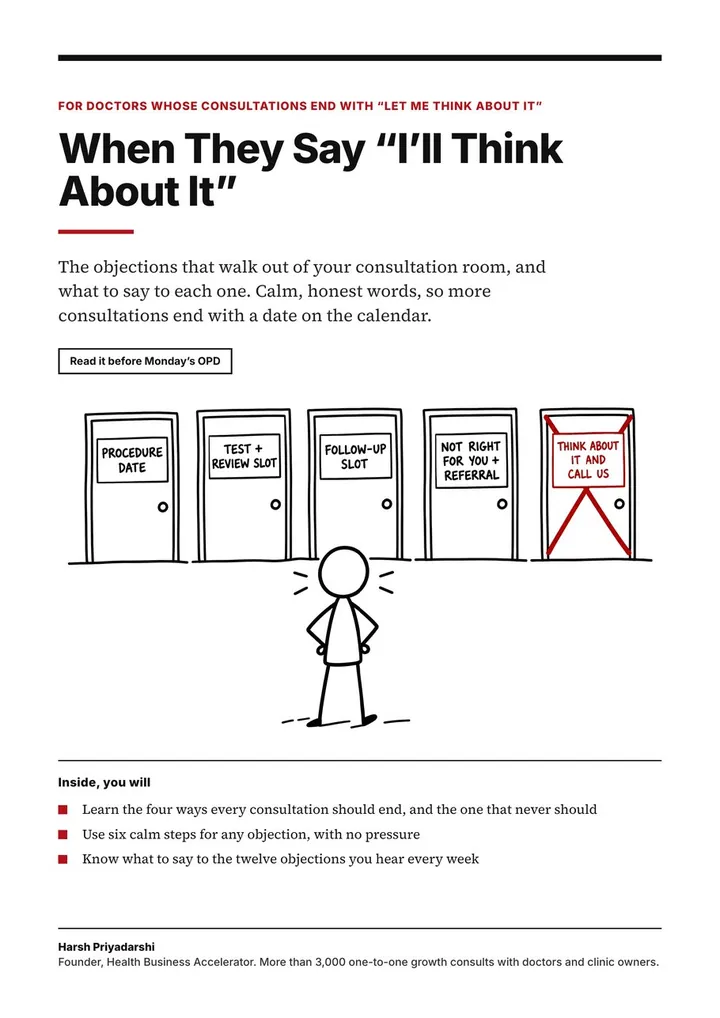
In my framework, every consultation should end with a definite next step: a procedure date, a test, a follow-up slot or an honest "this isn't right for you". The doctor can only steer towards that if she knows what's standing in the way. The form is where she finds out, quietly, before the patient has to say it out loud.
Which non-clinical questions should you add?
Five questions. Each one maps to a common reason consults end without a decision.
| Question | What it tells the doctor | The objection it prevents |
|---|---|---|
| What have you already tried for this? | Their history of disappointment | "I've tried everything, nothing works." |
| What worries you most about treatment? | Fear, cost, recovery, side effects | "I'm scared," said at the very end |
| Who else will help you decide? | The real decision-maker | "I need to discuss it with my family." |
| How soon would you like this sorted, and is there a reason? | The "why now" and the deadline | "Maybe later." |
| Would you like information about payment options? (yes / no) | Whether money will come up | "It's too expensive," said at the counter |
Take a bariatric surgery clinic as an example. A patient ticks "tried: diets, gym, medicines, two dieticians", writes "worried about: being judged, loose skin, time off work", names "husband and my mother" as deciders, and says "before my knee pain gets worse". The surgeon now knows to acknowledge everything she's tried, address loose skin and recovery time early, invite the husband to the explanation, and talk about timing in terms of her knees. That's a different, far more useful consult.
Why not just ask the patient's budget?
Some clinics put "your budget" on the form. I'd avoid it.
A budget question makes the form feel like a sales sheet. It also makes patients anchor low, often to a number they picked from a Google search, before they understand what they need. And it tempts the team to fit the plan to the budget instead of the case.
The payment options question does the useful part without the damage. A "yes" tells the coordinator to bring up milestones or EMI naturally. A "no" tells her not to. Nobody feels judged.
What does a sample form layout look like?
Keep the non-clinical part on one side of one page, after the medical history. Here's an example layout.
ABOUT YOUR VISIT TODAY (optional, but it helps the doctor)

1. What would you most like help with today?
   ______________________________________

2. What have you already tried for this?
   [ ] Medicines   [ ] Home remedies   [ ] Diet or exercise
   [ ] Another doctor or clinic   [ ] Nothing yet
   Anything else: ________________________

3. What worries you most about treatment?
   [ ] Pain   [ ] Cost   [ ] Recovery time   [ ] Side effects
   [ ] It might not work   Other: ____________

4. Who else will help you decide?
   [ ] Just me   [ ] Spouse   [ ] Parent   [ ] Son or daughter
   Will they be here today?  [ ] Yes  [ ] No

5. How soon would you like this sorted?
   [ ] As soon as possible   [ ] In 1 to 3 months   [ ] No rush
   Is there a reason or a date? __________

6. Would you like information about payment options?
   [ ] Yes   [ ] No
Tick boxes keep it fast. One free line under each question catches the details that matter. The word "optional" at the top lowers the pressure, and most patients fill it anyway.
How should the doctor use the answers?
The form is only useful if someone reads it before the patient sits down. Here's the order I suggest:
- The desk or nurse checks the form while the patient waits, and fills any obvious gaps with a quick question.
- The doctor reads the non-clinical side in 30 seconds before calling the patient in.
- The doctor uses one answer in the first two minutes. "I see you've already tried two dieticians. Let's talk about why that didn't hold." Nothing builds trust faster than the doctor already knowing the story.
- The worries get answered during the explanation, not saved for the end.
- If the decider isn't present, the doctor or coordinator offers a family call slot before the patient leaves.
The form also sets up the handover. The coordinator reads the same answers, so she doesn't make the patient repeat herself.
Does this really change results?
Here's a worked example. Say a clinic sees 80 consults a month and 32 end with "I'll think about it" or "I'll discuss at home". If the form helps the doctor handle the real concern in the room for even a quarter of those, that's 8 more definite next steps a month. If half of those become treatment at an example plan value of ₹2,50,000 for bariatric surgery, that's ₹10,00,000 a month. Smaller tickets give smaller numbers, but the mechanism is the same in any elective speciality.
There's a softer benefit too. Patients feel listened to before they've said a word. In my experience, that feeling is one of the strongest reasons people go ahead with a doctor.
A note on privacy: these forms hold sensitive information, so store them securely, limit who can see them, and check your consent and data obligations with a lawyer.
Intake forms are part of the consultation system we build under front desk and conversion, and they can live in your CRM so the coordinator sees the same answers. The full consultation structure is in Good Doctors Go Broke. Big-decision specialities like bariatric surgery benefit most.
The short version
- Add five non-clinical questions: what they've tried, what worries them, who decides, how soon and why, and payment options yes or no.
- Don't ask for a budget. It anchors patients low and makes the form feel like a sales sheet.
- Keep it to one side of a page, with tick boxes and one free line each, marked optional.
- The doctor reads it before the patient walks in and uses one answer in the first two minutes.
- If the decider isn't present, offer a family call slot before the patient leaves.
Frequently asked questions
How long should a patient intake form be for a specialist clinic?
Two sides of one page is plenty for most specialities: one side for medical history, one for the non-clinical questions. Longer forms get skipped or filled carelessly. Use tick boxes wherever possible and one free line for details. If you need detailed history for a procedure, collect it later, once the patient has decided.
Should the intake form ask how the patient heard about the clinic?
It's useful for tracking your channels, but put it at the very end, as one tick-box line, so it doesn't crowd out the questions that help the consult. Better still, the front desk records the source at booking. The form's main job is to help the doctor understand the patient and how they'll decide.
What if patients leave the non-clinical questions blank?
Some will, and that's fine. The desk or nurse can ask one or two of them gently while checking the form: "Will anyone else be part of the decision?" If the form is regularly left blank, check whether it looks too long, is printed too small, or isn't marked as optional and quick.
Can we use a digital intake form instead of paper?
Yes, and it often works better, especially if patients get it with the booking confirmation and fill it at home. A QR code at the desk also works for patients who prefer their own phone. Keep a paper version for elderly patients. Make sure the doctor sees the answers before the consult, wherever they're stored.
On a free growth call, my team traces your last month from enquiry to treatment and shows you your biggest leak in rupees.