Offer two specific slots instead of asking "When are you free?" Pick the two earliest sensible times, on different days and at different times of day, for example "Thursday at 11 or Saturday at 5". An open question invites "I'll check and tell you". A choice between two invites a decision. If neither works, ask one narrowing question, then offer two new slots.
Here's a real pattern from a dental clinic's WhatsApp. I've changed the names.
Patient: "Hi, I want to get my teeth cleaned." Clinic: "Sure! When are you free?" Patient: "This week sometime." Clinic: "Which day suits you?" Patient: "Maybe Friday?" Clinic: "Friday what time?" Patient: "Evening." Clinic: "We have 5, 5.30, 6, 6.30 and 7." Patient: "Will confirm."
Nine messages. No booking. And "will confirm" is where most of these chats go to die.
Same patient, different clinic: "Sure, Dr Anand can see you Thursday at 11 am or Friday at 6.30 pm. Which is better?" Reply: "Friday 6.30." Three messages. Booked.
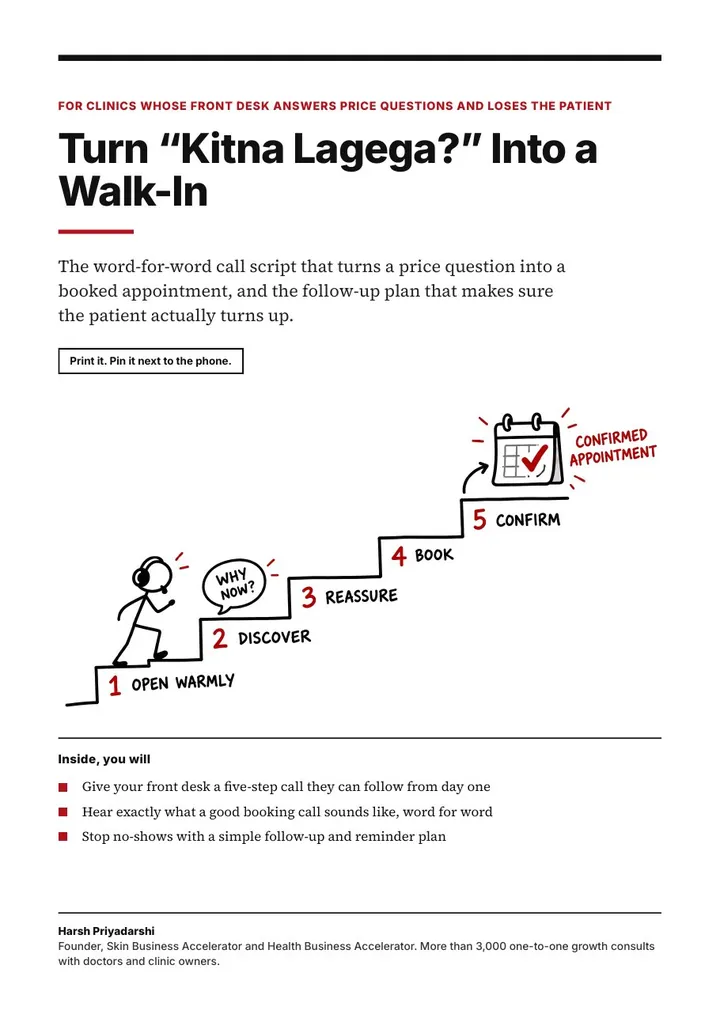
This is the smallest change in my whole front desk system and one of the most useful. It's step four of the five-step call in Good Doctors Go Broke: offer two specific slots, not an open question.
Why does "When are you free?" fail?
Because it hands the patient a job. Now they have to open their calendar, think about their week, maybe ask their spouse. That's effort. And when people face effort, they postpone it.
It also sounds like your clinic is empty. "Whenever you like" quietly says nobody else wants this doctor's time.
Two slots do the opposite. They make the decision small: this one or that one. And they say the doctor's diary has structure.
Rule: An open question invites "I'll see". Two slots invite a choice.
How do you pick which two slots to offer?
Don't just read the next two empty boxes. Pick them on purpose. My rules for the desk:
- Make both slots soon. Within the next two or three working days if you can. A slot ten days away gives the patient ten days to change their mind.
- Put them on different days. If Thursday doesn't work, Thursday at another time usually doesn't either.
- Put them at different times of day. One morning or afternoon, one evening or weekend. Office workers, students, homemakers and retired parents live in very different hours.
- Use what discovery told you. If the caller said "I work in Whitefield till 7", don't offer 11 am. Offer 7.30 pm and Saturday morning.
- Match the slot to the visit. A new patient consultation needs a full new-patient slot, not a squeezed follow-up gap.
- Say the doctor's name. "Dr Anand can see you" lands better than "We have a slot".
What should the desk say when neither slot works?
This happens a lot, and it's fine. The mistake is to fall back to "Okay, then when are you free?" Instead, ask one narrowing question, then offer two more.
Patient: "Neither, I'm travelling this week." Front desk: "No problem. Next week, would mornings or evenings suit you better?" Patient: "Evenings." Front desk: "Then Monday at 6 or Wednesday at 7. Which one?"
The narrowing question has only two answers too: weekday or weekend, morning or evening, this week or next week. You're still giving choices, just at a different level.
If the patient genuinely can't say, offer to hold one: "Shall I keep Wednesday at 7 for you, and you tell me by tomorrow evening if it changes?" Then set a reminder in the CRM to check at that time.
How does this look on WhatsApp?
On WhatsApp the two-slot offer matters even more, because every extra message is another chance for the patient to get distracted and never reply.
Here's how the two styles compare for the same enquiry:
| Step | Open question style | Two-slot style |
|---|---|---|
| Clinic's first reply | "When are you free?" | "Dr Anand can see you Thu 11 am or Fri 6.30 pm. Which suits you?" |
| Patient replies | "This week sometime" | "Fri 6.30" |
| Clinic | "Which day?" | Confirmation with date, time, map pin, fee and what to bring |
| Patient | "Maybe Friday" | "Thanks" |
| Clinic | "What time?" | Done |
| Messages to book | 8 to 10, often no booking | 3 to 4 |
A few WhatsApp details that help:
- Write the two slots on one line, with the day and date. "Thu 14 Nov, 11 am or Fri 15 Nov, 6.30 pm."
- Use WhatsApp quick replies or buttons if your system supports them, so the patient can tap a slot.
- Send the confirmation the moment they choose. Don't wait to "update the system" first.
Does this feel pushy to patients?
Only if the tone is pushy. The words aren't. Two slots is how a good restaurant, salon or airline books you. Patients are used to it.
What does feel pushy is fake scarcity. "Only one slot left this month!" when the diary is half empty. Don't do that. Offer real slots, honestly.
And if the caller isn't ready to book at all, that's a different problem. They have a question or a worry that discovery didn't uncover. Two slots won't fix that. Go back to asking what they'd like to know first.
What difference does it make in numbers?
Say your clinic gets 200 enquiries a month and books 50. That's a 25% booking rate, at the bottom of the healthy 25 to 40% range. If clearer slot offers and shorter WhatsApp chats lift that to 30%, you book 60. At a show rate of 70%, that's 7 more patients through the door every month.
If a first visit plus treatment averages ₹6,000 in a dental clinic, that's about ₹42,000 more a month from changing a sentence. An example, but the maths is the same everywhere.
How do you make the whole team do it?
Write the two-slot line into your script and your WhatsApp templates. Then in the weekly call review, check one thing on every recorded call and every chat: did the booking step use two named slots? Score it. It's easy to see and easy to fix.
This is one small part of the call structure we install in front desk and conversion systems. If your WhatsApp is drowning in back-and-forth, the slot buttons and templates sit inside CRM and WhatsApp automation. Dental clinics in particular live and die by chair time, so see our page on dental practices too.
The short version
- "When are you free?" gives the patient a job. Two slots give them a choice.
- Offer two soon slots, on different days and at different times of day, shaped by what discovery told you.
- If neither works, ask one narrowing question and offer two more. Never go back to open questions.
- On WhatsApp, two slots on one line cut a nine-message chat to three.
- Check every recorded call and chat for the two-slot offer in your weekly review.
Frequently asked questions
What if the patient asks for a time we don't have?
Say so honestly and offer the two nearest real slots around it. "5 pm is taken on Friday, but I have 4.30 or 6.30." Don't promise to squeeze them in unless the doctor has agreed to that. A squeezed slot usually means a long wait and a worse first impression.
Should we offer two slots even for follow-up appointments?
Yes. It works the same way for follow-ups, reviews and procedure dates, and it helps the patient leave with a date in their phone. For follow-ups, pick slots close to the interval the doctor asked for, and offer them before the patient leaves the clinic.
Is offering three slots better than two?
Usually not. Three is still manageable, but the more you list, the more the patient starts weighing options and postponing. Two keeps the choice simple. If the patient rejects both, the narrowing question gets you to the right part of the week faster than a longer list.
Can an AI receptionist or chatbot use the two-slot method?
It can, if it reads your live diary and offers two real slots that follow the same rules: soon, different days, different times of day. Make sure a human can step in quickly when the patient asks a question the bot shouldn't answer.
On a free growth call, my team traces your last month from enquiry to treatment and shows you your biggest leak in rupees.