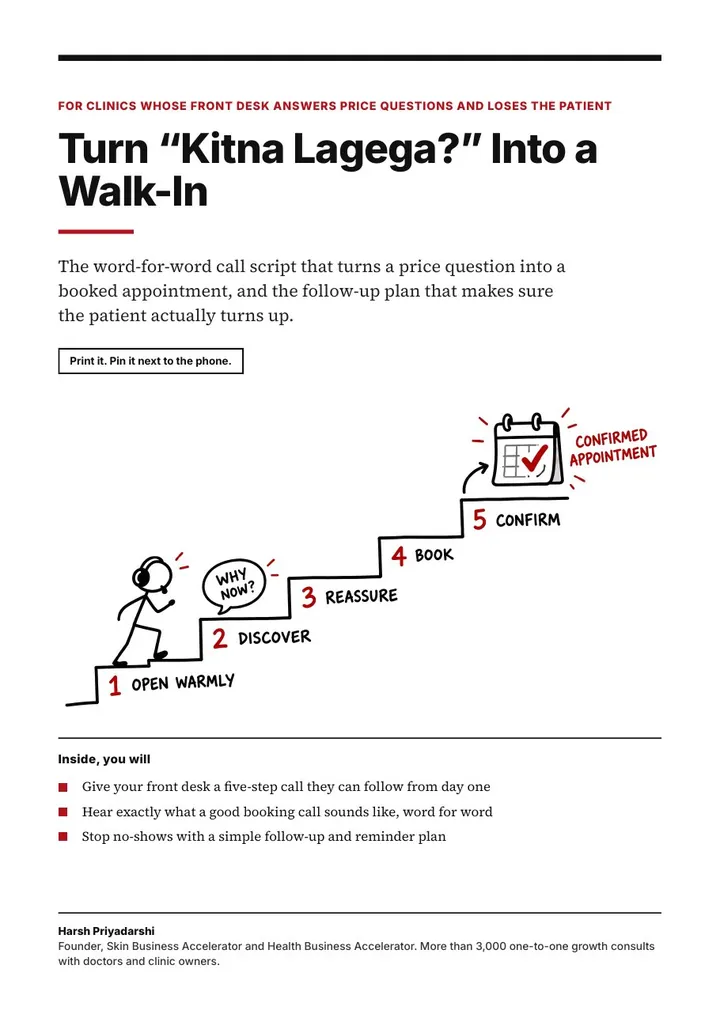
Patients put off colonoscopy for four reasons: embarrassment, fear of the bowel prep, losing a working day with an escort, and fear of what might be found. Price comes after these. Answer each one honestly: a calm private conversation, a plain one-page prep explainer from the doctor, a planned day, and a follow-up schedule so the advised test does not quietly become "next year".
A man in his fifties sits in your OPD. You explain why he needs a colonoscopy. He nods, says "haan doctor, karwa lenge", takes the slip and walks out. Six months later he is back with the same complaint, and the slip is still in his shirt pocket.
He did not disagree with you. He was scared, a bit ashamed, and nobody helped him with the part that scared him. In my experience, colonoscopy is one of the procedures where the gap between "advised" and "done" is widest, and it is almost never about the doctor's skill. This post is about closing that gap with honest words, not pressure.
Why do patients really delay a colonoscopy?
When we sit with gastro front desks and listen to calls, the same four fears come up again and again. Price is usually fifth.
- Embarrassment. The idea of someone examining "that area" is hard for many Indian patients to even say out loud, especially women and older men.
- The prep. Drinking a large volume of solution, running to the toilet all evening, and doing it at home in a joint family with one bathroom.
- The lost day. They need leave, someone to bring them, and someone to take them home after sedation.
- Fear of the result. "What if they find something?" Some patients would rather not know.
A patient who says "I'll do it after Diwali" is usually carrying one of these, not a scheduling problem. So the first job is to find out which one.
What should the team say to each fear?
Use your own words, but keep the honesty. Here is how we brief teams:
| What the patient says | What is usually behind it | What the team says |
|---|---|---|
| "Itna zaroori hai kya?" | Fear of the result | "The doctor advised it because it gives a clear answer. Not knowing does not make anything go away. Can I explain what the day looks like?" |
| "Woh peene wala bahut kharab hota hai" | Prep fear | "It is the hardest part, honestly. The doctor has written a simple sheet with timings, and our nurse will call you on prep evening to help." |
| "Chhutti nahi milegi" | The lost day | "Most patients plan it for a Saturday or the day before a holiday. Which day would be easier for you?" |
| Goes quiet, looks away | Embarrassment | "Many patients feel shy about it. Everything is private, and you will be sedated as the doctor has planned. Would you be more comfortable with a female nurse in the room?" |
| "Kitna lagega?" | Cost, sometimes a cover for fear | Give the full written price, then ask: "Apart from cost, is anything else worrying you?" |
That last question matters. "Apart from cost, is anything else worrying you?" brings out the real fear more often than any explanation does.
What should a good prep explainer contain?
The prep instructions themselves must come from the doctor, because they depend on the patient. What I want you to fix is how they are explained. Most clinics hand over a photocopy in small print with medicine names and nothing else.
A good explainer is one page, in the patient's language, and reads like a timetable:
- The day before: what to eat in the morning, when to stop, written as clock times, not "8 hours before".
- Prep evening: when to start the solution, how much at a time, and a line saying plainly that frequent toilet trips are expected and mean the prep is working.
- The morning: what is allowed, when to leave home, what to bring.
- Who to call: a WhatsApp number that a nurse answers on prep evening.
Add a 60 second video of the doctor walking through the sheet. Patients rewatch it at home with the family. It also tells the joint family why the patient is suddenly fasting and occupying the bathroom, which removes a surprising amount of friction.
Example: Say your clinic advises 40 colonoscopies a month and 18 get done. If a clearer prep explainer and one evening call get even 6 more patients through, at an example fee of ₹9,000, that is ₹54,000 a month. More important, 6 more people got the answer they needed.
How do you plan the day so it stops being a barrier?
Treat the day as part of the conversation, not an afterthought.
- Offer the slots patients can actually use. Saturdays and early mornings fill first for working patients. Hold some.
- Ask about the escort at booking, not on the morning. "Who will come with you?" If nobody can, the team helps plan around it before the date is fixed.
- Tell them how long they will be with you, door to door, so they can tell their office.
- Send the location pin, parking note and fasting reminder on WhatsApp the day before.
The coordinator owns all of this. You recommend. They plan.
What happens if the patient still says "baad mein"?
Some will still delay. Respect it, but do not let it end with a slip in the pocket. "Think about it and call us" is where most colonoscopies are lost. Put the patient on a written follow-up plan the day they leave:
- Day 2: a WhatsApp from the coordinator with the prep video and the written price. No pressure, just "here is everything in one place".
- Day 7: a call. "Did you get a chance to talk to the family? Is anything still worrying you?"
- Day 21: a short note from the doctor, in the doctor's own words, on why the test was advised for them.
- Then monthly, for three months, with one useful message each time, and an offer to talk to the doctor again on a call.
- If they say no clearly, note the reason in your CRM and stop. A clear no is a decision, and it deserves respect.
Track the reasons. If "prep fear" shows up in half your notes, the explainer still is not working. Fix the explainer, not the patient.
What must the team never say?
Fear is easy to use. Do not use it. No "you might have cancer, so do it now". No price cut "if you book this week". No promise that the procedure is painless if your sedation plan does not make it so. Scared patients remember who frightened them and who helped them.
What works is calm honesty and a team that has practised these conversations. If your front desk has never role-played the "woh peene wala" objection, that is your next team meeting. The six-step method behind these answers is in the objection chapters of Good Doctors Go Broke. If you would rather have someone listen to your desk's real calls and rework the words with your team, that is the conversion work we do with clinics. And our gastroenterology page shows where colonoscopy sits in the full GI patient journey.
The short version
- Colonoscopy delays are usually embarrassment, prep fear, the lost day or fear of the result, not price.
- Ask "apart from cost, is anything else worrying you?" to find the real reason.
- Turn the doctor's prep instructions into a one-page timetable plus a short video, and call on prep evening.
- Plan the day with the patient: slot, escort and time away, at booking.
- Put every undecided patient on a written follow-up plan, and stop when they give a clear no.
Frequently asked questions
How do I convince a patient who is scared of colonoscopy?
Do not try to convince them. Find out which fear it is first: the prep, embarrassment, the lost day or the result. Then answer that one honestly, with the doctor's written prep sheet, a private and respectful setting, and a planned date. Pressure and scare talk make patients disappear; calm specifics bring them back.
Should the front desk explain colonoscopy prep or only the doctor?
The doctor decides the prep instructions for each patient. The front desk and nurse explain the sheet, the timings and what to expect, using the doctor's words. Anything medical, like changing a medicine before the test, goes back to the doctor. That keeps advice clinical and the planning practical.
Why do patients agree to colonoscopy in the OPD and then not book?
Because agreeing in the room is easy and facing the prep at home is hard. Without a date, a named person to call and a clear timetable, the fear wins quietly. Book the date or a follow-up call before the patient leaves, and send the prep explainer the same day.
How many follow-ups are reasonable after a patient delays colonoscopy?
A simple plan works well: a message on day 2, a call on day 7, a short note from the doctor around day 21, then a monthly touch for three months. Every message should be useful, not pushy. If the patient clearly says no, record the reason and stop.
On a free growth call, my team traces your last month from enquiry to treatment and shows you your biggest leak in rupees.