GI enquiries go cold when callers feel embarrassed, when the front desk only quotes a price, and when endoscopy bookings fail on preparation, fasting or a missing escort. Fix it with a private WhatsApp option, a five-step call that lets patients describe symptoms in their own words, preparation instructions sent exactly as the doctor wrote them, two reminders, a same-day call for no-shows and a fixed follow-up cadence.
Gastroenterology has two leaks that most specialities do not. The first happens on the phone, when a caller who finally worked up the courage to ring is asked "what's the problem?" in a busy reception and quietly hangs up. The second happens on endoscopy day, when a booked patient arrives having eaten breakfast, or without anyone to take them home after sedation, and the slot is lost.
Both leaks are invisible on a revenue report. Both are fixable with a system. Here is how I would rebuild a GI front desk.
Why do GI enquiries go cold?
When we listen to recorded calls at GI clinics, these are the patterns that come up most:
- The embarrassed caller. They start with "I have a stomach problem" and go quiet when pushed for details.
- The price-only answer. "Endoscopy is ₹3,500." The call ends. Nobody asked a name.
- The direct-to-procedure caller. "I just want a colonoscopy." The desk does not know whether the doctor wants a consultation first, so it guesses.
- The working patient. They can only come early in the morning, and every slot offered is at noon.
- Preparation failures. Unclear or late instructions lead to cancelled or repeated procedures.
How should the front desk talk to a shy GI caller?
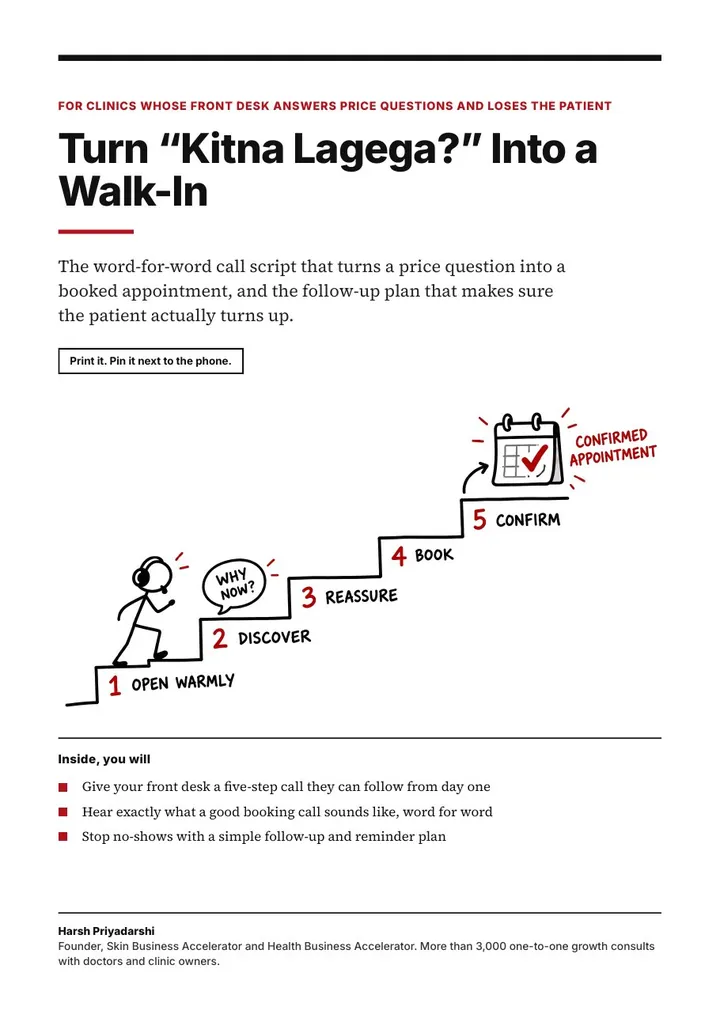
Use the same five steps every time: open warmly, discover, reassure, offer two slots, confirm. But in GI, discovery has to be gentle, and the caller must always have a private option.
Here is how it sounds. Every detail below, from the names to the fee, is just an example.
Front desk: "Good morning, this is Kavya from the clinic. How can I help you today?"
Caller: "I wanted to ask about colonoscopy. Kitna lagega?"
Front desk: "Sure, I can explain. May I have your name? And if it's easier, you can also message me the details on WhatsApp after this call."
Caller: "It's Sunil. I'd rather not go into it on the phone."
Front desk: "Of course, Sunil, completely understood. Has a doctor already advised the colonoscopy, or would you like to see our gastroenterologist first?"
Caller: "My family doctor said I should get it done."
Front desk: "Thank you. Our doctor will look at your reports and explain everything before the procedure, and the exact plan and cost will be given in writing. I'll send you the price range on WhatsApp right now. The exact figure depends on what is needed on the day. For the consultation, I have Tuesday at 8:30 in the morning or Wednesday at 6 in the evening. Which suits you?"
Notice what happened. Sunil never had to describe his symptoms out loud. He got a private channel, an honest answer about cost and two slots that fit a working day.
Also write down the doctor's rule for direct-to-procedure callers: when a consultation is needed first and when an advised procedure can be booked directly. The desk follows the rule. It never decides clinically.
What should happen between booking an endoscopy and the day itself?
In our experience, most endoscopy no-shows and cancellations come from confusion, not a change of mind. Plan the messages in advance, using only the instructions your gastroenterologist has written.
| When | What the patient receives on WhatsApp |
|---|---|
| Right after booking | Date, time, location pin, fee or estimate, what to bring, and the doctor's written preparation sheet |
| Two or three days before | A short video from the doctor on what happens on the day, and a check that bowel preparation, if needed, has been bought |
| The day before | A reminder of fasting and preparation timings exactly as written, plus a request to confirm who will accompany them home if sedation is planned |
| The morning of the procedure | A short reminder with the arrival time and location pin |
| If they do not arrive | A warm call the same day to understand why and rebook |
Give one named person ownership of the endoscopy list, so every patient on tomorrow's list has confirmed by the evening before. An unconfirmed patient gets a call, not another message.
How do you follow up GI enquiries that did not book?
Follow the same rhythm for every unanswered lead: three tries on the first day, then one each on days two, four, seven and fourteen, alternating calls with brief WhatsApp messages. For GI, make the follow-ups reassuring rather than pushy. A one-minute video from the doctor walking through the endoscopy room is a much better follow-up than "are you still interested?"
After day fourteen, the lead goes into your database. Many GI patients come back months later when the symptoms return. Being the clinic that was kind and private is how you get that second call.
Set the cadence up once in your CRM and WhatsApp automation so it never depends on anyone's memory.
Which numbers tell you the GI front desk is working?
Four weekly numbers tell the story: an answer rate of 95% or more, first contact in under five minutes, a booking rate between 25 and 40%, and a show rate between 60 and 75%. Add one GI-specific number: the share of endoscopy slots lost to preparation problems or late cancellations.
Example: Say your centre books 120 endoscopies and colonoscopies a month at an average of ₹6,000, and 18 slots are lost to poor preparation or no-shows. That is ₹1.08 lakh of slots a month, plus the doctor and nurse time already scheduled. If a clear message sequence and an evening-before confirmation cut that to 6, you recover about ₹72,000 a month without one extra enquiry.
Then listen to three recorded calls a week with your team and score each step of the call. The numbers tell you what is happening. The recordings tell you why.
The full system is in Good Doctors Go Broke, and it is the heart of our conversion systems work.
The short version
- GI callers are often embarrassed, so always offer a private WhatsApp option and discover gently.
- Write the doctor's rule for direct-to-procedure requests, and never let the desk decide clinically.
- Send preparation instructions exactly as the doctor wrote them, and confirm escorts for sedation.
- Give one person ownership of tomorrow's endoscopy list, confirmed by the evening before.
- Track answer rate, speed, booking, show rate and slots lost to preparation. More on our gastroenterology page.
Frequently asked questions
How can a GI clinic reduce endoscopy no-shows?
Send a WhatsApp confirmation right after booking with the doctor's written preparation sheet, a short video on what happens on the day, and reminders two or three days before and the day before. Confirm who will accompany the patient home if sedation is planned, and have one person check that everyone on tomorrow's list has confirmed.
What should a receptionist say when a patient asks about endoscopy cost?
Give an honest range and explain what it depends on, such as whether a biopsy or other steps are needed on the day. Ask the caller's name, whether a doctor has advised the procedure, and offer a private WhatsApp option. Then offer two specific slots for the consultation or procedure, as per the doctor's rule.
Should patients see the gastroenterologist before booking an endoscopy?
That is a clinical decision for your gastroenterologist, not the front desk. Ask the doctor to write a simple rule covering when a consultation is needed first and when a procedure advised by another doctor can be booked directly. The desk then follows that rule on every call, without improvising.
How do I handle patients who are embarrassed to discuss symptoms on the phone?
Never push for details on a call at a busy reception. Offer to continue on WhatsApp, where patients can type their concern privately, and train staff to ask gentle questions such as whether a doctor has advised anything. Book the consultation and let the gastroenterologist do the detailed history in the room.
On a free growth call, my team traces your last month from enquiry to treatment and shows you your biggest leak in rupees.