Price eye surgery as a plan, not a procedure. A cataract plan covers the pre-operative tests, surgery, the lens, post-operative medicines and every review visit, offered as three honest lens options with one clear recommendation. LASIK is priced after the suitability check, with the procedure chosen for that eye, not upsold. State fees plainly from one fee sheet, offer EMI and insurance help, and never discount.
Families compare cataract surgery the way they compare phones: by the brand of lens and the number at the bottom. Whose fault is that? Usually the clinic's. When the lens price is the first thing a family hears, on the phone, before anyone has examined the eye, the lens becomes the product. This post covers how to run an eye consultation that ends in a decision, how to build honest options and packages, and how to talk about money without ever cutting your price.
How should an eye consultation be run so families can decide?
A good consultation starts before the patient sits down. The front desk note tells you the problem, what they have tried and why they came now: stopped driving at night, cannot read the newspaper, a fall on the stairs, a trip coming up.
In the first two minutes, set the frame. Tell the patient and family that you will first understand what is happening, then examine properly, and by the end they will know what is going on, what the options are and what you recommend. Then listen. Ask what they would be able to do again if this was sorted. "Read my own medicine labels." "Recognise faces at my granddaughter's wedding." Write it down.
Narrate the examination. Put the image of their lens on the screen next to a clear one. A patient who sees their own cataract takes it seriously. Name the diagnosis in plain words, then connect it to their goal.
Very often the decision-maker is not in the room. If the son lives in another city, offer a short video call with you before they leave, so he hears the plan himself.
And end with a definite next step: a surgery date, a test with a review slot, a family session, or an honest "you don't need surgery yet, let's review in six months", with the date booked. That last one builds more trust than any closing line.
How do you build three honest cataract options?
When a family hears one price, they think "yes or no". When they see three options, they think "which one". In Good Doctors Go Broke I call them Basic, Recommended and Complete. Here is an example for cataract surgery, to adapt to your own clinical judgement:
| Basic | Recommended | Complete | |
|---|---|---|---|
| Lens | A standard lens for clear distance vision | The lens you judge best for this eye and this person's daily life | A premium lens aimed at reducing dependence on glasses at more distances, for suitable eyes |
| Reading glasses | Usually still needed | Depends on the lens chosen | Needed less often for most suitable patients |
| Review visits | Standard post-operative reviews | All reviews plus the final glasses check | All reviews, both eyes planned, extended follow-up |
| Best for | A tight budget | The best realistic result for this patient | The patient who wants the widest range of vision |
Three rules keep this honest. Offer only lenses that are clinically right for that eye. If a premium lens doesn't suit someone, it does not appear on their plan. The options must differ in outcome, not in extras nobody cares about. And present them from Complete down to Basic, then say plainly which one you would choose for them and why. Price comes last.
What should a cataract or LASIK package include?
Patients don't come for a lens. They come to see clearly again. So price the whole plan as one number: the pre-operative tests, the surgeon's fee, theatre charges, the lens, medicines for the recovery period, every review visit and the final glasses prescription. Write it on one page, with what is included and what isn't.
For insured patients, policies differ on what they cover, especially for lenses and room types. Your TPA desk should check coverage before admission and show the family, in writing, exactly what the insurer pays and what they pay. A surprise bill at discharge is what gets remembered, not the surgery.
LASIK is priced after the evaluation, never before. The procedure is the one the surgeon judges right for that cornea, not the most expensive one on the menu. Your options can then differ in what the plan covers: the number of reviews, dry eye care during recovery, and what happens if a touch-up is needed later under your clinic's policy.
How do you talk about price without discounting?
Put every plan on one written fee sheet. The surgeon, the front desk and the counsellor all quote from it. When it is time, the counsellor says the number clearly, then stops talking.
Discounts hurt more than they look. Say your Recommended cataract plan is ₹60,000 and the direct cost of the lens, consumables, theatre and surgeon's share is ₹30,000, leaving ₹30,000. Give 15% off and the price drops to ₹51,000 while the cost stays ₹30,000, leaving ₹21,000. To earn the same profit you would need about 43% more surgeries. That is an example, but the maths works the same in every clinic.
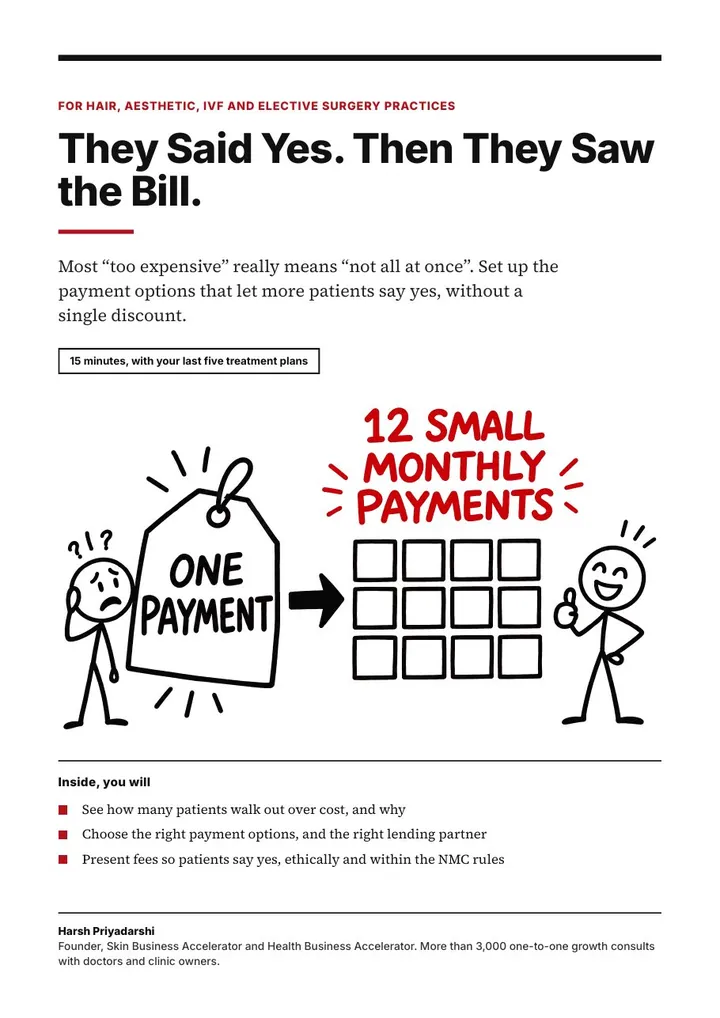
When a family asks for a discount, change the scope or the payment, never the price. "Our fees are the same for every patient. If budget is a concern, we can look at another lens option or spread the payment." For LASIK, which younger patients often pay themselves, EMI makes the decision easier: an example plan of ₹72,000 over 12 months is ₹6,000 a month. For cataract, milestone payments across the first and second eye work well. Remember that no-cost EMI is never free. Usually the clinic pays the lender's fee, so build it into your margin.
If they say another clinic is cheaper, help them compare properly: who operates, which exact lens, what the package includes, how many reviews, and what happens if there is a problem afterwards. Our conversion systems team builds these plans and scripts with eye care practices.
How do you know if your eye pricing is right?
Track which option patients choose. When Basic wins most of the time, the Recommended plan is either priced too high or not explained well enough. If many pick Complete, it is time to raise prices or add a higher tier. Track consult conversion as the share of advised surgeries that actually go ahead, and margin per plan, not just revenue.
Raise prices once a year on a fixed date, for new patients first, and honour every written quote. Pair the rise with something new, like a longer follow-up or a better aftercare kit. The full pricing method is in Good Doctors Go Broke. If you want us to look at your fee sheet, book a growth call.
The short version
- Never let the lens price be the first thing a family hears. Diagnosis, outcome and plan come first.
- Build three honest lens options that differ in outcome, and always recommend one.
- Price the whole plan, including tests, medicines and reviews, and explain insurance cover in writing before admission.
- Change the scope or payment, never the price. Offer EMI for LASIK and milestones for both eyes.
- Track the option split, margin per plan and how many advised surgeries go ahead.
Frequently asked questions
How should I price premium lenses for cataract surgery?
Price the whole plan, not the lens alone. Include the tests, surgery, lens, medicines and review visits, and present it as one of three honest options alongside the standard and recommended plans. Offer a premium lens only when it is clinically suitable for that eye, and track how many patients choose each option.
Is it okay to give a discount on cataract surgery for elderly patients?
Discounts tell families your price was never real and quietly eat your margin. If budget is the concern, change the scope by moving to the Basic option, or change how they pay with milestones or EMI. Keep one fee sheet that every person in the clinic quotes from, so everyone is treated the same.
How do I explain what insurance covers for cataract surgery?
Let your TPA desk check the policy before admission and give the family a written breakdown of what the insurer pays and what they pay, including any lens or room difference. Policies vary, so never guess on the phone. Clear coverage explained early prevents the surprise bills that lead to angry reviews.
Should I offer EMI for LASIK surgery?
Yes. Many LASIK patients are young professionals who can manage a monthly figure more easily than one large payment. Work with two or three healthcare lending partners, print the monthly amount next to the total on every written plan, and remember that a no-cost EMI usually means the clinic pays the lender's fee.
On a free growth call, my team traces your last month from enquiry to treatment and shows you your biggest leak in rupees.