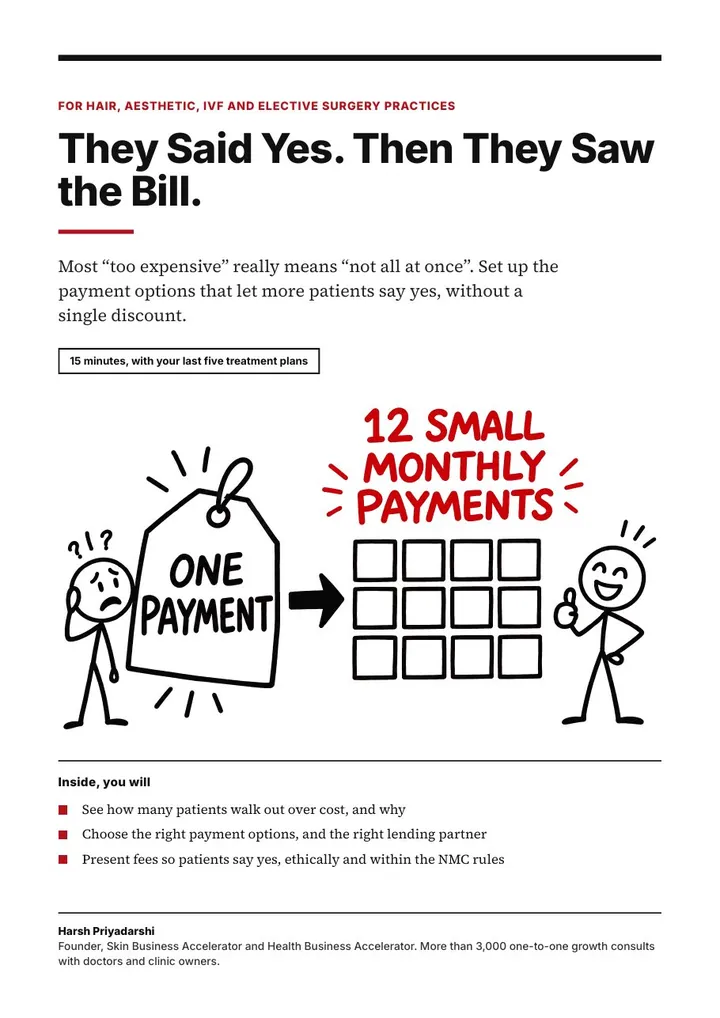
To handle a price objection without discounting, first ask: "Is it the total amount, or paying it all at once?" If it is paying at once, show the payment options and the monthly figure. If it is the value, go back to the outcome the patient described in their own words. If it is truly beyond their budget, change the scope to a smaller plan. Never change the price.
"Doctor, thoda zyada hai." (Doctor, it's a bit much.)
The moment a patient says this, most doctors and coordinators feel the same pull. Knock off ten percent. Waive the consultation fee. Throw in a free session. Anything to save the yes.
I understand the feeling. But a discount is the most expensive answer to a price objection, and usually the wrong one. Because most of the time, the patient isn't saying what you think they are saying.
What does "it's too expensive" usually mean?
In my experience, it means one of two very different things.
Either the patient doesn't yet see the value. They don't fully understand what the plan will do for their life, so the number feels too big for what they are getting.
Or the patient sees the value perfectly well, but can't pay it all at once. That is not a price problem. It is a payment problem.
These two need completely different answers. Cut the price for the second patient and you lose margin on someone who would have said yes to an EMI. Cut it for the first and you confirm their suspicion that the plan wasn't worth the original figure.
What is the one question that splits every price objection?
Before answering anything, ask this, warmly and with genuine curiosity:
"Is it the total amount, or is it paying it all at once?"
Then listen. The answer tells you which conversation you are in. And very often, the honest answer is "paying it all at once."
What should you say for each answer?
Here is the playbook we give treatment coordinators.
| What the patient says | What it usually means | What to do |
|---|---|---|
| "It's paying it all at once." | They want it, the timing is hard | Show milestone payments and EMI, with the monthly figure next to the total |
| "It's the total." | They don't see enough value yet | Go back to their outcome, in their own words, and what it means to their life |
| "It's genuinely beyond my budget." | The scope is too big for them | Move to the Basic plan. Change the scope, never the price |
| "Can you give me a discount?" | Testing whether the price is real | "Our fees are the same for every patient. If budget is a concern, let's look at another plan or spread the payment." |
| "Another clinic is cheaper." | They are comparing numbers, not outcomes | Help them compare on who performs it, what's included, the follow-up care and the results |
| "I'll wait for an offer." | They have learned to bargain | Explain that fees are the same all year, and go back to their own "why now" |
For the value conversation, use what the patient told you earlier. "You said you want to stop wearing a cap at your brother's wedding. This plan is built to get you there before March." The number is the same. The meaning is different.
For the payment conversation, the monthly figure does the work. As an example, a ₹1,80,000 plan spread over 12 months is ₹15,000 a month. Same plan, same price, but a very different feeling for the patient. Print both numbers side by side in the written plan.
For the comparison conversation, never criticise the other clinic. Patients who compare properly, on outcomes, rarely choose on price alone. And the ones who still leave for price leave without bad feeling.
Why does a discount make the problem worse?
Do the maths once and you will never discount casually again.
Here is an example. Say your plan is ₹2,00,000 and the direct cost of delivering it is ₹80,000. Your profit per patient is ₹1,20,000. Now give a 15% discount. The price drops to ₹1,70,000, but the cost is still ₹80,000. Profit falls to ₹90,000.
To make the same total profit as before, you now need ₹1,20,000 ÷ ₹90,000, which is about 1.33 times as many patients. A 15% discount needs a third more patients just to stand still.
And the damage isn't only financial:
- It tells patients the price was never real.
- It teaches the next patient to bargain, and makes the last one who paid full fee feel cheated.
- In our experience, the patient who came for the discount follows the plan less and refers less.
Who should handle the money conversation?
Ideally, not the doctor.
The doctor diagnoses, explains the plan and recommends one option. Then the treatment coordinator, or a well-trained front desk if you don't have a coordinator yet, takes the patient through the fee and the payment options in a quiet space.
Why split it? Because patients trust a doctor who sticks to medicine, and feel more comfortable asking a coordinator about money. And because a coordinator who has been trained to negotiate the plan, not the price, won't panic and reach for a discount.
Give every person in the clinic the same written fee sheet and the same discount line, word for word. A patient who hears three different numbers from three different people stops trusting all of them.
What if the patient still walks away?
Let them go, gracefully.
Not every patient is your patient. The one you discount today will ask for a discount on everything tomorrow. Book a follow-up if they are open to it, send the written plan home, and keep them in your follow-up cadence.
But hold the price. A clinic that holds its price attracts patients who value the outcome, and those are the patients who complete their plans and send their friends.
This is part of what we train teams on in our front desk and conversion systems work. One cosmetic surgery practice in my book kept losing patients to a cheaper clinic nearby, and the team's instinct was to criticise the competitor. We stopped that completely and gave the team a simple way to help patients compare on the surgeon, what was included, the aftercare and the results. Patients who compared properly started choosing the practice. If you run a plastic surgery practice, that comparison conversation is worth practising every week. The full objection playbook is in Chapter 8 of Good Doctors Go Broke. If price objections are costing you patients, book a free growth call.
The short version
- "Too expensive" usually means "I don't see the value yet" or "I can't pay it all today."
- Ask: "Is it the total amount, or paying it all at once?"
- Fix timing with payment options, value with the patient's own outcome, and budget with a smaller scope.
- A 15% discount on a ₹2,00,000 plan with ₹80,000 cost needs a third more patients to stand still.
- Change the scope or the payment plan. The price stays the price.
Frequently asked questions
What should a doctor say when a patient asks for a discount?
Be warm and clear: "Our fees are the same for every patient, so everyone is treated fairly. If budget is a concern, let's look at another plan or spread the payment so it's easier." Then hand over to your coordinator to show the options. Changing scope or payment keeps the price honest.
How do I respond when a patient says another clinic is cheaper?
Never criticise the other clinic. Say it is worth checking, and help the patient compare properly: who actually performs the procedure, what is included, what the follow-up care looks like and what results they can show. Then show your method, your support and proof from patients similar to them.
Is it ever okay to give a discount to close a patient?
In my framework, no. A discount tells patients your price was never real, trains people to bargain and needs many more patients to make the same profit. If money is the barrier, offer a smaller plan, milestone payments or EMI. You protect your margin and the patient still gets a real result.
Why do patients agree in the consultation and then say it's too expensive?
Often because the fee came without the payment options next to it, so they only saw the total. Put the monthly figure and payment choices on the same page as the fee in the written plan. The other common cause is that the outcome was never connected back to what they said they wanted.
On a free growth call, my team traces your last month from enquiry to treatment and shows you your biggest leak in rupees.