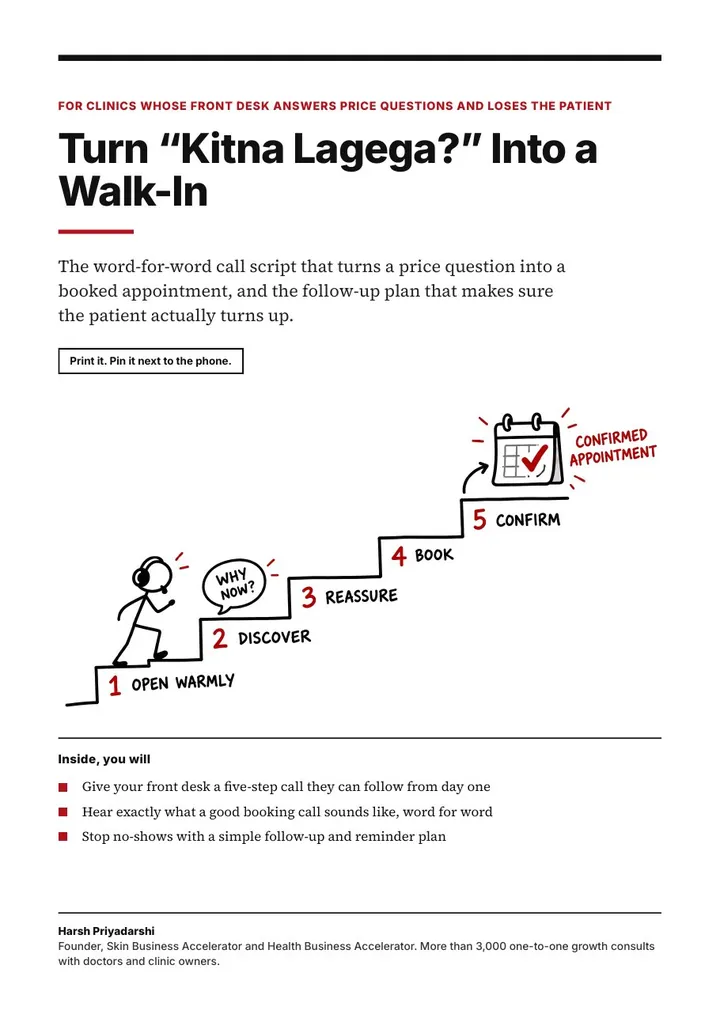
A Varanasi clinic front desk should answer at least 95% of calls, reply to every enquiry within five minutes, and speak Hindi, with Bhojpuri for callers who prefer it. The caller is often a relative in another city, so the script must find out who the patient is, who will travel with them and who decides, then offer two slots and confirm the journey on WhatsApp.
"Main Mumbai se bol raha hoon. Papa Ballia mein hain, unko peshab ki dikkat hai. Doctor sahab kab milenge, aur kitna lagega?" I am calling from Mumbai. My father is in Ballia and has a urine problem. When can he see the doctor, and how much will it cost?
That is one of the most common calls a Varanasi specialist's front desk gets. The caller is not the patient. The patient may not even know the call is happening. And the front desk that handles it like an ordinary booking usually loses it.
Why are Varanasi enquiries different?
Three reasons. The caller is often a relative, sometimes in another city. The patient is often travelling in from a town in Purvanchal or Bihar, with someone to accompany them. And the patient may be more comfortable in Bhojpuri than in Hindi, let alone English.
So your front desk needs to do everything a good front desk does anywhere, plus handle the family and the journey.
What should the script sound like when a relative calls?
The five steps still apply: open warmly, discover, reassure, book with two slots, confirm. Here is an example. The names, slots and fee are illustrations.
Front desk: "Namaste, clinic se Pooja bol rahi hoon. Bataiye, kaise madad karoon?" Hello, this is Pooja from the clinic. How can I help?
Caller: "Papa ko peshab ki dikkat hai, Ballia mein rehte hain. Kitna lagega?" My father has a urine problem, he lives in Ballia. How much will it cost?
Front desk: "Zaroor bataungi. Aapka naam? Aur papa ji ki umar kitni hai, aur dikkat kab se hai?" Of course. May I have your name? And how old is your father, and how long has this been going on?
Caller: "Sunil. Papa 64 ke hain. Ek saal se raat mein baar baar uthna padta hai." Sunil. He is 64. For a year he has been getting up again and again at night.
Front desk: "Samajh gayi. Abhi kya hua ki aapne aaj call kiya?" I understand. What made you call today?
Caller: "Pichhle hafte bahut takleef hui, aur main agle mahine ghar aa raha hoon." It got very bad last week, and I am coming home next month.
Front desk: "Achha kiya aapne. Doctor sahab roz aise patients dekhte hain. Kharcha jaanch ke baad hi sahi bata payenge, isliye doctor likhit plan denge. Papa ji ke saath kaun aayega? Aur kya aap video call par consultation mein judna chahenge?" Good that you called. The doctor sees patients like this every day. The cost can only be told properly after the examination, so the doctor will give a written plan. Who will come with your father? And would you like to join the consultation by video call?
Caller: "Mere chacha aayenge. Haan, main video par judunga." My uncle will come. Yes, I will join by video.
Front desk: "Badhiya. Agle mahine aap ghar honge, to Somvaar 11 baje ya Budhvaar 4 baje, kaun sa theek rahega?" Great. Since you will be home next month, Monday at 11 or Wednesday at 4, which suits you?
Caller: "Somvaar." Monday.
Front desk: "Somvaar 11 baje book kar diya. Consultation fees ₹800 hai. Main aapko aur chacha ji ko WhatsApp par location, landmark aur purani reports bhejne ka tarika bhej rahi hoon." Booked for Monday at 11. The consultation fee is ₹800. I am sending you and your uncle the location, a landmark and how to send old reports on WhatsApp.
Sunil got a plan, not just a price. The clinic got the patient, the person travelling with him and the person who decides.
What should a Varanasi front desk capture on every call?
Use this list. Every item goes into the CRM.
- Patient's name, age and home town.
- Caller's name and relationship, if the caller is not the patient.
- The problem, how long, what has been tried, and why now.
- Who will travel with the patient.
- Who decides, and whether they will join the consultation.
- Preferred language: Hindi, Bhojpuri or English.
- How they found the clinic.
How fast should a Varanasi clinic respond?
Within five minutes in working hours, ideally within thirty seconds. Every new lead triggers an instant WhatsApp reply and an alert to the front desk. If there is no answer: three attempts on day one, then day two, four, seven and fourteen. Missed calls are returned within five minutes.
Remember that relatives in other cities often call in their own lunch break or late evening. Cover those hours, or at least send an instant WhatsApp reply saying exactly when someone will call. An AI assistant on WhatsApp can help after hours, replying in Hindi within seconds, asking a few simple questions and offering real slots. Keep it honest about being the clinic's assistant, keep it away from medical advice, and hand anything complex or anxious to a human first thing in the morning. Our CRM, WhatsApp and AI work sets up the alerts and replies so nothing waits.
How should Varanasi clinics confirm appointments?
Confirm with everyone involved. Send the patient's companion the location pin, a landmark everyone knows, the best way to approach given traffic in the older parts of the city, where the auto can drop them, and what reports to bring. Send the relative in the other city the video link and the time. Remind both the day before and a couple of hours before. If the patient does not arrive, call the same day, kindly.
How do you train for this?
Role-play the relative call every week, alongside the normal patient call. Record calls with the caller's knowledge, score three a week out of five, and track answer rate, speed, booking rate and show rate. Our conversion systems work trains teams on exactly these scripts. For the wider plan in the city, see our Varanasi page.
The short version
- Expect relatives calling for parents, often from other cities, and script for it.
- Discover the patient, the companion and the decision-maker, not just the problem.
- Reply in five minutes, cover lunch and evenings, and speak Bhojpuri when it helps.
- Confirm the journey with the companion and the video link with the relative.
Frequently asked questions
How should my Varanasi front desk handle a caller booking for a parent?
Treat it as normal and plan for it. Take the caller's name and relationship, the patient's details, the problem and why now, who will travel with the patient and who decides. Offer the relative a video link to join the consultation, then confirm with both on WhatsApp.
Should my Varanasi clinic's receptionist speak Bhojpuri?
It helps if many patients come from villages in Purvanchal or from Bihar. Hindi is the baseline, but a front desk that can switch to Bhojpuri when the caller does makes people relax and explain more. Note the preferred language in the CRM for every patient.
What should my Varanasi front desk say when asked "kitna lagega" on the phone?
Give an honest range, explain what it depends on, and invite them to the consultation for an exact written plan. Never refuse and never just say a number. Then offer two specific slots. A price without a diagnosis is just a number for the family to compare.
How can my Varanasi clinic reduce no-shows from patients travelling in?
Confirm with the person travelling with the patient, not just the caller. Send a map pin, a known landmark, advice on approaching through traffic and what to bring. Remind them the day before and on the day, and call any no-show the same day to reschedule.
On a free growth call, my team traces your last month from enquiry to treatment and shows you your biggest leak in rupees.