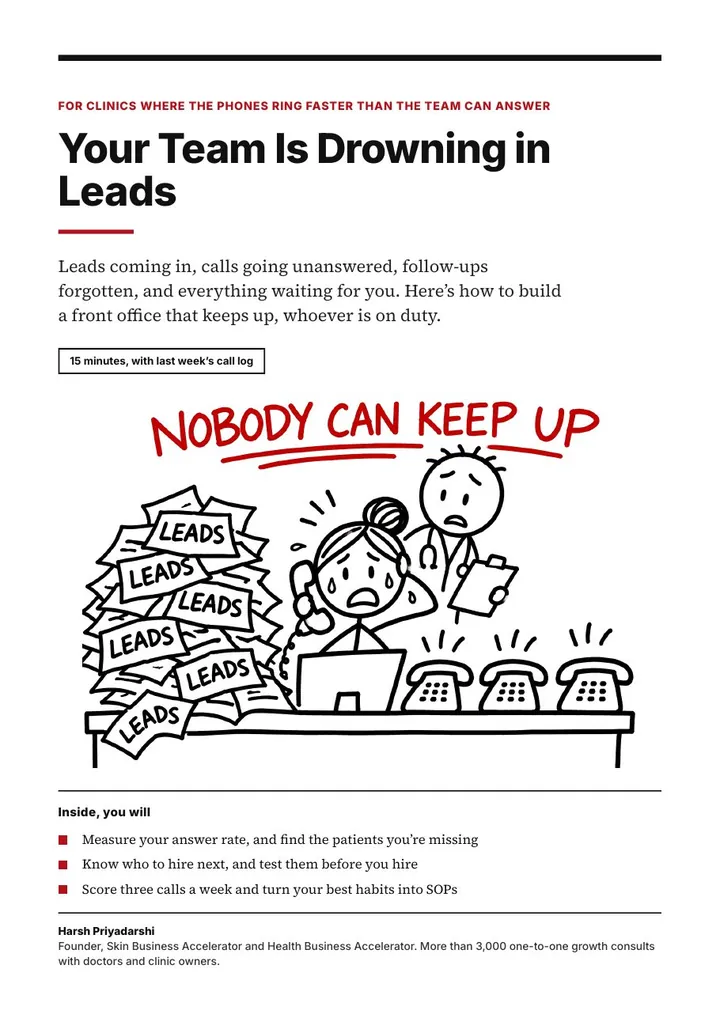
To measure speed to lead automatically, your CRM records two timestamps for every enquiry: when it arrived and when a human first called or messaged. The gap is your speed to first contact. Track it by source, by hour and by team member on your dashboard. The healthy benchmark is under five minutes, ideally thirty seconds. Above thirty minutes, stop adding ad spend.
Every clinic owner I meet believes their team calls new leads "quickly". Then we pull the timestamps.
The morning leads get called in eight minutes. The lunch leads in forty. The Saturday evening form fill gets called on Monday. The average looks fine. The patients who matter most, the ones who enquired when nobody was watching, are quietly going to someone else.
You cannot fix what you are guessing at. So measure it, automatically, for every single lead.
What is speed to lead, exactly?
It is the time between an enquiry arriving and a human from your clinic reaching out. A call, a WhatsApp, a voice note. It is also called speed to first contact or turnaround time.
Here are the benchmarks I use:
- Ideal: within thirty seconds.
- Healthy: under five minutes, at least during working hours.
- Danger: above thirty minutes. At that point you are burning the enquiries you paid for, and more ad spend just means more leads going cold.
Why is it the biggest metric of the lot? Because nobody enquiring with you is enquiring only with you. Whoever reaches out first, and sounds like they care, usually wins.
What does the system need to record?
Two timestamps per lead, captured without anyone typing them.
- Lead created: the moment a form is submitted, a WhatsApp message arrives, an ad lead comes in or a new number calls. Your CRM should create the record automatically, tagged with its source.
- First human contact: the moment a team member calls the patient, sends a personal WhatsApp or answers their call. Your phone system and WhatsApp inbox should log this to the same record.
Speed to lead is simply the second minus the first.
Two rules make this honest:
- The instant automated reply does not count as first human contact. It is great, and you should have one, but measure the human separately.
- Answered inbound calls count as zero. If a patient calls and a person picks up, speed to lead is immediate. A missed call starts the clock until someone calls back.
Connecting the phone, WhatsApp and forms so these timestamps land in one place is the heart of our CRM, WhatsApp and AI setup.
How should you read the numbers?
One average hides everything. Break it down.
| View | What it shows | What to do |
|---|---|---|
| By source | Whether ad leads, Google profile calls and Instagram DMs get the same speed | Fix the slowest source first |
| By hour of day | Whether lunch and evening leads wait longer | Cover those hours or add an AI reply and voice callback |
| By day of week | Whether weekend leads wait until Monday | Set weekend cover or a clear callback promise |
| By team member | Who is fast and who is overloaded | Coach, or rebalance work |
| Share over 30 minutes | How many leads are being burned | This is your urgent number |
Use the median as well as the average. One lead called after three days can make the average look terrible, while the median shows what a typical patient experiences. Then look at the share over thirty minutes, because that is where the money is leaking.
What does it look like in rupees?
Example: say your clinic gets 150 enquiries a week from ads, at about ₹400 per enquiry. That is ₹60,000 a week. Your dashboard shows that 45 of those leads, 30%, waited more than thirty minutes for a first call. That is ₹18,000 a week of enquiries you paid for and then let cool down, more than ₹9 lakh over a year.
Getting those 45 leads called within five minutes does not need a single extra rupee of ads. It needs cover at lunch, an alert, and perhaps an AI reply and voice callback for the hours when nobody is free.
How do you set up alerts so the number improves?
Measuring is step one. Acting in real time is step two.
- New lead alert: every new lead pings the front desk on phone and desktop the moment it lands.
- Missed call alert: every missed call triggers an alert to call back within five minutes.
- Five-minute escalation: if a lead has no human contact after five minutes, it alerts a second person.
- Thirty-minute red flag: anything over thirty minutes shows in red on the front desk screen and in the daily huddle, so the team sees yesterday's slow leads every morning and calls them first.
- Follow-up cadence: if the patient does not pick up, the system schedules attempts: three on day one, then day two, day four, day seven and day fourteen, mixing calls with short useful messages. Only then is a lead marked cold.
Put speed to lead on the Monday dashboard next to booking rate. The two move together: when speed slips, booking rate usually follows a week or two later. Seeing them side by side is the fastest way to convince a team that the five-minute rule is not a slogan.
What if speed to lead is slow no matter what you do?
Then it is not a tool problem. It is a team problem.
In many clinics, one person is running sessions, sitting at reception, handling walk-ins, billing and the pharmacy, and is also expected to call every new lead. They cannot. Nobody could.
The fix is a dedicated line, or a dedicated person, for new enquiries, separate from walk-ins and billing. The clinic thinks it is saving a salary. In reality, it is losing far more through the leads it never converts. Our front desk and conversion work starts with exactly this staffing check, and the full reasoning is in Good Doctors Go Broke.
The short version
- Speed to lead is the gap between an enquiry arriving and the first human contact.
- Capture both timestamps automatically, and do not count the instant automated reply as human contact.
- Break the number down by source, hour, day and team member, and watch the share over thirty minutes.
- Use alerts and escalations so slow leads get caught in real time.
- If it stays slow, the fix is staffing and a dedicated enquiry line, not more software.
Frequently asked questions
What is a good speed to lead for a clinic?
Ideally, a new enquiry gets its first human contact within thirty seconds. Under five minutes is the healthy benchmark during working hours. Above thirty minutes, you are wasting the money you spent getting that lead, and you should fix your response before spending more on ads, because more enquiries will simply go cold.
Does an automatic WhatsApp reply count as first contact?
Measure it separately. An instant automated reply is valuable because the patient knows you received their message, but it is not the same as a person reaching out. Track speed to first human contact as its own number, from when the lead arrived to when a team member called or personally messaged the patient.
How do I track response time for clinic leads without a CRM?
You can start by noting the time each enquiry arrived and the time someone first called, in a shared sheet, and reviewing it weekly. It is slow and easy to skip, so treat it as a temporary step. A CRM connected to your phone, WhatsApp and forms records both timestamps automatically for every lead.
Why are evening clinic leads called so late?
Usually because nobody is assigned to them. Evenings and lunch breaks are often when working patients finally have a moment to enquire, and exactly when the front desk is busy or gone. Cover those hours with staff, or set up an instant WhatsApp reply, a voice callback and a clear promise of when someone will call.
On a free growth call, my team traces your last month from enquiry to treatment and shows you your biggest leak in rupees.