An IVF centre grows past the lead doctor by building the roles around the cycle: a fertility counsellor, a coordinator for every couple, a strong embryology team, a practice manager and then associate fertility specialists whose trust is transferred deliberately. Track consult-to-cycle conversion, cost per started cycle and margin per cycle, and grow through satellite consultation clinics, teleconsultations and allied care.
In many IVF centres, everything runs through one person. The lead doctor does the consultations, the retrievals, the transfers, the difficult conversations after a negative result, and still answers WhatsApp messages from anxious couples at eleven at night. The centre is excellent. And it cannot grow, because there is only one of her.
Here is how we help fertility practices grow past that point, without losing the personal care couples chose them for.
Why do IVF centres stall at the lead doctor?
Because couples bond with one doctor, and the doctor feels responsible for every couple. That is a strength at the start. At some point it becomes the ceiling.
Rich Doctors Walk Away gives a simple test for this. You are ready to move from practice owner to business owner when 40% or more of your revenue comes from other doctors or from services you don't personally deliver. Say your centre brings in ₹40 lakh a month. That means at least ₹16 lakh needs to come from associates' cycles, counselling, diagnostics and other services. Most single-doctor IVF centres are far below that.
Which roles does an IVF centre need?
Build the team around the cycle, not just the consultation.
| Role | What they own | What to look for |
|---|---|---|
| Enquiry handler | Private, fast first contact, bookings and show rate | Warmth, discretion and patience |
| Fertility counsellor | Emotional support, the result conversation, difficult decisions | Calm, empathy, clear boundaries |
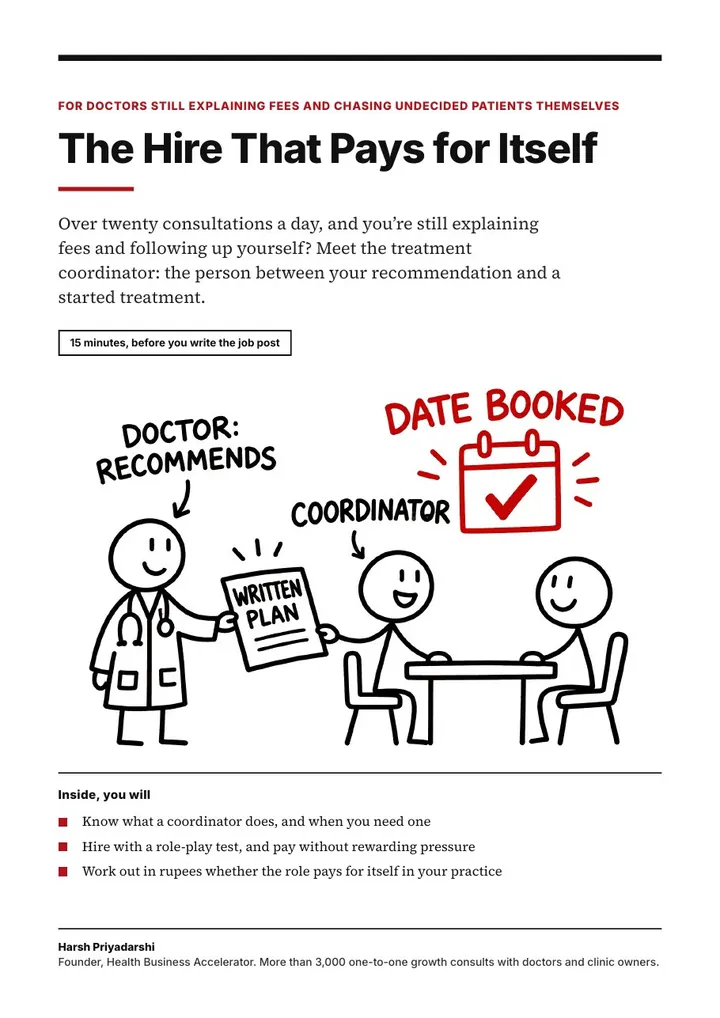
| Couple coordinator | The plan, payments, the cycle calendar, follow-up | Organised, calm about money, follow-up discipline |
| Embryology lab lead | Lab quality, protocols and records | Clinical skill and meticulous habits |
| Practice manager | The day running on time, SOPs, inventory, weekly numbers | Organised, firm but fair, comfortable with numbers |
The counsellor role is the one most centres underbuild. Couples need someone who is not the doctor to talk to, especially after a negative result. When the counsellor owns those conversations, the doctor's time goes back to clinical work, and couples feel more supported, not less.
Once you are doing more than twenty consultations a day, you need dedicated coordinators. Pay them a fair salary plus an incentive on cycles actually started, with guardrails: never reward pressure, track complaints and refund requests, and review a sample of their conversations every week.
How do you bring in an associate fertility specialist?
Couples fear "being handed over". So transfer your trust deliberately.
- Joint consultations first, introducing the associate as part of your team, trained in your method.
- Then the associate consults while you review the plan, and you say so: "Dr Kapoor works exactly the way I do, and I review every plan."
- Then they take over scans, follow-ups and reviews, before taking on new couples independently.
Build their authority publicly: their own Google profile, their own videos answering questions, talks to local gynaecologists. Pay fixed plus a fair incentive, with clinical quality checks beside it. Protect the centre with a written agreement drafted by a lawyer, covering confidentiality, ownership of records and data, your brand and method, notice period and non-solicitation of patients and staff.
Which numbers should an IVF centre watch?
Beyond the eight weekly numbers, watch these every month:
- Consult-to-cycle conversion: how many couples who consulted started a cycle within 90 days.
- Cost per started cycle, by channel.
- Gross margin per cycle, separating medicines and consumables from the centre's own work, so popular plans don't quietly lose money.
- Lab and procedure room use: revenue per available hour, before you invest in more capacity.
- Staff cost ratio, with anything above 30% treated as a warning sign.
- Owner dependence: the share of revenue that still needs you personally.
Run them in a fixed rhythm: a ten-minute daily huddle on the day's scans, procedures and anxious couples; a thirty-minute review every Monday; books closed by the seventh; and a quarterly review of channels, team and the couple experience.
Which new services and locations fit an IVF centre?
Every stream must improve care and fit your niche. In fertility, the best options include:
- Satellite consultation clinics. A fixed day each month at a hospital or clinic in a smaller town, with consultations and early scans done locally and retrievals and transfers at your main lab. Couples who had been putting off the journey begin earlier. Put the days, fees, patient pathway and exit terms in writing.
- Teleconsultations for reviews, report discussions and outstation couples between visits. When an examination is needed, they come in.
- Male fertility services, in partnership with urology colleagues, so both partners are cared for in one place.
- Nutrition and counselling. Fertility patients often need nutrition guidance and emotional support, and offering both in-house makes the care more complete.
- Fertility preservation, such as egg freezing, with storage and annual reviews built in.
- Diagnostics, starting with a partner lab collection point inside the centre.
- International and outstation patients, usually through an established facilitator first, with clear plans for follow-up after the couple flies home.
- Teaching other doctors, from evening sessions for local gynaecologists to structured workshops.
Partner first, build later. Pilot one stream for ninety days with one owner and simple SOPs, then scale, adjust or stop it. Never take a commission just for sending a couple somewhere. And check every registration and regulation that applies to assisted reproduction with your lawyer before expanding.
Say a satellite clinic costs ₹40,000 a month to run and brings in 12 consultations, of which 3 couples start a cycle at your main centre worth ₹1,80,000 each. That is ₹5,40,000 of treatment from ₹40,000 of cost, before you count the couples who start later. Our growth consulting work helps you map this, and Rich Doctors Walk Away covers the full path from practitioner to owner. See also our IVF and fertility page.
The short version
- Aim for 40% of revenue from work the lead doctor doesn't personally deliver before the next stage.
- Build around the cycle: counsellor, couple coordinators, embryology lead and practice manager.
- Transfer trust to associates in steps, with fair pay, quality checks and a written agreement.
- Watch consult-to-cycle conversion, cost per started cycle and margin per cycle every month.
- Grow through satellite clinics, teleconsultations and allied care, one pilot at a time.
Frequently asked questions
Does an IVF centre need a dedicated counsellor?
In our experience, yes. Couples need someone other than the doctor to talk to before decisions and after results, especially a negative one. A counsellor improves the couple's experience, protects the doctor's time for clinical work and helps couples who pause come back when they are ready.
How do IVF centres open satellite clinics in smaller towns?
Start with a fixed monthly day at an established hospital or clinic that lacks a fertility specialist. Do consultations and early scans locally, and procedures at your main lab. Agree days, fees, the patient pathway and exit terms in writing, never miss a scheduled day, and track consultations and started cycles per location.
What is a healthy staff cost ratio for a fertility centre?
In our framework, salaries above about 30% of revenue are a warning sign that you may be overstaffed or lacking systems. Very low ratios can mean the doctor or a few people are overloaded. Review it monthly alongside margin per cycle and owner dependence.
Should an IVF centre offer egg freezing as a new service?
If it fits your niche and you can deliver it well, it can be a valuable stream with long-term relationships through storage and annual reviews. Pilot it for ninety days, check the regulations and registrations that apply with your lawyer, and market it honestly, without fear about age.
On a free growth call, my team traces your last month from enquiry to treatment and shows you your biggest leak in rupees.