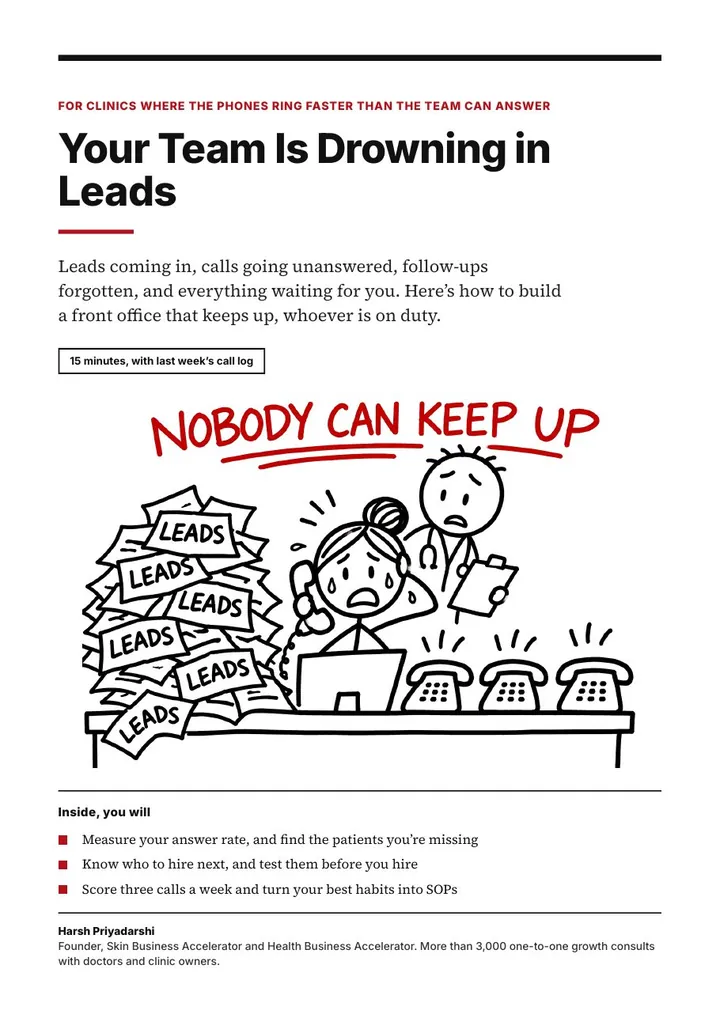
To convert more clinic enquiries into booked patients, fix what happens after the enquiry arrives before you spend more on ads. Reply within five minutes, ideally thirty seconds. Ask about the problem and why the patient is calling now. Offer two specific slots, not an open question. Confirm on WhatsApp straight away, and follow up anyone who doesn't answer on days one, two, four, seven and fourteen.
Every week a doctor tells me, "Harsh, I need more leads." Then we open the numbers together. The leads are almost always there. The calls come in. The WhatsApp messages come in. The forms get filled. They just don't turn into appointments.
That is not a marketing problem. It is a conversion problem. And it is the cheapest problem you will ever fix, because you have already paid for every one of those enquiries.
Do you have a lead problem or a conversion problem?
Start with one number: your booking rate. That is the share of enquiries who confirm a slot. In my framework, a healthy booking rate is 25 to 40%.
If you are inside that range and still short of patients, you may need more enquiries. If you are below it, more ads will only pour more water into a leaking bucket.
Here is an example. Say your clinic gets 200 enquiries a month and 36 of them book. That is an 18% booking rate. Now lift it to 30%. That is 60 bookings, 24 more than before, from the same ad spend.
Follow those 24 people down the line. Say 75% of them show up. That is 18 consultations. Say half of those start treatment. That is 9 new patients. At an example average ticket of ₹40,000, that is ₹3.6 lakh more revenue a month. You did not buy a single extra lead.
What should happen in the first five minutes?
The patient who filled in your form probably filled in two others in the same ten minutes. Whoever calls first, and sounds like they care, usually wins.
So set it up like this:
- Every new enquiry lands in one CRM, tagged with its source.
- The patient gets an instant WhatsApp reply with the doctor's name and a line saying someone will call shortly.
- Your front desk gets an alert at the same moment.
- A human calls within five minutes. Thirty seconds is the ideal.
And answer the phone. At least 95% of calls in working hours should be picked up by a person. A missed call is a patient who was ready to talk to you at that exact moment, and is now dialling someone else.
What should the front desk actually say?
Most clinics treat the first call like an information line. The patient asks a question, the staff answers it, and the call ends. No booking was ever offered.
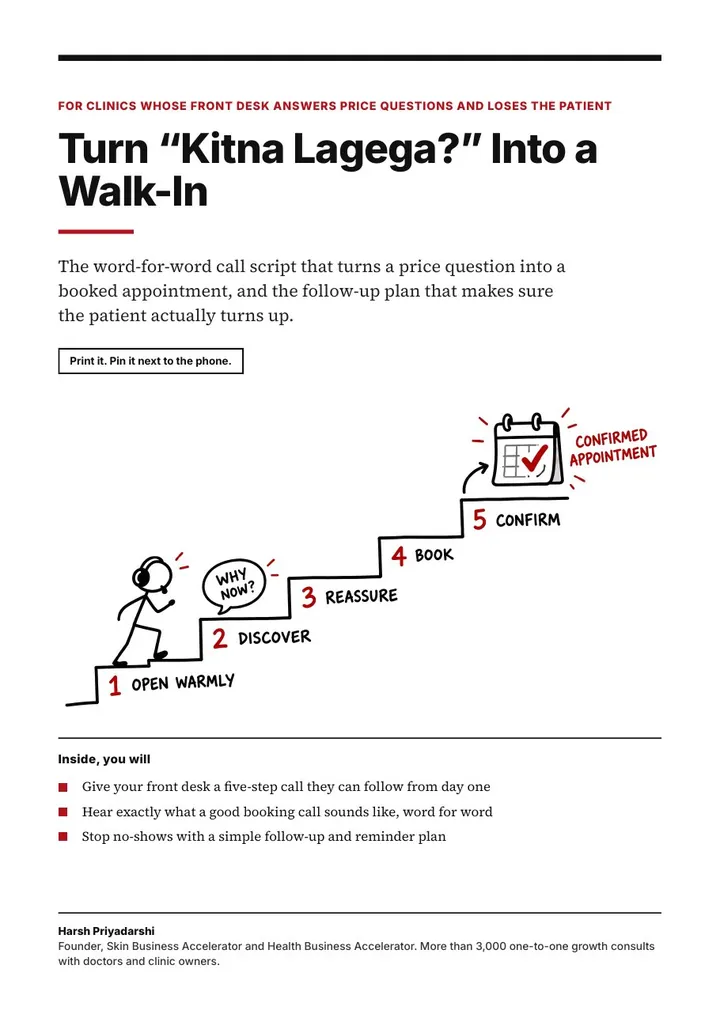
A good call has one goal: a confirmed appointment the patient turns up for. It follows five steps.
- Open warmly. The clinic's name, the staff member's name, and a genuine "How can I help you?"
- Discover. What is the problem? How long has it been going on? What have they tried? And why are they calling now?
- Reassure. Reflect back what you heard, and explain that the doctor sees exactly this problem every day.
- Book with two slots. "I have Thursday at 11 or Saturday at 5. Which suits you?" An open question invites "I'll see." Two slots invite a choice.
- Confirm. Name, number, date, time, consultation fee, location and what to bring. Then tell them what happens next.
The "why now" question is the one most teams skip. A wedding, a fall, a comment from a relative. That reason is what makes a patient act this week instead of next year, and it tells your team exactly how to talk to them.
What about enquiries who never pick up?
Plenty of patients will not answer the first call. They are at work, driving, or putting children to bed. That does not make them cold.
My rule of thumb is three attempts on day one, then day two, day four, day seven and day fourteen. Mix calls with short, useful WhatsApp messages: a short video from the doctor, what the consultation includes, the clinic's location. Never "just checking in."
Only after day fourteen do you mark the lead as cold. And a cold lead is not a dead lead. It goes into your database, where you can reach out again later with a genuine reason.
Where do clinics usually lose enquiries?
Here are the leaks I see most often, and what fixes each one.
| Leak | What it looks like | The fix |
|---|---|---|
| Missed calls | Phone rings out during lunch or the evening rush | A dedicated enquiry line, and every missed call returned within five minutes |
| Slow callback | Leads called the next morning, or never | Instant WhatsApp, an alert, and a call within five minutes |
| Price and hang up | Staff read out a number and the call ends | An honest range, then two slots for the consultation |
| Open questions | "When would you like to come?" | Two specific slots, every time |
| No confirmation | Patients forget or get the time wrong | WhatsApp confirmation the moment the call ends, plus reminders |
| One person, four jobs | Reception, billing, walk-ins and leads on one desk | Someone whose only job is new enquiries |
That last one hurts the most. The clinic thinks it is saving a salary. In reality it is losing far more through the enquiries nobody had time to call.
How do you know the changes are working?
Track four numbers every Monday: answer rate, speed to first contact, booking rate and show rate. Break the booking rate down by source and by staff member, so you can see whether the problem is lead quality or the call itself.
Record calls, with the caller's knowledge, and score three of them every week out of five, one point for each step of the call structure. Do it with your front desk, not about them.
Then change one thing at a time. Fix speed first. Watch the numbers for a few weeks. Then work on the script. If you change five things at once, you will never know which one worked.
This is the exact system we build with clinics in our front desk and conversion work, and the instant replies and reminders run through the CRM, WhatsApp and AI setup. The full method, with the sample script, is in Chapter 6 of Good Doctors Go Broke. If you want us to look at your own numbers, book a free growth call.
The short version
- Most clinics don't have a lead problem. They have a conversion problem, and a booking rate below 25% is the sign.
- Reply within five minutes, ideally thirty seconds, and answer at least 95% of calls.
- Every call follows five steps: open, discover, reassure, offer two slots, confirm.
- Follow up non-answering enquiries on days one, two, four, seven and fourteen before calling them cold.
- Track answer rate, speed, booking rate and show rate every Monday, and change one thing at a time.
Frequently asked questions
What is a good booking rate for a clinic in India?
In my framework, 25 to 40% of enquiries should book a confirmed slot. If you are below 25%, check your speed to first contact before anything else. If speed is fine and bookings are still low, the problem is either the quality of the leads or how your front desk handles the call.
Should my receptionist tell patients the price on the phone?
Never refuse, and never just throw out a number. Give an honest range, explain what the final figure depends on, and bring the patient back to the consultation, where they will get an exact plan in writing. Then offer two specific slots. A price without a diagnosis is just a number to compare.
How many times should we call a lead who doesn't answer?
My rule of thumb is three attempts on the first day, then day two, day four, day seven and day fourteen. Mix calls with short, useful WhatsApp messages rather than reminders that only say you called. After day fourteen, move the lead into your database instead of deleting it.
Can WhatsApp automation replace my front desk staff?
No. Automation and AI assistants make sure no enquiry waits, by replying in seconds, offering real slots and sending reminders. But anything medical, emotional or complicated should go to a human straight away. The tools remember for your team. They don't replace the warm voice that earns the patient's trust.
On a free growth call, my team traces your last month from enquiry to treatment and shows you your biggest leak in rupees.