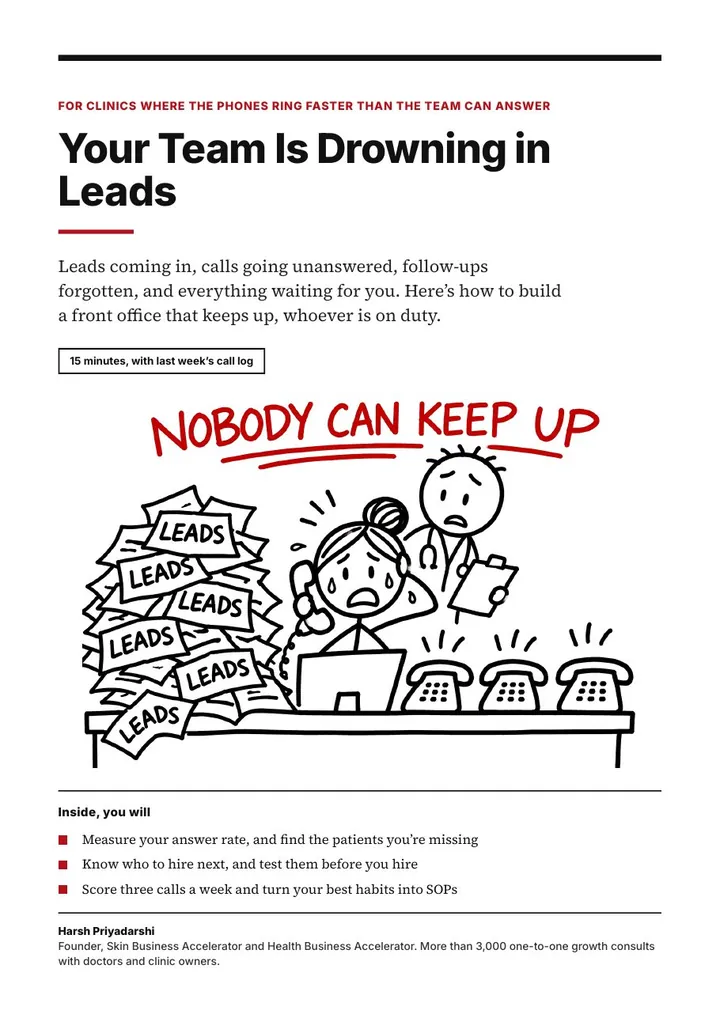
Hospital enquiries fail to become appointments when calls get lost in IVR menus and transfers, nobody owns ad leads, doctor schedules are unclear, and estimate or cashless questions go unanswered. Fix it with one lead desk that owns every new enquiry, department scripts, a live doctor schedule, a five-minute callback rule, a quick TPA check, and booking stages tracked in one CRM.
Call your own hospital tonight as a patient. Press 1 for English. Press 3 for appointments. Hold. Get transferred to orthopaedics. The extension rings out. Call again, and this time ask how much a knee replacement costs. You will probably hear "Please come and meet the doctor", with no idea when the doctor sits, whether your policy is cashless, or what happens next. Many hospital owners have never made that call. The patients who did are now at another hospital.
Where do hospitals lose their enquiries?
Hospitals don't have a lead problem as often as they have an ownership problem. Enquiries arrive from ads, the website, Google profiles, referring doctors, outreach camps, WhatsApp and walk-ins, and nobody owns them end to end.
The leaks we see most often:
- IVR menus and transfers that end in an extension nobody answers.
- Ad leads sitting in a spreadsheet until someone downloads them the next day.
- Unclear doctor schedules. "Doctor may come at 12, or maybe at 2."
- Estimate questions bounced. The caller wanted a rough idea of cost and got none.
- Cashless questions with no answer, so the family checks a network hospital instead.
- Outstation callers with no help on travel, stay or which day to come.
- Second opinion and report review requests with no clear process.
- WhatsApp messages unanswered on Sundays and evenings, when families have time to ask.
What does a hospital lead desk need?
The single biggest fix is one desk that owns every new enquiry until it becomes an attended OPD visit. Not the switchboard, not each department's reception, not the marketing team.
- A dedicated team for new enquiries, separate from billing, admissions and inpatient queries.
- Every lead in one CRM, tagged with its source and department, from every channel, with the phone system and WhatsApp connected so nothing is copied by hand.
- A live doctor schedule the desk can see: who is consulting today, until when, and the next available slots.
- Department scripts, with the common questions, the package approach and an honest estimate range for each major procedure.
- A quick TPA check, so the desk can tell a caller whether their insurer is on your panel and what the next step is.
- An escalation rule for anything urgent, written with your clinical heads, so callers are never left waiting when they need emergency care.
- Missed call alerts and a callback rule: every missed call returned within five minutes.
- After-hours cover: an instant WhatsApp reply, a voice assistant or a clear message saying exactly when someone will call back.
For calls, the benchmark is an answer rate of at least 95% in working hours. For new leads, aim for the first human contact within five minutes, and ideally within thirty seconds.
What should a hospital enquiry call sound like?
The same five-step shape that works in any clinic: open warmly, discover, reassure, offer two slots, confirm. What changes in a hospital is that the desk must also route the patient to the right doctor and handle cashless questions.
Lead desk: "Good evening, City Hospital, this is Kavita. How can I help?"
Caller: "My mother has knee pain for years. What does a knee replacement cost?"
Lead desk: "I can help with that. May I know your mother's name and age, and how long the pain has been there? Has a doctor already advised surgery?"
Caller: "Sunita Verma, 64. Her doctor in our town said she needs it."
Lead desk: "Thank you. Our joint replacement team sees this every day. The cost depends on what the surgeon recommends after examining her, and you get a written package estimate at the consultation. Does she have health insurance? I can check whether we are cashless for it. Dr Rao consults on Tuesday at 11 and Thursday at 4. Which suits you?"
She gathered the history, routed to the right unit, handled the insurance question and offered two specific slots with a named doctor. Then she confirms on WhatsApp with the location, the fee, what reports to bring and, for outstation families, where to park and stay.
How should hospitals follow up enquiries that don't book?
Use a fixed cadence: three attempts on day one, then day two, day four, day seven and day fourteen, mixing calls with short, useful WhatsApp messages such as the surgeon's video on the procedure. Only then mark the lead cold, and even then it stays in the database for later reactivation.
For surgical departments, keep a second list: patients who attended an OPD consultation and were advised surgery but have not been admitted. These belong to the department's coordinator, not the lead desk. They need a family session, an estimate walkthrough or a cashless check, not a booking reminder.
Which numbers should a hospital track for enquiries?
Track each department separately, every Monday. A hospital-wide average hides the unit that is leaking.
| Number | Healthy benchmark | Where it breaks in hospitals |
|---|---|---|
| Answer rate in working hours | At least 95% | IVR menus, transfers, lunch breaks |
| Speed to first contact | Under 5 minutes | Ad leads downloaded the next day |
| Booking rate | 25 to 40% | No slots offered, estimates refused |
| Show rate | 60 to 75% | No confirmation or reminders |
Example: Say your flagship departments get 1,500 enquiries a month, and 18% book an OPD visit. That is 270 bookings. Fix the desk and reach a 30% booking rate: 450 bookings. At a 65% show rate, that is about 176 attended visits before and about 293 after, from the same marketing spend.
Record calls with the caller's knowledge, score a sample every week against the five steps, and play the best and worst ones in the team meeting. AI call scoring can do the first pass for you across every call, so managers only listen to the ones that matter.
We set up hospital lead desks, routing and CRM pipelines in our conversion systems and CRM and AI work. See our hospitals page, and the front desk chapter of Good Doctors Go Broke.
The short version
- Most hospitals have an ownership problem, not a lead problem.
- Build one lead desk that owns every new enquiry until the OPD visit happens.
- Give the desk a live doctor schedule, estimate ranges, a quick TPA check and an escalation rule.
- Follow up on a fixed cadence, and hand "advised but not admitted" patients to department coordinators.
- Track answer rate, speed, booking rate and show rate by department every week.
Frequently asked questions
How can a hospital improve its call centre conversion?
Give one team ownership of every new enquiry, separate from billing and admissions. Connect phone, WhatsApp and ad leads to one CRM, show the desk a live doctor schedule, give them department scripts and estimate ranges, and require every call to end with two specific OPD slots. Review recorded calls every week.
Should hospital staff give surgery cost estimates on the phone?
Give an honest range and explain what it depends on, then invite the patient to a consultation where they get a written package estimate. Refusing to say anything sends callers elsewhere, but an exact number before a diagnosis is just a figure to compare. Check cashless status during the same call.
Who should follow up patients advised surgery who never got admitted?
The department's treatment coordinator, not the general lead desk. These patients have already met the surgeon. They usually need a family conversation, a walkthrough of the estimate, payment options or a cashless check. Keep them on a separate list in the CRM, with a dated next step for each.
What is a good answer rate for a hospital enquiry line?
At least 95% of calls during working hours should reach a human, with every missed call returned within five minutes. Measure it per department and per hour of the day. Many hospitals find their worst gaps at lunch, shift changes and evenings, which is when families often finally call.
On a free growth call, my team traces your last month from enquiry to treatment and shows you your biggest leak in rupees.