Cut waiting time in a busy gastro OPD with three changes: separate slot types for new, review and report visits with realistic lengths, reports collected on WhatsApp before the visit, and one team member whose only job during OPD is managing the queue and telling patients the real wait. Start on time, keep a short fast-track for report checks, and measure average wait and walkouts every week.
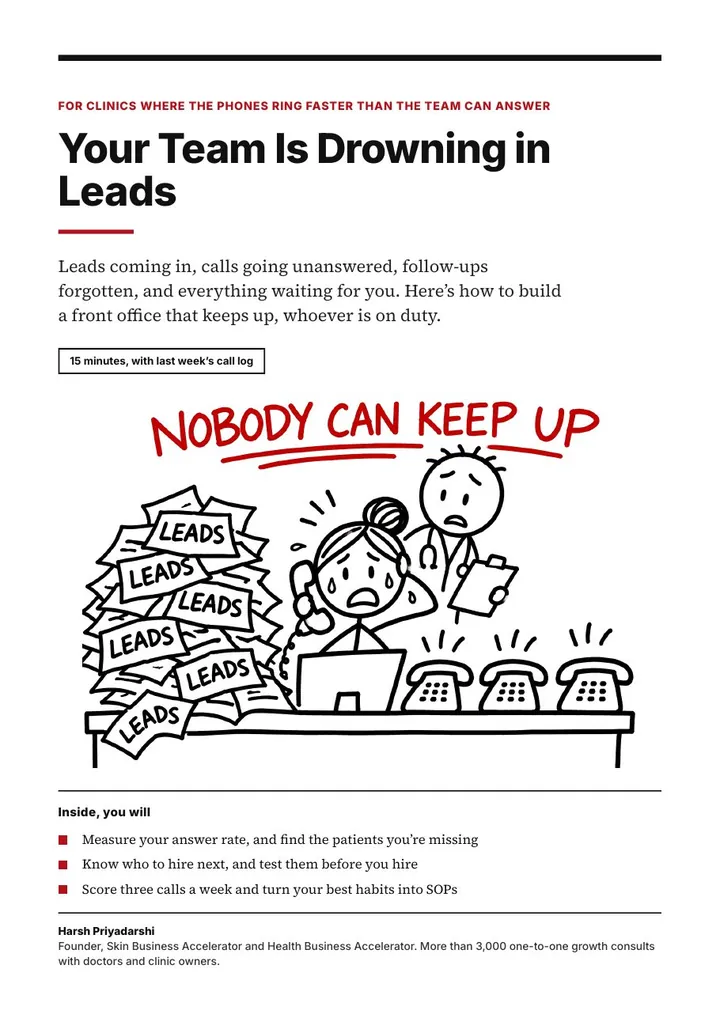
It is 1.30 pm. Your OPD started at 11. The waiting area has 34 people, half of them family members. A patient with a "just to show reports" visit has been waiting since 10.45. An elderly man with abdominal pain is sitting on the floor because the chairs are full. Someone at the back says, loud enough for everyone to hear, "Yahan toh poora din lag jaata hai."
Some of those people will not come back. Some will leave before you see them. And everyone in that room will tell somebody about the wait. In Good Doctors Go Broke, I call arrival the moment patients are most anxious about the clinic and the cost. In a gastro OPD, a three-hour wait undoes a lot of what your doctors do well.
Why do gastro OPDs back up so badly?
Look at the mix of patients in one session. New patients with long, complicated histories. Review patients after treatment. Patients bringing biopsy or scan reports. Pre-procedure counselling. Walk-ins in pain. When all of them get the same 10 minute slot, or no slot at all, the queue breaks within the first hour.
The usual causes:
- One slot length for every kind of visit.
- Reports arriving with the patient, unsorted, so the doctor reads them in the room.
- Late start. The doctor arrives at 11.40 for an 11 am OPD.
- Nobody owns the queue. The front desk is answering calls, billing and booking at the same time.
- No honest updates, so patients do not know whether to wait or come back.
How should you design slot types?
Give each kind of visit its own slot, with a length that matches reality. Time your own OPD for a week first. These are only examples.
| Slot type | Example length | Notes |
|---|---|---|
| New patient | 20 minutes | Story, examination, plan, written next step |
| Review | 10 minutes | Progress check, plan adjustment |
| Report visit | 7 minutes | Results explained, next step booked |
| Procedure counselling | 15 minutes | Often handed to the coordinator after the doctor's part |
| Walk-in or urgent | 2 or 3 held slots per session | Released to the queue if unused |
Then build the session pattern. For example, a new patient, two reviews, a report visit, a new patient, and so on, rather than all new patients at the start. Mixing slot types keeps the queue moving.
Example: Say a session runs 4 hours, 240 minutes. With an example mix of 6 new (120 minutes), 9 reviews (90 minutes) and 4 report visits (28 minutes), you use 238 minutes and see 19 patients. If the same session has 30 patients booked into 8 minute slots, it will overrun by over an hour every time.
How does collecting reports before the visit save time?
When booking, the front desk tells every patient coming for a follow-up or results visit to send their reports on WhatsApp the day before. The assistant:
- sorts them by date,
- attaches them to the patient's record,
- flags anything the doctor should see first,
- tells the patient they have been received.
The doctor walks into each visit already knowing what the report says. A report visit that took 15 minutes of shuffling papers takes 7. Patients also feel looked after, because someone confirmed their reports reached the clinic.
What does a queue manager actually do?
This is the single most useful change in a busy OPD. One person, during OPD hours, whose only job is the flow of patients. Not calls, not billing, not pharmacy.
- Greets each patient and checks them in against their slot type.
- Gives honest updates: "Doctor is running about 30 minutes behind. You are fourth. Would you like to step out for tea? I will call you."
- Moves report-only patients to a short fast-track when the doctor has a gap.
- Prepares the next patient, with vitals or forms done as your protocol allows, so the doctor never waits.
- Watches for anyone unwell in the waiting area and alerts the doctor or nurse immediately.
- Logs arrival and seen times so you can measure the wait.
Rule: Patients forgive a delay they were told about. They do not forgive a delay they had to guess.
What else makes a real difference?
- Start on time. If OPD is at 11, the first patient is seen at 11. Patients notice, and it sets the pace for the whole session.
- Stagger reporting times. Do not tell 30 patients to come at 11. Give each patient a time close to their slot.
- Hand over the non-doctor parts. Test explanations, fee questions and procedure scheduling go to the coordinator in a separate space.
- Send a WhatsApp update to patients still at home if the doctor is running late. Some will happily come 40 minutes later.
- Hold walk-in slots so genuine urgent cases do not wreck the schedule.
What do you tell patients while you fix it?
Do not wait for the new system to be perfect before you start talking to patients. Put a simple notice at the front desk and in your WhatsApp confirmation:
- what time to arrive for their slot type,
- to send reports the day before,
- that the team will tell them honestly if the doctor is running late.
Then keep the promise. Once patients see the clinic telling the truth about time, the mood in the waiting area changes. People stop crowding the desk every ten minutes to ask "aur kitna time?" That alone gives your front desk back an hour a day.
How do you measure whether it worked?
Track three numbers every week, from the queue manager's log:
- Average wait from arrival to being seen, by slot type.
- Walkouts: patients who checked in and left before being seen.
- On-time start: how many sessions started within 10 minutes of the scheduled time.
Review them on Monday with the team. Change one thing, then watch for two weeks. Patient flow is part of the conversion systems we build, because a patient who walks out of the waiting area never reaches the consultation. Report collection and delay messages are simple WhatsApp automations. Our gastroenterology page has more on GI OPD operations.
The short version
- Long gastro OPD waits come from one slot length for every visit, unsorted reports, late starts and nobody owning the queue.
- Create slot types for new, review, report and counselling visits, timed from your own OPD.
- Collect and sort reports on WhatsApp the day before every review and report visit.
- Give one person the queue during OPD hours, with honest updates and a report fast-track.
- Start on time, stagger arrivals, and track average wait, walkouts and on-time starts weekly.
Frequently asked questions
How can I reduce waiting time in my clinic OPD?
Use different slot types with realistic lengths for new, review and report visits, collect reports before the visit, start on time and give one person the job of managing the queue. Tell patients the real wait. Then measure average wait and walkouts every week and fix one cause at a time.
What is a queue manager in a clinic?
A team member whose only job during OPD is patient flow: checking patients in, giving honest updates on the wait, preparing the next patient, moving quick report visits into gaps and alerting the doctor if anyone looks unwell. They do not handle calls or billing during OPD.
Why do report-only visits take so long in a gastro OPD?
Because reports usually arrive with the patient, unsorted, and the doctor reads them in the room. Asking patients to send reports on WhatsApp the day before, sorted by date and attached to their record, turns a long visit into a short, focused one.
Should a busy OPD take walk-in patients?
Yes, but plan for them. Hold two or three walk-in slots per session for urgent cases and release them to the queue if unused. Without held slots, walk-ins either wait for hours or push every booked patient back.
On a free growth call, my team traces your last month from enquiry to treatment and shows you your biggest leak in rupees.