Write one courtesy policy and stop deciding case by case. Name who qualifies (staff, their immediate family, fellow doctors and your own family), what each group gets, and what is never waived, such as implants and consumables. Only the doctor-owner approves procedure courtesy, in writing, before booking. Record every courtesy in billing, keep it private, and give friends and "known people" the standard fee.
The desk phone rings at 11.15 am. "Main Dr Verma ke mama ji ka padosi hoon. Doctor sahab ko bolo, kuch kam kar dein." The receptionist does not know if this is true. She does not want to upset the doctor's family. So she walks into the procedure room and interrupts a cystoscopy to ask.
This happens five or six times a week in most clinics I see. Each time, the desk wastes minutes, the doctor gets interrupted, and somebody gets a different price from the patient sitting next to them. Nobody records it. At the end of the year, nobody knows how much was given away, or to whom.
The fix is not to become stingy. It is to decide once, in writing.
Why does a clinic need a written courtesy policy?
In Good Doctors Go Broke I give every front desk one line: "Our fees are the same for every patient." That line only works if exceptions are rare, planned and decided by the right person. Without a written policy, three things go wrong:
- The desk becomes a bargaining counter. Anyone who claims a connection gets a reduction, and staff feel forced to judge who is "really" family.
- Patients compare. A patient who paid the full fee hears that his neighbour paid less, and stops trusting your fee sheet.
- Revenue leaks without a trace. Courtesies given verbally never show in your reports.
A policy turns courtesy from a negotiation into a benefit, given with warmth and without drama.
Who should qualify, and for what?
Keep the groups small and clear. Here is a starting policy I often suggest. Adjust the amounts to your margins.
| Group | Consultations | Procedures and plans | Never waived |
|---|---|---|---|
| Staff, after three months of service | Waived | Courtesy rate set in the policy | Implants, consumables, outside lab tests |
| Staff spouse, children and parents | Waived | Courtesy rate set in the policy | Same as above |
| Doctors and their immediate family | Waived | Doctor-owner's decision, case by case | Same as above |
| Your own family | Waived | Doctor-owner's decision | Same as above |
| Friends, "known people", relatives of relatives | Standard fee | Standard fee | Not applicable |
That last row is the one that saves your desk. Friends get your time, your warmth and your best care. They do not get a different price, unless you personally decide to gift it and tell the desk in writing.
Two more limits keep the policy healthy. Set an annual cap of courtesy value per staff family, so one expensive plan does not swallow the year's margin. And make the rule that direct costs are always paid: implants, lenses, consumables and outside tests. Courtesy covers your fee, not your supplier's bill.
Who approves, and how?
Approval follows the size of the courtesy:
- Consultation waivers for people on the policy list: the practice manager applies them, using the list.
- Procedure courtesy for any group: only the doctor-owner approves, in writing, before the date is booked. A WhatsApp message to the manager is enough, as long as it is saved.
- Anything outside the policy: the doctor-owner, in writing, every time. If you find yourself approving many outside cases, your policy needs updating.
And one rule for the doctor too. No corridor promises. If you tell an old school friend "don't worry, we'll sort it out" and the desk then charges him the standard fee, you have embarrassed your own team. Send the message to the manager first.
How do you record courtesy so you can see it?
Every courtesy goes into your billing software with a courtesy code. The bill shows the standard fee, then a courtesy line, then the amount paid. That one habit tells you exactly what the policy costs.
Example: Say a urology clinic gives about 25 informal reductions a month, averaging ₹1,200 each. That is ₹30,000 a month, or ₹3.6 lakh a year, given away with no record of who got it or why. After a written policy, the same clinic gives 12 recorded courtesies a month averaging ₹1,150, about ₹13,800. Staff families are still looked after. The "padosi" calls simply get the standard fee.
Review the courtesy total once a month in your numbers meeting. If you run a urology practice or any procedure-heavy clinic, check it against your procedure margins too.
What does the desk say to "I know the doctor"?
Give your team the words. This is part of every front desk system we build.
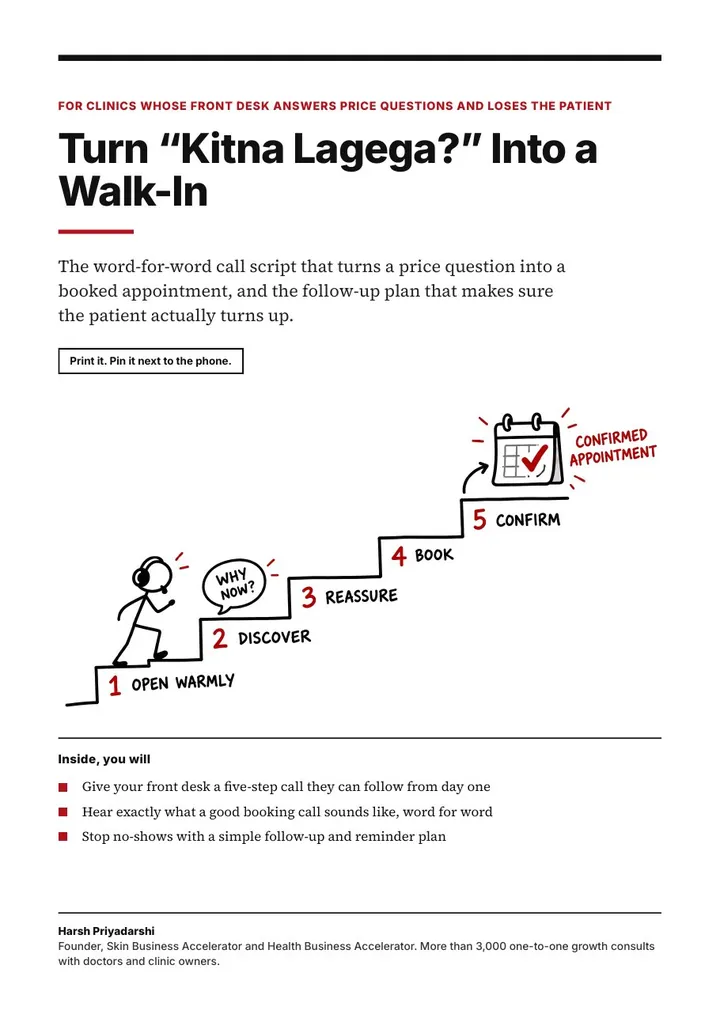
Caller: I'm Dr Verma's relative's neighbour. Can you reduce something?
Desk: Doctor will be very happy to see you. Our fees are the same for every patient, and the consultation is ₹800. Shall I book you for Thursday at 5?
For someone who genuinely is on the policy list, like a staff member's mother:
Desk: Of course. You're covered under our staff family policy, so the consultation is waived. If doctor advises a procedure, I'll share the courtesy rate with you after he confirms.
No hesitation, no going to ask the doctor mid-procedure, no awkward "let me see what I can do".
Is a courtesy policy allowed under the advertising rules?
A private, written courtesy for your own staff and their families is an internal benefit, not a promotion. Keep it that way. Never advertise it, never offer it to pull a new patient in, and never let staff use it as a favour to bring friends in for treatment they do not need. Read the current NMC guidelines yourself if you are unsure. And remember the difference between courtesy and need: a patient who cannot afford care belongs under your concession policy, decided by the doctor, not under "family rate".
If you want help writing the policy and training the desk on it, see how we work.
The short version
- Decide courtesy once, in writing, instead of negotiating at the desk every day.
- Cover staff, their immediate family, fellow doctors and your own family. Friends pay the standard fee.
- Never waive direct costs like implants and consumables, and set an annual cap.
- Only the doctor-owner approves procedure courtesy, in writing, before booking. No corridor promises.
- Record every courtesy with a code, review it monthly, and never advertise it.
Official sources
Rules change. Check the current version at the source before you act.
Frequently asked questions
Should clinic staff get free treatment for their family?
Waiving consultations for staff and their immediate family is a kind, common benefit. For procedures, set a written courtesy rate, keep direct costs like implants and consumables payable, and cap the yearly value. Write it into the staff policy so nobody has to ask, and nobody feels others got more.
How do I say no when a relative asks for a lower fee?
Let the policy say no for you. Your desk says warmly that fees are the same for every patient and books the appointment. If you personally want to gift something to a close relative, tell your manager in writing first. That keeps your team out of an awkward spot and keeps your fee sheet believable.
Is professional courtesy for other doctors still a good idea?
Many doctors waive consultation fees for fellow doctors and their families, and it builds goodwill. Keep it a courtesy you offer, not a payment or favour linked to referrals. For procedures, decide case by case and keep direct costs payable. Never let it become an exchange for sending patients.
Where should courtesy reductions show in clinic accounts?
Every courtesy should appear on the bill as the standard fee, then a courtesy line, then the amount paid, with a code in your billing software. That shows exactly what the policy costs each month. Ask your chartered accountant how to treat these reductions in your books and for tax.
On a free growth call, my team traces your last month from enquiry to treatment and shows you your biggest leak in rupees.