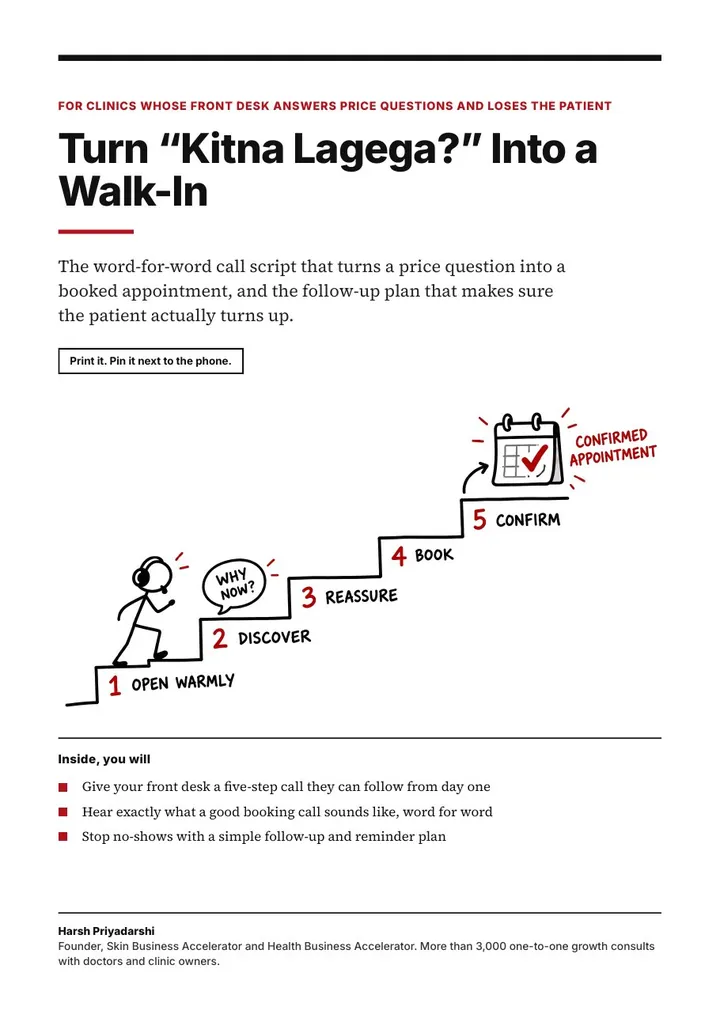
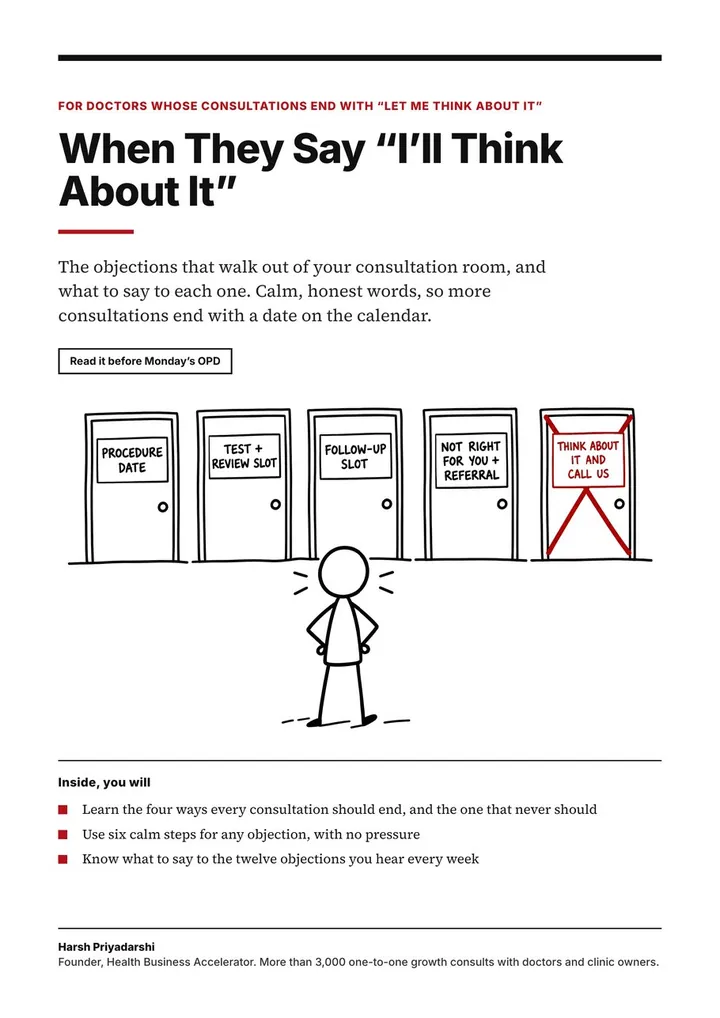
To delegate the fee conversation, the doctor diagnoses, explains the outcome, presents three options and recommends one. Then the doctor hands the patient by name to a trained coordinator, or a trained front desk person below twenty consultations a day, who walks through the written plan, the fee from one fee sheet, the payment options and the next date. You stay the doctor; they handle the money.
You've just explained the diagnosis well. The patient is nodding. Then comes the question you were dreading.
"Doctor, kitna lagega? Thoda kam ho sakta hai?"
So you explain the fee. They ask about EMI. Their husband calls. You negotiate a little because the next patient is waiting. Ten minutes later you've given away ₹5,000, the patient still wants to "think about it", and you're running late for the rest of the day.
This is one of the most common leaks I see in busy practices. Not because doctors are bad at money conversations, but because the doctor is the wrong person to have them.
Why shouldn't the doctor discuss fees?
Three reasons.
It costs your time. Here's an example. Say you see 30 consultations a day and the money part takes four minutes each. That's two hours a day, every day, on a conversation someone else could have.
It weakens your recommendation. When the same person who just told you what you need is also bargaining over the price, the recommendation starts to sound like a sales pitch.
It invites discounts. Patients bargain harder with the doctor, and doctors give in to save time. And discounts hurt more than they look. If your plan is ₹1,00,000 and the direct cost is ₹40,000, a 20% discount drops your profit from ₹60,000 to ₹40,000. You now need 50% more patients just to make the same profit.
Rule: You stay the doctor. They handle the money.
What does the doctor still do in the consultation?
You do the parts only a doctor can do, in this order:
- Diagnose, and explain it simply.
- Explain the outcome the patient can realistically expect.
- Walk through your method, phase by phase.
- Present the three options: Complete, Recommended and Basic.
- Say clearly which one you would choose for this patient, and why.
Then you hand over. You don't need to say the number at all. If the patient asks "kitna lagega?" before the handover, say: "Anjali will take you through the exact fee for each option and the ways you can pay. The fee is the same for every patient."
How does the handover work?
The handover is one sentence, said in front of the patient, using the coordinator's name:
Doctor: "Anjali will take you through the plan and the details, and she'll be your point of contact from here."
That one sentence transfers your trust to her. Without it, the patient feels passed down the line.
Make sure the coordinator already knows what you recommended before the patient sits down. A one-line note in the CRM, or the written plan you've already ticked, is enough. Nothing breaks trust faster than a patient having to repeat everything they just told the doctor.
Then the coordinator sits with the patient, and family if they're there, in a quiet space with the written plan between them. The coordinator:
- Walks through the written plan and the three options again, slowly.
- States the fee from the fee sheet, clearly, and then stops talking.
- Explains the payment options next to the fee: milestone payments, EMI through your lending partner, or insurance paperwork where it applies.
- Answers the questions the patient was too shy to ask the doctor.
- Books the definite next step: a procedure date, a test, a follow-up or a family session.
Who should handle fees if you don't have a coordinator?
It depends on how many consultations you see.
| Consultations a day | Who handles the fee conversation | What they need |
|---|---|---|
| Under 10 | The doctor, briefly, or the front desk lead | The fee sheet and the discount line |
| 10 to 20 | A trained front desk person or a nurse, in a quiet corner | Fee sheet, payment options, a short script, a follow-up schedule |
| More than 20 | A dedicated treatment coordinator | Full training, a quiet room, a CRM, incentive on treatments started |
Past twenty consultations a day, you need a dedicated coordinator. Below that, a well-trained front desk person or nurse can usually share the job, as long as they have a quiet space and aren't also answering the phone.
What should they say when the patient asks for a discount?
Give your team one line, word for word, so nobody improvises:
"Our fees are the same for every patient. If budget is a concern, we can look at another plan or spread the payment."
Then they have three honest moves, and none of them cut the price:
- Change the scope, not the price. "Let's look at the Basic plan."
- Change how they pay, not what they pay. Milestones or EMI.
- Restate the value. Go back to the outcome the patient said they wanted.
A coordinator negotiates the plan, never the price. And if the patient truly isn't ready, they leave with a follow-up booked and a message the same day, a call the next day, then check-ins on days three, seven and fourteen.
What makes delegation fail?
I see four things go wrong:
- No fee sheet. If the doctor, the front desk and the coordinator quote different numbers, patients stop trusting all of them. Put every plan and fee on one written sheet.
- The doctor overrides. If patients learn they can come back to you for a better price, the coordinator is powerless. Back them every time.
- No quiet space. A fee conversation at a busy reception counter, with the phone ringing, rarely ends in a decision.
- Incentives on the wrong thing. Reward treatments started, never discounts given. Track complaints and refunds next to it.
Then measure it. Track the share of consultations that turn into started treatments, how long patients take to decide, and which of the three options they choose. If most pick Basic, your Recommended plan is either overpriced or poorly explained. Review these numbers every week alongside a few recorded conversations.
Getting this handover right is a core part of our front desk and conversion work, and the full playbook for pricing, the consultation and the coordinator is in Good Doctors Go Broke. If you'd like us to look at where your consultations are leaking, book a free growth call.
The short version
- The doctor diagnoses, presents three options and recommends one, then hands over by name.
- A trained coordinator or front desk person handles the fee, payment options and the next date.
- Below twenty consultations a day, a trained front desk or nurse can do it; above twenty, hire a coordinator.
- One fee sheet, one discount line, and a doctor who never overrides.
- Negotiate the plan, never the price.
Frequently asked questions
Won't patients feel I'm avoiding them if someone else discusses the fee?
Not if you hand over properly. Recommend your option clearly, then introduce the coordinator by name in front of the patient and say they'll be the point of contact. Patients usually find it easier to ask money questions of someone other than the doctor. Make sure you're still available if a clinical question comes up.
What if a patient insists on discussing the price with the doctor?
Answer briefly and consistently: the fee is the same for every patient and it's on the plan. Then bring the coordinator in. Never offer a lower number yourself, or every patient will learn to ask you. If you override your team even once, the coordinator loses all authority in the fee conversation.
Can my receptionist explain treatment costs to patients?
Yes, with training, a written fee sheet and a quiet space away from the phone. They should explain the three options, state the fee plainly, show the payment options next to it and book a next step. They should never give medical advice. Above twenty consultations a day, move this to a dedicated coordinator.
How do I explain EMI options without sounding like a salesperson?
Put the payment options right next to the fee, as part of the plan, not as a pitch afterwards. Separate the total from the timing: is the concern the amount, or paying it all today? Explain the full cost of any EMI honestly, never push a bigger plan than the patient needs, and let them choose.
On a free growth call, my team traces your last month from enquiry to treatment and shows you your biggest leak in rupees.