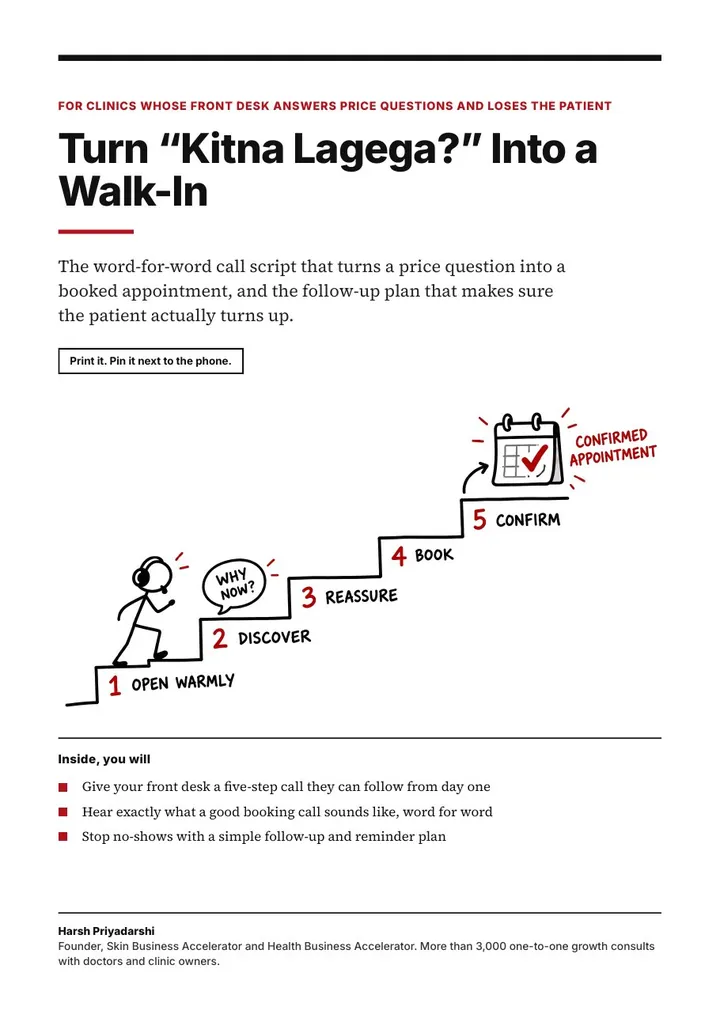
Dental enquiries fail to become appointments when calls ring out while the assistant is chairside, when the front desk quotes an RCT or implant price and hangs up, and when nobody confirms or reminds. Fix it with a dedicated person for calls, a five-minute callback, same-day slots for pain, two specific slots for everyone else, WhatsApp confirmations and a follow-up on days one, two, four, seven and fourteen.
Here is a scene from almost every dental clinic we audit. The phone rings. The only person at the front desk is also the dentist's chairside assistant, and right now she is holding suction for a root canal. The call rings out. The patient with the toothache calls the next clinic on the map. That clinic picks up.
Nobody in the first clinic even knows that patient existed.
Dental clinics rarely have a lead problem. They have a phone problem. Here is how to fix it.
Why do dental enquiries leak?
Dental is high-volume, which hides the leaks. The chairs are busy, so the clinic feels full, while a steady stream of enquiries quietly goes elsewhere.
| Leak | A typical moment | Fix |
|---|---|---|
| Calls missed during procedures | Five missed calls between 11 and 1 | A dedicated person or line for new enquiries, separate from chairside work |
| Price and hang up | "RCT ka 6,000 se start hai" and the call ends | An honest range, a few questions, then two slots |
| No same-day slot for pain | "Doctor is busy, come tomorrow" | Protected emergency slots every day |
| Office hours only | Working adults can't come before 7 | Evening and Sunday slots, clearly offered |
| No confirmation | Check-up patients simply forget | WhatsApp confirmation and reminders |
| WhatsApp left on read | A price question answered two days later | A shared inbox with an instant reply and a human within minutes |
What should a dental front desk ask on the first call?
The call structure stays the same five steps: a warm opening, discovery, reassurance, two slots and a confirmation. In dental, discovery is short but it changes everything:
- Is it pain, a problem they've been putting off, or something they'd like to improve?
- How long has it been going on, and has another dentist seen it?
- Who is the patient? Themselves, a child, a parent?
- What have they tried? Painkillers, clove oil, a temporary filling elsewhere?
- Why now? Pain last night, a wedding in three months, a parent who can't chew, a new job.
Pain patients get today's protected slot. Everyone else gets two specific choices, including one outside office hours.
What does a good dental call sound like?
Here is an example. Adapt the words, keep the shape.
Front desk: "Good morning, this is the dental clinic, Kavya speaking. How can I help you?"
Caller: "I wanted to know the cost of a root canal."
Front desk: "Sure, I can help. May I know your name? And is the tooth troubling you right now?"
Caller: "Arjun. Yes, it's been paining on and off for two weeks. Worse at night."
Front desk: "I'm sorry, Arjun, that sounds uncomfortable. Have you seen a dentist for it yet?"
Caller: "No, just taking painkillers."
Front desk: "That's very common. The doctor sees this every day. The cost depends on the tooth and whether it needs a crown afterwards, so the doctor will check it, take an X-ray and give you the full plan in writing. Most patients find the root canal and crown together is the clearest way to plan it. Since it's paining, I can see you today at 5:30, or tomorrow at 9 before work. Which suits you?"
Caller: "Today at 5:30."
Front desk: "Done. I'm sending the details and location on WhatsApp now. The consultation fee is ₹500. If you have any old X-rays, please bring them."
A price question became a name, a problem, a "why now", the full plan explained, a same-day slot and a booking.
How do you cut no-shows in a dental clinic?
Check-ups and cleanings have the highest no-show rates in dentistry, because nothing hurts. A booking isn't an appointment until the patient sits in the chair.
- Straight after booking: a WhatsApp confirmation with the date, time, dentist's name, location pin and parking note.
- For high-value consultations: one short video from the dentist on what happens at an implant or aligner consultation.
- One day ahead: a reminder asking the patient to reply and confirm.
- Morning of the visit: one last short reminder.
- Missed visit: a friendly call that same day to find a new slot, with no blame.
For multi-visit plans, book every visit on the day the patient says yes. A patient who leaves with all three RCT sittings and the crown appointment in their phone is far more likely to finish.
What if the patient says "I'll call back"?
Ask what they'd like to think about, and answer it. Often it's cost or fear. Offer to hold the slot until tomorrow.
If they don't book, follow up on days one, two, four, seven and fourteen, mixing short calls with useful WhatsApp messages: what an implant consultation involves, how comfort is managed in an RCT, the payment options. Only then mark them cold, and keep them for reactivation.
Here is why it matters. Say your clinic gets 200 enquiries a month and books 25%, which is 50 appointments. Lift that to 38% and you have 76, from the same spend. If 4 of the extra 26 become implant or aligner plans at ₹60,000 on average and the rest bring ₹4,000 of routine care each, that is about ₹3,28,000 a month you were already paying for. Our front desk and conversion work starts here.
Who should handle dental enquiries?
Not the chairside assistant. A dedicated person for calls and WhatsApp, at least during your busiest hours, even if they share billing. Hire for warmth you can hear, calm with people in pain, persistence and your patients' language. Test with a phone call before the interview and a role-play where you ask "just tell me the implant price".
Pay a fair salary plus an incentive for patients who book and actually come. Record calls with consent, score three a week on the five steps, and track answer rate (at least 95%), speed to first contact (under five minutes), booking rate (25 to 40%) and show rate (60 to 75%). An AI assistant on WhatsApp can reply instantly at night and offer real slots, but anything clinical goes to a human. That is part of our CRM, WhatsApp and AI work. The full method is in Good Doctors Go Broke, and our dental approach is on the dental page.
The short version
- Separate the phone from the chair. Missed calls during procedures are your biggest dental leak.
- Protect same-day slots for pain patients, and offer evening or Sunday slots to working adults.
- Never just quote the RCT or implant price. Give a range, discover, then offer two slots.
- Book every visit of a multi-visit plan on the day the patient says yes.
- Confirm, remind, call no-shows the same day and follow up on days one, two, four, seven and fourteen.
Frequently asked questions
Should dental clinics tell patients the RCT or implant price on the phone?
Give an honest range and explain what it depends on, such as the tooth, whether a crown is needed and the type of implant. Then invite them in for an examination and a written plan. A price without a diagnosis is just a number to compare with the clinic down the road.
How can a small dental clinic answer every call?
Separate the phone from chairside work during your busiest hours, even if it means one part-time person. Call back every missed call within five minutes, set an instant WhatsApp reply for after hours, and review your call log weekly. Most clinics are surprised how many calls ring out during procedures.
Why do dental check-up patients not show up?
Usually because nothing hurts, so the appointment slips their mind. Send a WhatsApp confirmation straight after booking, a reminder the day before that asks for a reply, and another two hours before. Call anyone who misses it the same day, warmly, and offer a new slot.
Is online booking enough for a dental clinic?
It helps, but it doesn't replace a person. Many patients still call or message to ask about cost, pain or timing before they book. Online booking works best alongside a fast human reply, so every question gets answered and turned into a confirmed appointment.
On a free growth call, my team traces your last month from enquiry to treatment and shows you your biggest leak in rupees.