A Delhi front desk should reply to every enquiry within five minutes, in Hindi, Punjabi or English as the caller prefers, and expect that the caller is often a family member, not the patient. Ask who the treatment is for, where they are coming from in NCR or which city, and why now. Offer two specific slots, invite the decision makers, and confirm on WhatsApp with Metro and parking directions.
Listen to a day of calls at almost any Delhi clinic and you will notice something. A large share of callers are not the patient. "Meri mummy ke liye pooch raha hoon." "My father lives in Meerut, we want to bring him to Delhi." "Bhaiya, final package kitne ka hai?" The front desk script that works in most cities, built around the patient describing their own problem, needs a few changes here.
Your front desk is the first step of your treatment plan. In Delhi, it is also the first conversation with the family.
Who calls a Delhi clinic, and what does each caller need?
Train your team to recognise four kinds of callers in the first minute.
| Caller | What they usually say | What the front desk must find out |
|---|---|---|
| The patient | "Mujhe ghutne mein dard hai" | The problem, how long, what they tried, why now |
| A family member | "Papa ke liye appointment chahiye" | Who the patient is, who decides, whether they can all come together |
| An out-of-town family | "We are coming from Agra for a consultation" | Which reports they have, which tests can be done the same day, how long to plan for |
| A second-opinion seeker | "We have already seen a doctor at another hospital" | What they were told, what worries them, which reports to bring |
Each one still ends with the same goal: a confirmed appointment that actually happens.
What does a good Delhi booking call sound like?
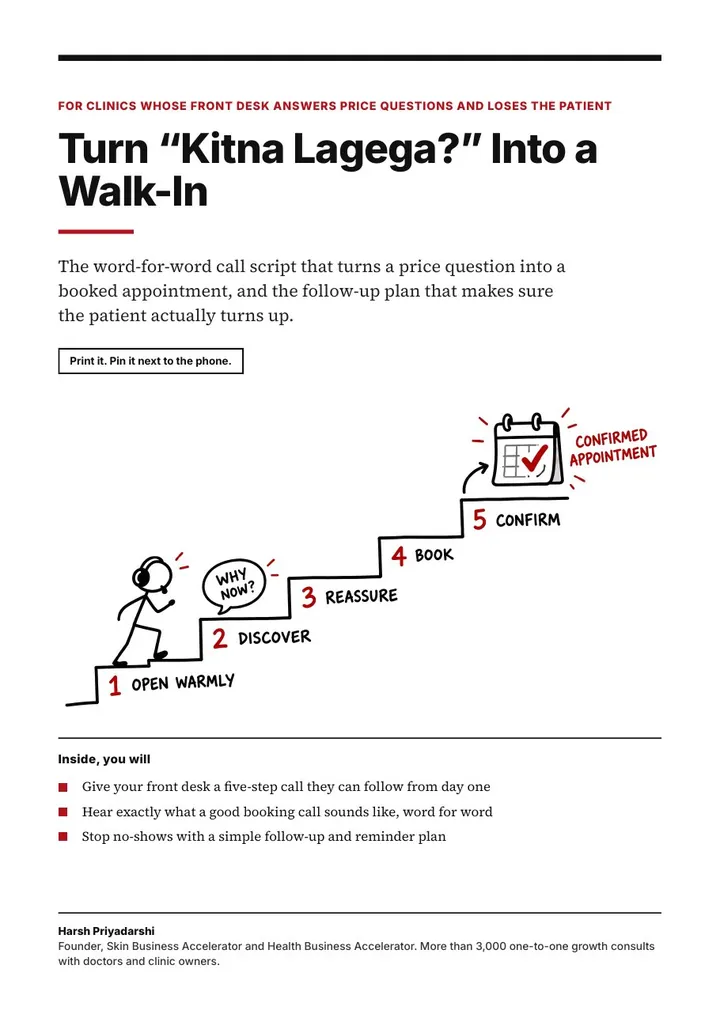
The structure does not change: open warmly, discover, reassure and show authority, book with two slots, confirm. Here is an example with a family caller. The names, slots and fee are illustrations.
Front desk: "Good morning, thank you for calling the clinic, this is Simran. How can I help?"
Caller: "Mere father ke ghutno mein bahut dard rehta hai. Doctor kitna lete hain?"
Front desk: "Main help karti hoon. Aapka naam? Aur papa ki age kya hai?"
Caller: "Main Rohit. Papa 68 ke hain."
Front desk: "Rohit ji, dard kab se hai? Aur abhi tak kya try kiya hai?"
Caller: "Do saal se. Medicines, physio, sab kiya. Ab seedhiyan nahi chadh paate."
Front desk: "Aur abhi doctor ko dikhane ka socha, koi khaas wajah?"
Caller: "Next month cousin ki shaadi hai, woh jaana chahte hain."
Front desk: "Samajh gayi. Doctor yeh problem roz dekhte hain, aur consultation mein woh papa ke ghutne check karke saare options likh kar denge. Consultation fee ₹1,000 hai. Kya aap aur papa saath aa sakte hain? Agar ghar mein koi aur bhi decision mein involved hai, unhe bhi le aaiye. Mere paas Wednesday 11 baje ya Saturday 5 baje ka slot hai. Kaunsa better rahega?"
Caller: "Saturday 5 baje."
Front desk: "Done. Main abhi WhatsApp par location bhej rahi hoon, nearest Metro aur parking ke saath. Papa ki saari reports aur X-rays le aaiyega."
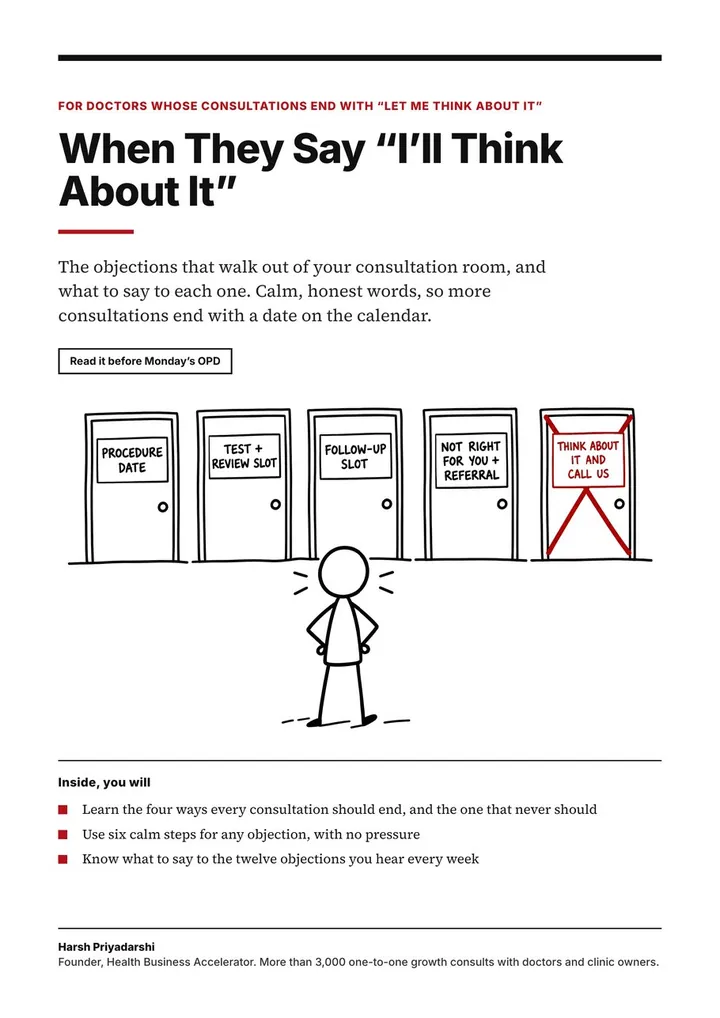
Notice the two extra moves for Delhi. Simran asked about the patient, not just the caller. And she invited the people who will decide.
How fast should a Delhi front desk respond?
Within five minutes, ideally within thirty seconds. In a city full of clinics and hospitals, a family looking for a knee specialist has probably messaged three of them. Whoever responds first, and sounds like they care, usually gets the visit.
Set it up so every new lead triggers an instant WhatsApp message and an alert to the front desk. If the caller does not pick up, follow the cadence: three attempts on day one, then days two, four, seven and fourteen, mixing calls and short useful messages.
Cover the times people actually call. Many working family members in Gurugram and Noida call during lunch or after office. Check your call logs for when calls arrive and when they go unanswered. That gap is your first fix. Our CRM and WhatsApp work automates the instant reply and alerts.
How should the front desk handle out-of-town families?
They need a different kind of help. A family travelling from another state is spending a day, sometimes two, plus travel costs. They want to make one trip count.
- Ask which reports they already have, and ask them to send photos on WhatsApp before the visit.
- Tell them which tests may be needed and whether they can be done on the same day.
- Offer a morning slot, so there is time for tests and a review in one visit.
- Send directions from the main railway stations or the airport, and the nearest Metro station.
- Tell them roughly how long to plan for, so they can book their return.
These small things decide whether the family books with you or with the hospital that made the trip feel easy.
How do you stop Delhi no-shows?
A booking is not an appointment until the family walks in. Send a WhatsApp confirmation the moment the call ends, with the date, time, doctor, location pin, nearest Metro station and gate, and parking. Send one useful message in between, like a short video from the doctor on what to expect. Remind them the day before, asking them to confirm, and again a couple of hours before. Call every no-show the same day, warmly.
On days when traffic or weather makes Delhi roads especially slow, a quick message in the morning offering to adjust the time saves both the slot and the relationship.
What does a missed call cost a Delhi clinic?
Here is an example. Say your clinic gets 200 calls a week and answers 160, an 80% answer rate. That is 40 missed calls. If half of them were new enquiries, and a quarter of those would have started a plan worth ₹80,000, that is 5 patients, about ₹4 lakh a week, going to the next hospital on the list.
Track answer rate, speed to first contact, booking rate and show rate every week. The target answer rate is at least 95% in working hours. Review three recorded calls a week with your team, with the caller's knowledge, and score each one out of five on the call structure. Our conversion systems and team training work set this up. See our Delhi page for how we work in the city.
The short version
- Expect family callers: ask who the patient is and who decides, and invite them all.
- Reply within five minutes in Hindi, Punjabi or English, and cover lunch and after-office calls.
- Help out-of-town families make one trip count, with reports and tests planned in advance.
- Confirm with Metro and parking directions, and remind before every visit.
- The full front desk system is in Good Doctors Go Broke.
Frequently asked questions
How should my front desk talk to a son calling about his father?
Warmly, and about the father. Ask the patient's name and age, the problem, how long it has been there, what has been tried, and why the family is looking now. Then ask who else is involved in the decision and invite them to the consultation. Offer two specific slots and confirm everything on WhatsApp.
Should a Delhi clinic front desk speak Punjabi?
If a meaningful share of your patients are more comfortable in Punjabi, having at least one person on each shift who speaks it helps a lot, especially with older patients. Ask your front desk to note each caller's preferred language for a month, and build your roster around what the data shows.
What should I tell patients who ask for the final package price on the phone?
Give an honest range and explain what it depends on, such as the patient's condition and the plan the doctor recommends. Explain that the family will get the exact all-inclusive plan in writing after the consultation. Then offer two specific slots. Quote the range from the same written fee sheet everyone uses.
How do I reduce waiting time complaints at my Delhi clinic?
Most waiting complaints come from overbooking and consultations that run long because the doctor is also explaining fees. Book realistic slot lengths, keep the doctor's role clinical, and hand fee and payment conversations to a coordinator. Tell patients honestly if the doctor is running late, by WhatsApp, before they arrive.
On a free growth call, my team traces your last month from enquiry to treatment and shows you your biggest leak in rupees.