Use ChatGPT for structure, not for facts or voice. Feed it the exact questions your patients ask and a transcript of you answering them in your own words, then ask for a short script in that style. Check every medical fact yourself, delete anything you would not say in OPD, and read it aloud before recording. If AI helps make promotional visuals, label them as the NMC rules require.
Picture an ENT surgeon showing me a script ChatGPT wrote for him. It begins: "Are you struggling with persistent nasal congestion that is affecting your quality of life? You are not alone."
I ask him, "Would you ever say that to a patient?"
He laughs. "I would say: naak band rehti hai raat ko? Mooh khol ke sote ho? Suno."
That is the whole problem with AI scripts in one exchange, and I have had some version of it with many doctors. The tool writes like a brochure. Patients trust a doctor, not a brochure. In Known Doctors Get Booked I write that AI can speed up scripts and editing, but your face and your voice are what build trust. Here is how to use it without losing either.
What is ChatGPT actually good at for doctor content?
Be clear about the job you are giving it.
| Let AI do this | Keep this for yourself |
|---|---|
| Turn your rambling answer into a tight order | Every medical fact and number |
| Suggest five opening lines to choose from | The final choice of opening |
| Cut a 4-minute answer into a 45-second script | What to leave out for safety |
| Turn a script into captions and a written post | Checking spellings of drug and condition names |
| Group 60 patient questions into topics | Deciding which topics fit your niche |
| Translate into Hindi or another language as a first draft | Making it sound like you in that language |
AI is a fast junior who has read everything and seen no patients. Use it like one.
How do I get ChatGPT to write in my own voice?
The secret is input. If you give it a topic, you get the internet's average. If you give it your words, you get something close to you.
- Collect real patient questions. Ask your front desk to write down the exact words patients use for a week. "Kaan mein seeti bajti hai" is a better starting point than "tinnitus".
- Record yourself answering one question. Use your phone's voice recorder. Talk the way you would to the patient in front of you. Three minutes is enough.
- Transcribe it. Most phones and many apps can do this now.
- Give ChatGPT both, with clear rules. Something like the prompt below.
- Ask for three versions, then pick and mix.
Here is a prompt you can adapt:
I am an ENT surgeon in Lucknow. Below is a question my patients ask, in their words,
and a transcript of me answering it.
Write a 45-second script for a reel, in Hinglish, using my phrases and my way of
explaining. Short spoken sentences. One idea only.
Do not add any facts, numbers or claims that are not in my transcript.
Do not use words like "best", "cure", "guaranteed" or "revolutionary".
Do not mention prices, offers or my clinic. End with a line inviting questions.
The line "do not add facts that are not in my transcript" matters most. Without it, the tool fills gaps with confident guesses.
How do I check what ChatGPT wrote?
Treat every AI draft as unverified. Here is the check I give doctors.
- Every number. If it says a percentage, a recovery time or a dose, cross it out unless you said it or can confirm it yourself.
- Any line that quotes a study, a survey or "research". Delete it unless you have read the source yourself. AI invents studies and sources that look real.
- Absolute words. Always, never, completely, permanent, painless. Your patients are not all the same, and these words become promises.
- Advice that sounds like a prescription. A reel should tell people what to watch for and when to see a doctor, not what to take.
- Phrases you would never say. "Embark on your journey", "holistic wellness", "you are not alone". Replace with how you talk.
- Anything off your niche. AI will happily drift from sinus to sleep apnoea to allergies. Pull it back to one idea.
Then the most important test: read it aloud. If you stumble, rewrite that line in your own words. If you would feel silly saying it in OPD, cut it.
Do I need to label content if ChatGPT helped write it?
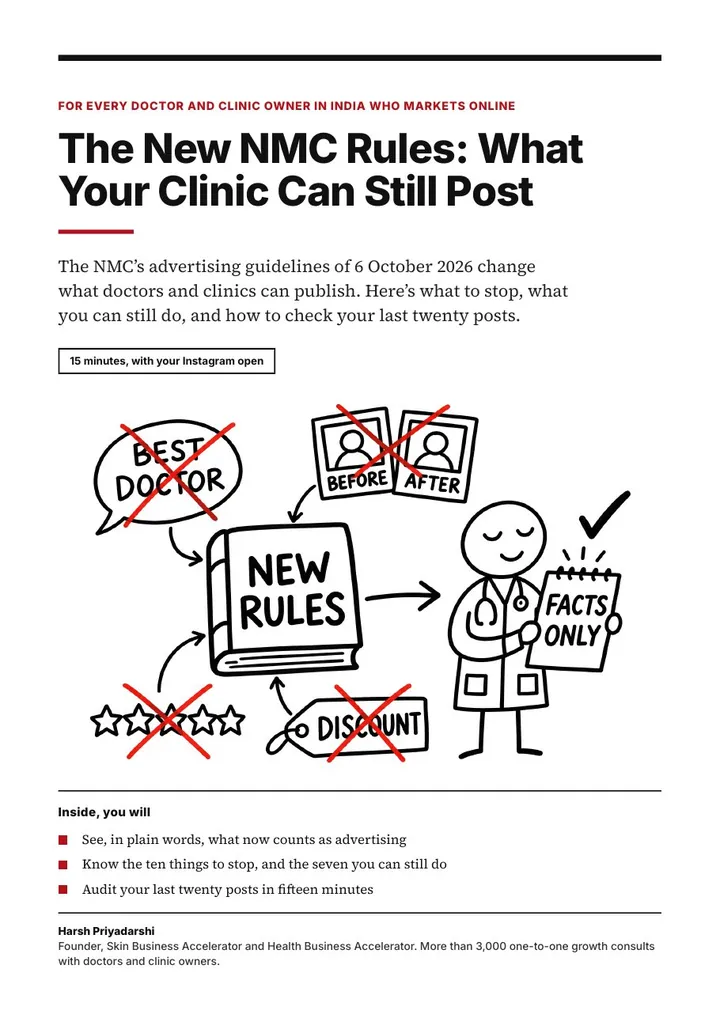
The NMC Guidelines on Ethical Advertising and Public Communication dated 6 October 2026 say AI-made promotional content must be labelled, and they do not allow synthetic testimonials or altered results. How that applies to a script you rewrote and spoke yourself, compared with AI-generated images, voices or video, is something you should read in the guidelines yourself, not take from a blog.
My practical rule: if AI made anything the viewer sees or hears, such as an image, an animation, a voice or a face, label it clearly. If AI only helped you organise your own words and you checked and spoke them yourself, keep a record of that process, and follow whatever the current guidelines say. When in doubt, label.
What does a good workflow look like each week?
Here is an example for a doctor who records in one weekly slot.
- Monday: front desk sends the week's patient questions.
- Tuesday: you record five voice-note answers in 15 minutes between patients.
- Wednesday: a team member runs them through ChatGPT with your prompt and sends you the drafts.
- Thursday: you check facts and edit in 20 minutes.
- Saturday: you record all five in your batch slot.
Say your own time drops from about three hours of script writing a week to about 40 minutes. That is more than two hours back for patients or family. The quality goes up too, because the scripts start from your real answers, not a blank page.
If you want this kind of workflow built around your clinic, our CRM, WhatsApp and AI and doctor authority teams set it up together. It works the same for an ENT surgeon or an orthopaedic surgeon.
The short version
- Use ChatGPT for structure and speed, never for facts or voice.
- Feed it your patients' exact questions and a transcript of you answering.
- Tell it not to add facts, claims, prices or "best" words.
- Check every number, delete every invented "study", and read the script aloud.
- If AI made anything viewers see or hear, label it, and read the NMC guidelines yourself.
Official sources
Rules change. Check the current version at the source before you act.
Frequently asked questions
Can I use ChatGPT to write Instagram captions for my clinic?
Yes, as a first draft. Give it your script or transcript and ask for a caption in your style, with no claims, prices or offers. Then check every fact, remove words like best or guaranteed, and make sure it sounds like you. Read the NMC guidelines on AI-made promotional content yourself.
Why do AI-written doctor scripts sound so fake?
Because the tool writes from the average of the internet, not from your OPD. It uses brochure phrases patients never hear from real doctors. Fix it by feeding it your patients' exact questions and a transcript of you answering in your own words, then editing the draft by reading it aloud.
Is it safe to trust medical facts from ChatGPT?
No. Treat every fact, number and reference as unverified. AI tools can invent studies, percentages and sources that look real. Tell the tool not to add facts that are not in your own words, and check anything it adds yourself before you record or post.
What is a good ChatGPT prompt for a doctor reel script?
State your speciality and city, paste a real patient question and your own spoken answer, then ask for a 45-second script in your language using your phrases. Add rules: one idea only, no new facts or numbers, no claims like best or cure, no prices or offers, and end with an invitation to ask questions.
On a free growth call, my team traces your last month from enquiry to treatment and shows you your biggest leak in rupees.