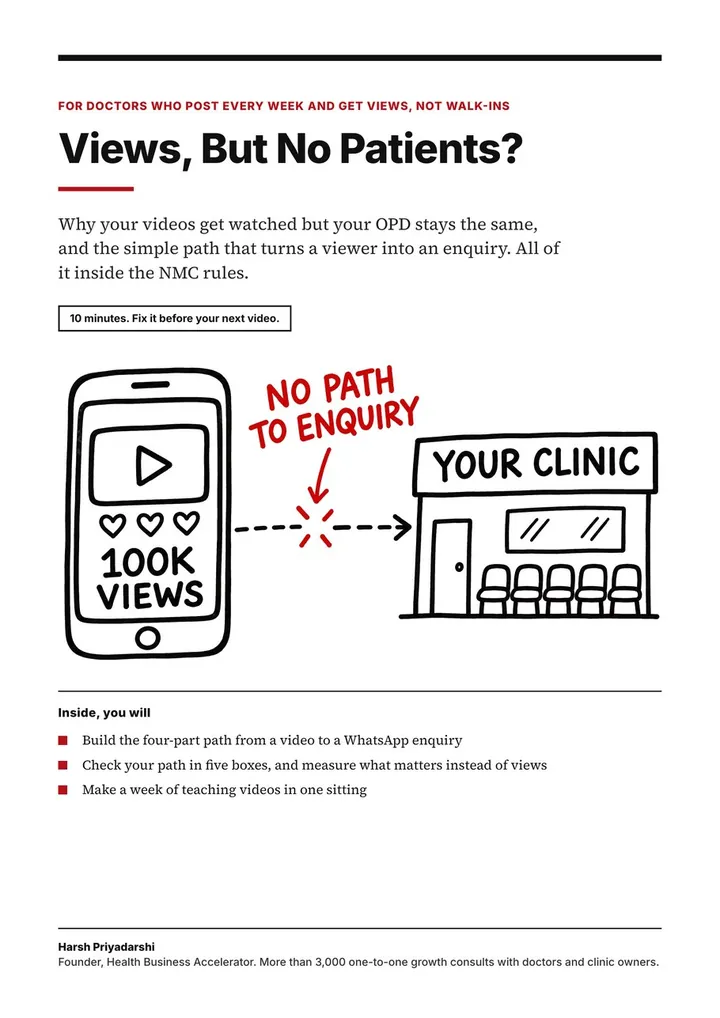
Busy doctors stay consistent by recording all their content in one fixed weekly slot instead of filming every day. Block about two hours, arrive with five to eight scripts already written from your patient map, record them back to back in a ready corner, and hand everything to one editor with a fixed turnaround. One session can cover a whole week of reels across every platform.
Almost every doctor I work with has tried to post daily at some point. They record a video between patients on Monday, another on Tuesday, miss Wednesday because of an emergency, feel guilty on Thursday, and stop by the end of the month.
It is not a discipline problem. It is a system problem. Recording every day means setting up the camera, the light and your head seven times a week, in the middle of OPD. Nobody lasts.
The fix is boring and it works: one fixed recording slot a week.
Why does recording daily fail for doctors?
Because your days are unpredictable and content is never urgent. A patient in front of you will always win over a video. So content gets pushed to "later", and later never comes.
Daily recording also wastes effort. Every session has setup time: finding a quiet corner, fixing the light, checking audio, thinking of what to say, getting into the right frame of mind. Do that seven times and you have spent hours on setup alone.
Quick maths: one video a day means 7 recording sessions a week. One batch slot with 7 videos means 1 session. Same 7 videos, six fewer setups.
What does a weekly recording slot look like?
Block a fixed time in your diary, the same day and time every week, and treat it like a surgery slot. Many doctors choose a quieter morning or the hour before OPD starts. Here is a sample two-hour plan.
| Time | What happens | Who |
|---|---|---|
| 0:00 to 0:10 | Corner ready, light and mic checked, phone on silent | Assistant |
| 0:10 to 0:20 | Doctor reads all scripts once, asks questions | Doctor, content person |
| 0:20 to 1:20 | Record 5 to 8 short videos back to back | Doctor, with prompts |
| 1:20 to 1:30 | Quick change of shirt or setting for variety | Doctor |
| 1:30 to 1:50 | Record one longer video or two talking points for YouTube | Doctor |
| 1:50 to 2:00 | Files handed to editor, next week's topics agreed | Content person |
Two hours a week. That is often less than the time doctors were losing to failed daily attempts.
What must be ready before the slot starts?
The slot only works if the doctor walks in and records. No thinking about topics in the room. So prepare these in advance:
- Scripts for every video, written from your patient map and the questions patients asked that week. Short, in your natural speaking style, with a strong first line.
- A fixed corner with the camera, light and microphone already set, so setup takes minutes.
- A prompter or printed scripts at eye level.
- Props, models or scans you will use, laid out in order.
- Two or three outfits if you want videos to look like different days.
- A next step for each video, like a comment keyword.
Ideally one person in your team, or your agency, owns the scripts and the session. The doctor's only job is to show up and speak.
Who does what after the recording?
Consistency breaks after recording as often as before it. Keep it simple: one editor, one style, one turnaround everybody sticks to.
- The editor cuts all videos within a fixed number of days, in a consistent style.
- The content person checks each video against your niche and adds captions, the next step and the post schedule.
- The doctor approves the batch in one go, not one video at a time.
- Each video goes out on Instagram Reels, YouTube Shorts and Facebook. Same effort, three times the reach.
How do you make a batch of videos not look like a batch?
Doctors worry that seven videos recorded in one sitting will look identical. A few simple tricks fix that:
- Change one visible thing every two or three videos: your shirt, the angle of the camera, standing instead of sitting, or moving from your desk to the procedure room.
- Mix formats inside the slot. A myth video talking straight to camera, a walkthrough holding a model, a rating video looking at a screen.
- Vary the energy. A warning signs video can be serious; a myth video can be lighter.
- Record the hook last if it needs a second take. Many doctors warm up during the session, so re-recording the first two or three openings at the end often gives better results.
Viewers do not watch your feed in one go, the way you do. They see one video at a time, days apart. Small changes are enough.
How do you keep going when a week goes wrong?
Weeks will go wrong. An emergency, a conference, a family wedding. Build in a buffer.
- Record a little extra when you can, so you always have one week of videos in reserve.
- Never cancel the slot; move it. If Tuesday is impossible, record on Thursday.
- Shrink, do not skip. On a bad week, record three videos instead of eight.
- Keep a library of evergreen scripts for the days you have nothing new.
Consistency is the whole game. Five videos one week and nothing for a month, and both the algorithm and your audience forget you.
What does one slot produce over a month?
Here is an example of the output from four weekly slots.
- 4 sessions x 7 short videos = 28 reels, posted on three platforms.
- 4 longer videos for YouTube, each cut into 5 short clips = 20 more short posts.
- Each long video also gives a blog post and a Google profile post.
That is a full month of content across every channel, from about eight hours of the doctor's time. Our doctor authority team runs this whole rhythm for busy surgeons, from scripts to posting.
How do you know it is working? Do not judge it by views. Track a few numbers monthly: how many weeks you actually recorded, DMs and comment keyword replies, enquiries that mention your videos, and patients who walk in saying, "I saw your video." When your front desk starts hearing that sentence, the slot is paying for itself.
The short version
- Daily recording fails because OPD always wins; one fixed weekly slot does not.
- Block about two hours, same day every week, and treat it like a surgery slot.
- Arrive to written scripts, a ready corner and a prompter. The doctor only speaks.
- Use one editor, one style, one turnaround, and approve videos in a batch.
- Keep a buffer and shrink rather than skip on bad weeks. The full system is in Known Doctors Get Booked, or book a free growth call.
Frequently asked questions
How much time does a doctor need for social media content each week?
With a batch system, about two hours a week of the doctor's own time is enough for most practices. That covers recording five to eight short videos and one longer video. Scripting, editing and posting are done by someone else, and the doctor approves the finished batch in one sitting.
How many videos can a doctor record in one session?
Five to eight short videos in an hour is realistic once scripts are ready and the corner is set up. Add one longer video in the same session if you are building a YouTube library. Changing your shirt or the background between a few videos keeps the feed from looking repetitive.
Should a doctor write their own video scripts?
Not necessarily. The ideas and medical substance must come from the doctor, often from the questions patients ask. A content person can turn those into short scripts in the doctor's natural speaking style. The doctor then reads them before recording and corrects anything that does not sound like them.
What if I miss a week of recording?
Keep one week of videos in reserve so missing a session does not break your posting. Never cancel the slot outright; move it to another day that week, or record fewer videos rather than none. Consistency over months matters far more than any single week.
On a free growth call, my team traces your last month from enquiry to treatment and shows you your biggest leak in rupees.