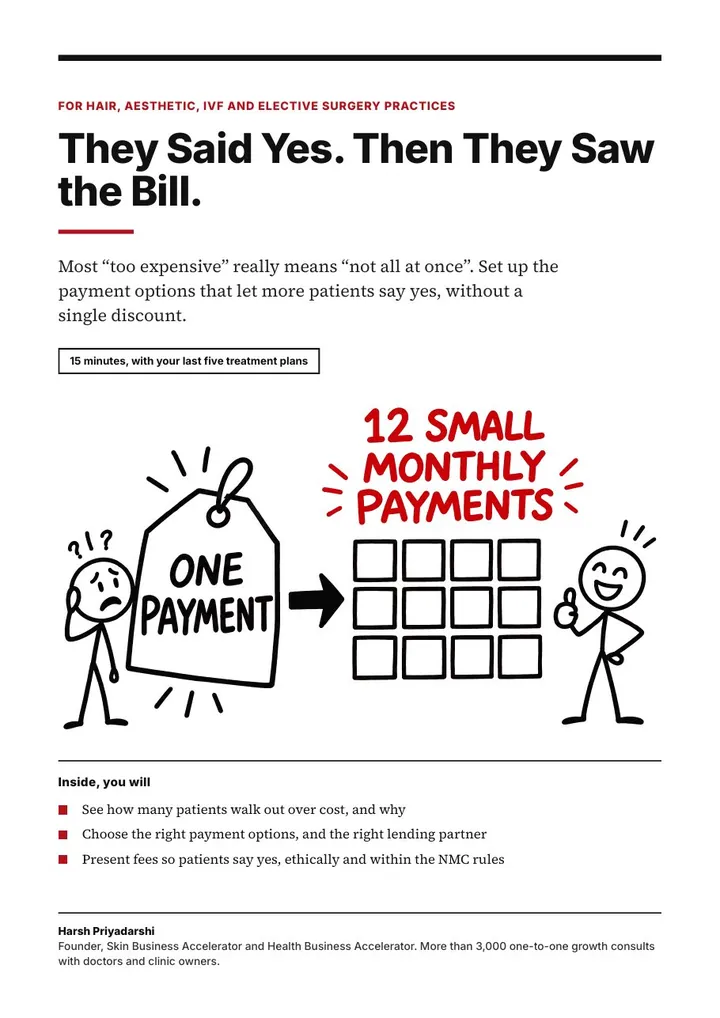
For treatments that need several visits to reach a result, price the whole plan, not each session. Per-session pricing makes every visit a new buying decision, so many patients stop halfway, get half a result and blame the clinic. A plan priced as one number, with milestones or EMI, means the patient decides once, completes more often and gets a better outcome. Single visits can still be priced alone.
Here is a pattern I see again and again, in physiotherapy, laser, dental and skin clinics alike.
The patient needs twelve sessions. The clinic charges per session. The patient comes for the first four, feels a bit better, and starts asking themselves before every visit: is it worth going again this week? Somewhere around session five, the answer becomes no.
The patient got a third of a result. The clinic got a third of the revenue. And when the problem comes back, the patient tells friends, "I tried that clinic, it didn't really work."
That is the hidden cost of pricing the visit instead of the outcome.
What is the difference between per-session and plan pricing?
Per-session pricing charges for each visit, session or unit: per physiotherapy session, per laser session, per peel, per graft.
Plan pricing, what many clinics call a package, charges one price for everything it takes to reach the outcome: the sessions, the reviews, the aftercare and the timeline, from start to finish.
The difference is not just the bill. It is what the patient is buying. With sessions, they buy visits. With a plan, they buy a result.
Why does per-session pricing quietly lose you money?
Every visit becomes a new buying decision. The patient decides again and again whether to come back, and many decide not to.
Patients drop out halfway. They get a half result, and often blame you for it.
Your average ticket stays low, because you are selling one visit at a time instead of the whole journey.
Plan completion falls, which means fewer good results, fewer reviews and fewer referrals.
Your front desk works harder for less. Every visit has to be sold, booked and chased separately, often by the same person who is also answering new enquiries.
Here is an example. Say a physiotherapy clinic charges ₹800 a session, and a typical rehab needs 15 sessions. If the average patient stops after 5, revenue per patient is ₹4,000. Now offer a 12-week rehab plan for ₹12,000, covering 15 sessions, a home exercise programme and a final review, with milestone payments. The price per session hasn't changed at all. But a patient who completes the plan is worth three times as much, and gets the result they came for.
What does a plan look like in different specialities?
| Speciality | Pricing the visit | Pricing the plan |
|---|---|---|
| Physiotherapy | A fee per session | A 12-week return-to-activity plan: assessment, sessions, home programme and a final review |
| Dental | A fee for each filling or visit | A full treatment plan for the mouth, with every step, its timeline and review visits |
| Hair restoration | A price per graft | A hairline restoration plan: the procedure, medicines, supporting sessions and reviews through the first year |
| Laser hair reduction | A price per session | A full course for the area, including the touch-ups usually needed, with reviews |
These are examples of structure, not clinical advice. Your own protocols decide what goes into each plan.
How do you turn your sessions into a plan?
- Start from the outcome. What exactly will the patient have at the end? "Walking without pain to the market" beats "15 sessions".
- List every step it takes, including the ones patients usually pay for separately.
- Set the timeline. When each step happens, and when they should expect results.
- Include the follow-ups and aftercare. This is where results are protected, and where most clinics cut corners.
- Price the whole plan as one number.
- Offer a simple payment schedule. Milestones across the phases, or EMI, so the patient can say yes to the full result.
Then build three versions of it, Basic, Recommended and Complete, and recommend one.
When does per-session pricing still make sense?
Plans are for treatments where the result needs several visits. Some things are naturally one visit.
- The consultation itself, which stays a separate, paid visit.
- Genuinely one-off procedures, where there is no course to complete.
- Maintenance after a plan is complete, such as top-up sessions or yearly reviews, which can be priced per visit or as a simple yearly plan.
If you are unsure, ask one question: does the patient need more than one visit to get the outcome they came for? If yes, price the plan.
What changes in your numbers when you switch?
Four numbers usually tell you whether the switch is working. Track them for eight to twelve weeks after you change.
Average ticket should rise, because each patient now buys the whole journey.
Plan completion should rise, because the decision was made once, at the start.
Cash flow becomes more predictable. Milestone payments arrive on a schedule tied to the phases of the plan, instead of whenever the patient decides to come back.
Reviews and referrals follow completion. Patients who finish get the result, and patients who get the result talk about it.
Change one thing at a time while you watch. If you switch to plans and change your ads in the same month, you won't know which one moved the numbers.
How do you stop patients dropping out of a plan?
A plan helps, but it doesn't run itself. Four habits protect completion.
Book every visit on the day the patient says yes. Not "we'll call you for the next one." Every date in the calendar from day one.
Call every missed visit within a day. Warmly, with two new slots.
Celebrate milestones. A message or call when the patient finishes a phase reminds them how far they have come.
End every plan with a completion review, and book the next review before they leave.
Plan completion and long-term care are the heart of our retention and reactivation work. Physiotherapy and dental practices are where the switch from sessions to plans usually makes the biggest difference. The full method is in Chapter 4 of Good Doctors Go Broke, and you can book a free growth call to work through your own treatments.
The short version
- Per-session pricing makes every visit a new decision, so many patients stop halfway.
- A plan priced as one number means the patient decides once and commits to the result.
- In the example, the same ₹800 per session earns three times as much per completed patient.
- Build plans from the outcome, include aftercare, and offer milestones or EMI.
- Keep single visits per-session, and protect plans by booking every visit up front.
Frequently asked questions
Should my clinic sell treatment packages or charge per session?
For any treatment that needs several visits to reach the result, sell a plan priced as one number. Per-session pricing makes patients decide again before every visit, and many drop out halfway. Keep the consultation, genuine one-off procedures and post-plan maintenance priced separately, since those are naturally single visits.
Isn't a package just a discount on sessions?
It doesn't have to be. In a good plan, the price per visit can stay exactly the same. What changes is that the patient buys the whole outcome, including reviews and aftercare, and commits to completing it. Plans increase revenue through completion, not through cutting your price.
How do I stop patients leaving a treatment plan halfway?
Book every visit on the day the patient says yes, so all the dates are in their calendar. Call any missed visit within a day with two new slots. Send a message when they finish each phase. And end every plan with a completion review, booking the next review before they leave.
How should patients pay for a treatment plan?
Give them choices: full payment, milestone payments tied to the phases of the plan, and EMI through a lending partner, with the monthly figure shown beside the total. That lets patients say yes to the full result without paying everything on day one, and keeps your cash flow predictable.
On a free growth call, my team traces your last month from enquiry to treatment and shows you your biggest leak in rupees.