A Kolkata front desk should answer at least 95% of calls, greet in Bengali and switch to Hindi or English easily, and reply to WhatsApp within five minutes. Turn "book a serial" calls into proper booked appointments: ask about the problem and the reason for calling now, offer two specific chamber slots, and confirm on WhatsApp with the chamber address, day and time.
In many Kolkata chambers, the phone call goes something like this.
"Doctor babu kobe bosben?" When does the doctor sit?
"Tuesday and Friday, six o'clock."
"Ekta serial dite parben?" Can you give me a serial?
"Name bolun." Tell me the name.
A name is written in a register. Serial number fourteen. Nobody asks what the problem is, how long it has been there, or whether this person needs the doctor at all. Nobody confirms the chamber address. And on Friday evening, serial fourteen does not turn up, because something came up and nobody reminded them.
The serial system works for a busy OPD. But it treats every caller the same, and it loses the patients a clinic most wants to keep.
What should a Kolkata front desk measure?
Four numbers, every week.
| Number | Benchmark | What to watch in Kolkata |
|---|---|---|
| Answer rate | At least 95% in working hours | Calls to chamber numbers on days the doctor is elsewhere |
| Speed to first contact | Under 5 minutes, ideally 30 seconds | WhatsApp and form leads, not just calls |
| Booking rate | 25 to 40% of enquiries | Whether callers get a real appointment or just a serial |
| Show rate | 60 to 75% of bookings | District patients travelling by train or road |
If you sit at several chambers, the first fix is usually one central number and one desk that books for every location. Today, many chamber phones are answered only on the days the doctor sits there, by whoever is at the pharmacy counter. On the other days, the calls ring out. A patient who calls on Monday for a Friday chamber should still reach someone who can book them, answer a question and send the details. That single change often lifts bookings within weeks.
How do you turn a serial into a real booking?
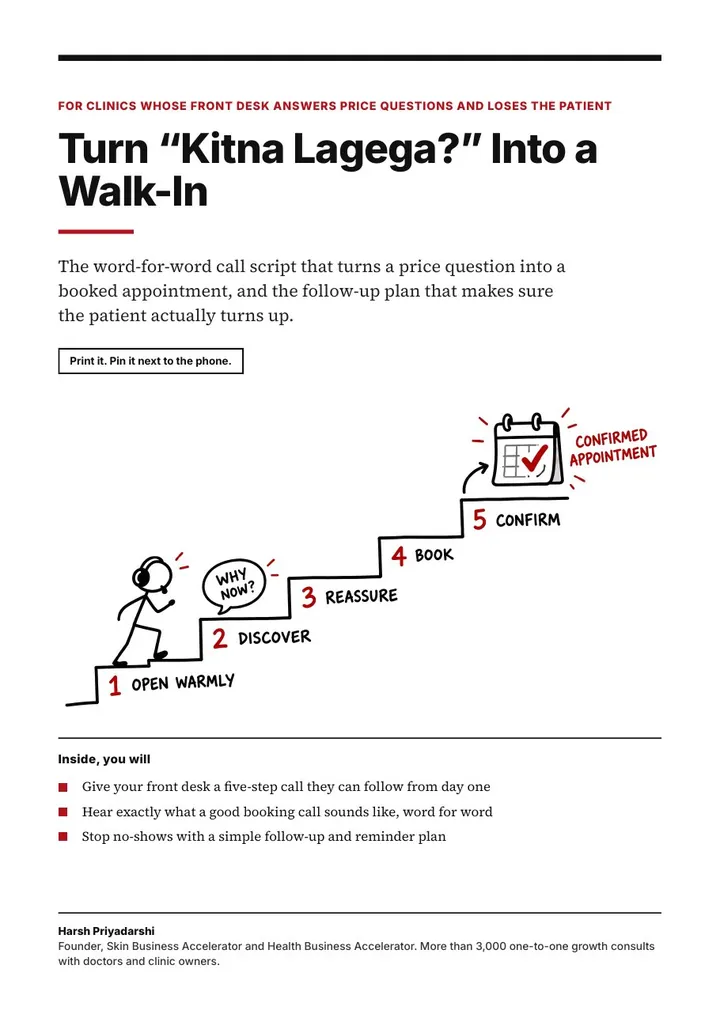
Keep the speed of the serial system, but add the five steps of a good call: open warmly, discover, reassure, offer two slots, confirm.
Here is the same call done well. Names, timings and fees are just examples.
Front desk: "Nomoskar, this is the clinic, Mitali speaking. How can I help?"
Caller: "Doctor babu kobe bosben? I want a serial for my father."
Front desk: "Of course. May I know your father's name and what the problem is?"
Caller: "Pradip Ghosh. He has had stomach pain and acidity for months. The medicines from the pharmacy are not helping."
Front desk: "I understand. Has he had any tests done?"
Caller: "An ultrasound last year."
Front desk: "Please bring that. Is there something that made you call today?"
Caller: "He has lost some weight, and my mother is worried."
Front desk: "Thank you for telling me. Doctor sees patients with long-standing stomach problems every day and will check carefully. He sits in Salt Lake on Tuesday at 6 and in Behala on Friday at 6. Which chamber is closer for you?"
Caller: "Behala."
Front desk: "I have Friday at 6.15 or 6.45. Which is better?"
Caller: "6.15."
Front desk: "Done. The consultation fee is ₹800. I am sending the Behala chamber address, a map pin and the time on WhatsApp now, and we will remind you on Thursday."
The caller asked for a serial. He got care, questions, a reason, the right chamber, a specific time and a confirmation. And the desk now knows this patient may need prompt attention, so the doctor can be told before Friday.
How should the desk handle languages?
Kolkata patients may speak Bengali, Hindi or English, and many mix them.
- Greet in Bengali, then follow the caller's language. Never make a caller switch.
- Have Hindi on every shift, for Hindi-speaking families in the city and patients from neighbouring states.
- Keep scripts and WhatsApp templates in Bengali, Hindi and English, each written naturally.
- For callers from Bangladesh or the Northeast, be patient with accents and dialects, and confirm details in writing on WhatsApp.
How do you make district patients show up?
Many patients travel into Kolkata by train or road from the districts. A missed appointment costs them a whole day.
- Ask where they are travelling from during the call, and offer a slot that fits the journey.
- Tell them how long the visit usually takes, and whether tests can be done the same day.
- Confirm on WhatsApp with the chamber address, a map pin, the nearest station or landmark, and what to bring.
- Call the day before to confirm, rather than relying on a message alone.
- If they miss it, call the same day, warmly, and rebook.
For city patients, remind them the day before and a couple of hours before, and call every no-show the same day.
How fast should WhatsApp replies be?
An automatic reply the moment a message arrives, in the language they wrote in. A person within five minutes during working hours. Then three attempts on day one, and days two, four, seven and fourteen. Outside hours, a message saying exactly when someone will call, and a callback first thing. Our CRM, WhatsApp and AI work sets up the shared inbox and alerts.
What about the common phone objections?
"Just tell me the fee for the operation." Give an honest range, explain what it depends on, and offer a consultation slot.
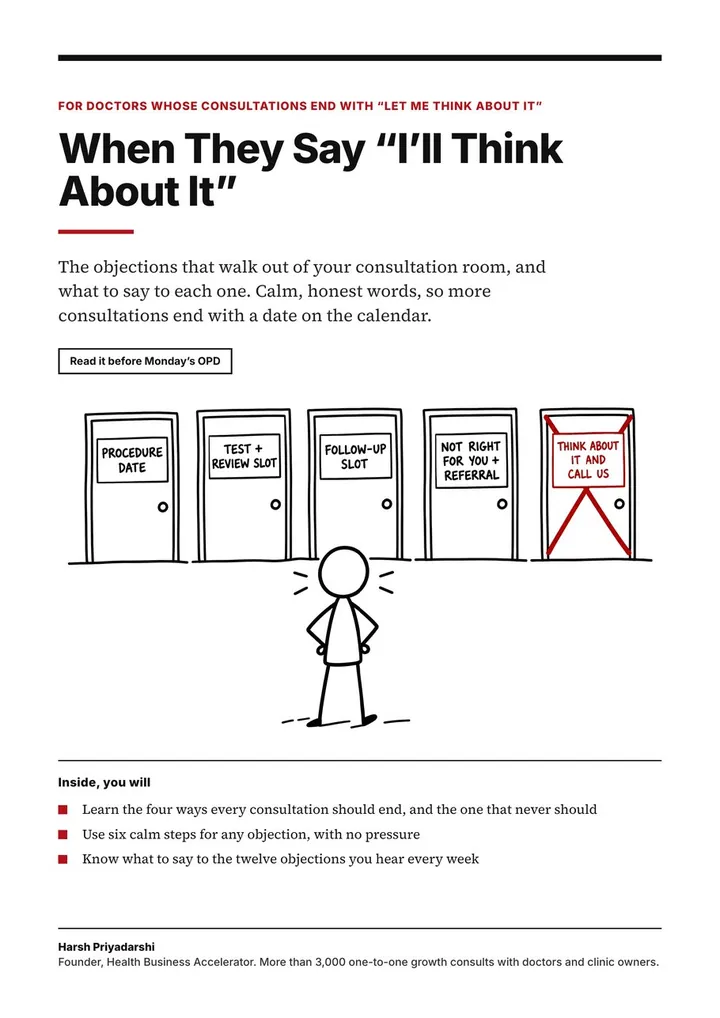
"We will talk at home and call back." Ask what the family would like to know, answer it, and offer to hold the slot. Suggest the family member who decides comes to the consultation too.
"Another doctor gives a cheaper serial." Do not argue. Explain what the consultation includes and let them choose.
Practise these on a quiet afternoon each week. One person plays a worried son calling from Asansol, another answers, and the team scores the call on the five steps. Then listen to three real recorded calls from that week. Our front desk and conversion work writes the Bengali and Hindi scripts, and our team training runs the practice sessions.
We work with clinics across India, including Kolkata, mostly on video calls. See our Kolkata page.
The short version
- Measure answer rate, speed to lead, booking rate and show rate every week, across every chamber.
- Keep the speed of serials but add the five steps: open, discover, reassure, two slots, confirm.
- Greet in Bengali, follow the caller's language and keep Hindi on every shift.
- Plan district patients' visits around their journey and call the day before.
Frequently asked questions
How do I replace the serial system at my Kolkata chamber?
You do not have to remove it. Keep quick bookings, but have the desk ask the problem, how long it has been there and why now, then offer two specific times instead of just a number. Confirm the chamber, day and time on WhatsApp and remind patients the day before.
What languages should my clinic front desk speak in Kolkata?
Bengali for most callers, Hindi on every shift for Hindi-speaking families and patients from neighbouring states, and English for professionals and others. The desk should greet in Bengali, then follow whatever language the caller uses. Keep scripts and WhatsApp templates in all three.
How do I reduce no-shows from patients coming from the districts?
Ask where they are travelling from and offer a slot that fits the journey. Tell them how long the visit takes and what to bring. Confirm on WhatsApp with the address and map pin, and call the day before. If they miss it, call the same day to rebook.
Should one desk handle bookings for all my chambers?
Usually yes. One central number and one desk, working from one CRM, means calls are answered even on days you sit elsewhere, patients are booked into the right chamber, and every enquiry is tracked. Chamber staff can then focus on patients who are physically there.
On a free growth call, my team traces your last month from enquiry to treatment and shows you your biggest leak in rupees.