Ethical medical marketing means never guaranteeing results, never selling with fear or shame, never inventing urgency with countdown offers, never faking or buying reviews, never using patient material without written consent, never paying for referrals and never pushing bigger treatment than a patient needs. These lines apply to the whole patient journey, from the ad to the front desk, the consultation and the follow-up.
Most conversations about medical marketing ethics stop at the ad. What can the post say? What can the reel show?
That matters. But in my experience, the biggest ethical slips in clinics don't happen in the ad at all. They happen at the front desk, in the consultation room and in the follow-up calls, where nobody from the platform is watching.
A clinic can run spotless ads and still pressure an anxious patient into a plan she doesn't need. That isn't ethical marketing. It's ethical advertising with unethical selling behind it.
So here are the lines I hold every clinic we work with to, across the whole patient journey.
What are the lines a clinic should never cross?
- Never guarantee a result. Medicine has no guarantees, and patients know it. Promise your process and your care instead.
- Never sell with fear or shame. Don't make people feel bad about their bodies or frighten them into booking.
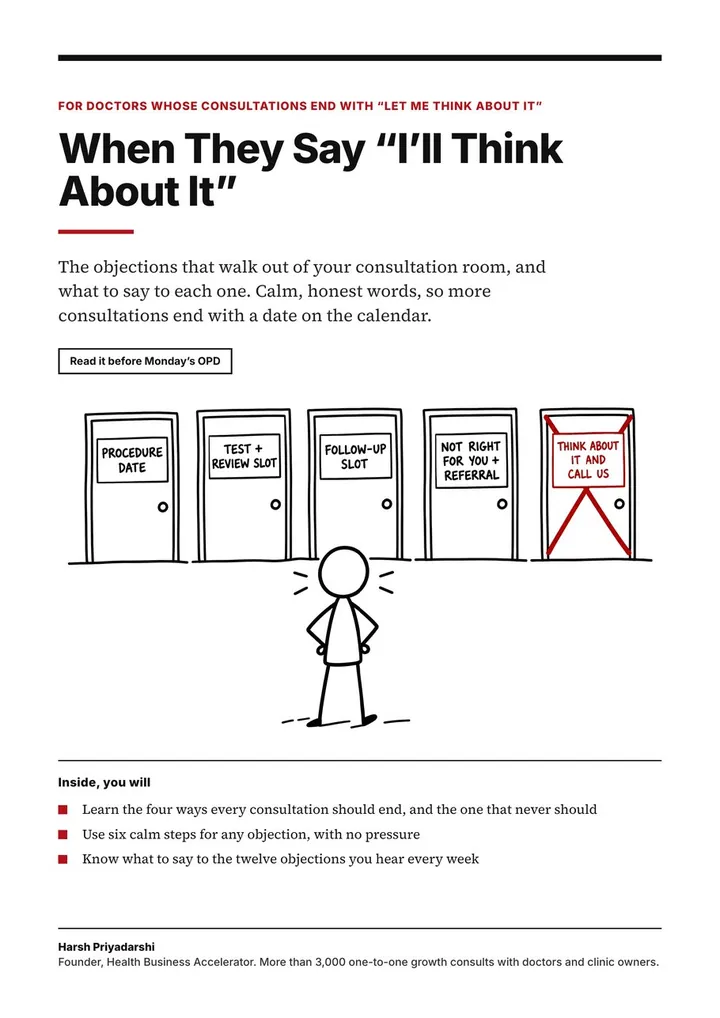
- Never invent urgency. "Book before Sunday and save" belongs in a shoe shop, not a clinic. The only real urgency is the patient's own "why now": a wedding, a fall, a family function.
- Never fake, buy or incentivise reviews. Ask every genuine patient, never offer anything in return, and never post fake ones.
- Never use a patient's face, story or result without written consent, and never reveal medical details when replying to a review.
- Never pay for referrals. Commissions and cuts to other doctors, labs or agents are kickbacks.
- Never push a bigger plan than the patient needs. Every option you offer must be honest, and your recommendation stays clinical.
- Never hide the full cost. If you offer EMI, explain the total cost, including any interest and charges.
- Never let AI give medical advice or pretend to be human. It books appointments; the doctor gives the advice.
- Never message people who haven't agreed to hear from you, and keep every patient's data private.
Where do these lines get crossed in a real clinic?
Rarely where doctors expect. Here's where I see each one slip, stage by stage.
| Stage | How the line gets crossed | What to do instead |
|---|---|---|
| Ads and content | "Guaranteed results", "best clinic", fear-based hooks | Educate; promise your process, not outcomes |
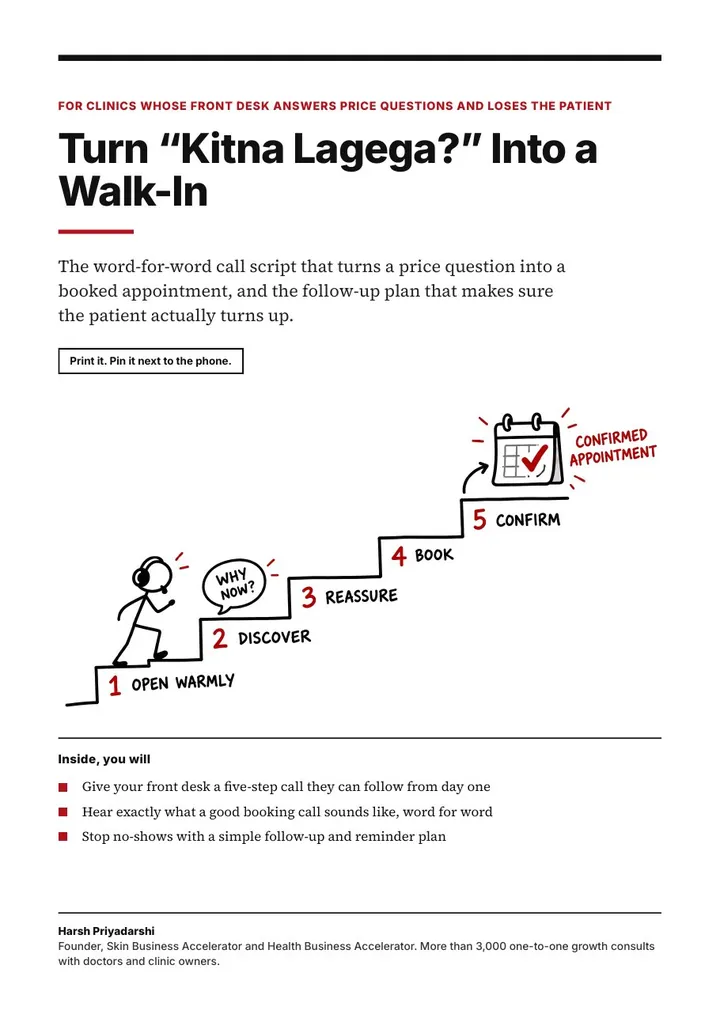
| Front desk call | "Offer ends today, book now" | Ask the patient's "why now" and offer two slots |
| Consultation | A fake Basic option built to push people towards Complete | Three honest options, one clinical recommendation |
| Fee conversation | Discounts as pressure, or EMI pushed on someone uncomfortable | One fee sheet; financing explained fully and offered to everyone as a normal option |
| Follow-up | Ten "just checking in" calls a week | A fixed, helpful schedule: same day, next day, days 3, 7 and 14 |
| Reviews | Discount for a five-star review | Ask everyone at the right moment, offer nothing in return |
| Partnerships | A "cut" per patient sent to a lab or another doctor | Partnerships based on real value, transparency and patient choice |
Notice how many of these are sales behaviours, not marketing. That's why ethics has to be built into your SOPs, scripts and incentives, not just your ad approval process.
Why do incentives decide whether a clinic stays ethical?
Because people do what they're paid to do.
Pay a coordinator a percentage of plan size, and some patients will leave with more treatment than they need. Pay a front desk person per booking, and you'll get bookings that were never going to show up. Pay an associate doctor only on billing, and you'll get billing.
So reward the right result: show-ups for the front desk, treatments started for the coordinator, fixed pay plus a quality-checked incentive for doctors. And put guardrails beside every incentive. Track refund requests and complaints. Review a sample of recorded conversations every week.
Watch out: A coordinator who pushes patients into plans they regret will cost you far more in reputation than any target they hit.
Doesn't ethical marketing grow slower?
In my experience, it's the opposite over any period longer than a few months.
Discounts and countdown offers create spikes, then dead weeks in between, because patients learn to wait for the next sale. Fear-based ads bring anxious patients who often don't complete their plans. Fake reviews can get your Google profile restricted. And kickbacks turn every referral relationship into an auction that ends the moment someone else pays more.
Honest marketing compounds. Patients who were told the truth complete their plans, come back, leave genuine reviews and send their families. That's the cheapest patient acquisition there is.
There's a money reason too. Here's an example. Your plan is ₹1,00,000 and the direct cost is ₹40,000, so you make ₹60,000 per patient. A 20% "offer" drops the price to ₹80,000 and your profit to ₹40,000. You'd need 50% more patients just to stand still. Pressure tactics aren't only unethical. They're usually bad business.
How do you build ethics into the clinic, not just the ads?
Make it part of the system, so it doesn't depend on anyone's mood on a busy day.
- Write the lines into your front desk and coordinator SOPs.
- Give the team one discount line, word for word: "Our fees are the same for every patient. If budget is a concern, we can look at another plan or spread the payment."
- Keep written consent for every patient image and story, stored in one place.
- Set AI guardrails: no medical advice, no promises, nothing outside the fee sheet, always identified as an assistant.
- Review recorded calls and consultations every week, and act on what you hear.
- Read the current National Medical Commission regulations and platform policies, and take legal advice when unsure.
This is how we build conversion at HBA: no pressure, no discounts, no fake urgency. You can see how in our front desk and conversion work and our positioning and doctor authority work. The full rules are in Good Doctors Go Broke and Known Doctors Get Booked.
The short version
- Ethics covers the whole patient journey, not just the ad.
- Never guarantee results, use fear, invent urgency, fake reviews or pay for referrals.
- Use patient material only with written consent, and explain the full cost of any financing.
- Reward the right results and put guardrails beside every incentive.
- Honest marketing compounds into completed plans, genuine reviews and referrals.
Official sources
Rules change. Check the current version at the source before you act.
Frequently asked questions
Is it unethical for a clinic to run discount offers?
In my view, limited-period discounts and countdown offers don't belong in medicine. They rush a medical decision, train patients to wait for the next sale and quietly shrink your margin. If budget is the concern, change the scope to a simpler plan or spread the payment with milestones or EMI, explained honestly, instead of cutting the price.
Can a clinic use fear in its health awareness posts?
You can talk honestly about risks, but never use fear or shame to sell a treatment. There's a difference between "knee pain on the stairs is often the first sign of arthritis" and frightening someone into booking. Educate about the problem, explain what helps and let the patient decide. Platform rules also restrict ads that make people feel bad about themselves.
Is it ethical to call patients repeatedly after an enquiry?
Following up is part of caring for an enquiry, but it should follow a fixed, reasonable schedule and every message should be genuinely useful. Three attempts on day one, then days two, four, seven and fourteen, mixing calls with short WhatsApp messages, is a sensible pattern. Only message people who agreed to hear from you, and stop if they ask.
Who is responsible if my marketing agency posts something misleading?
You are, because it goes out under your name and your registration. Brief your agency on the rules in writing, approve anything that shows a patient or makes a claim, and check AI-written content line by line. Read the current National Medical Commission regulations yourself, and take legal advice if you're unsure about any campaign.
On a free growth call, my team traces your last month from enquiry to treatment and shows you your biggest leak in rupees.