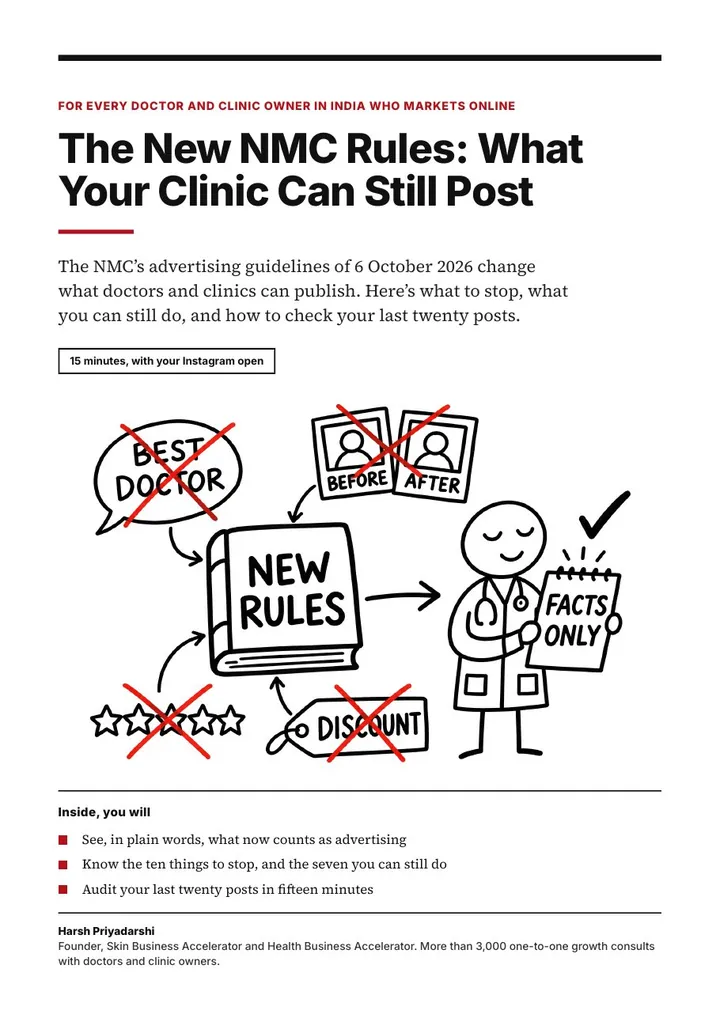
Clinics should stop festival discounts because a discount needs far more patients just to make the same profit, tells patients your price was never real, trains them to wait for the next sale and attracts patients who complete plans less. Keep your fees the same all year. Add value instead of cutting price, offer payment options, and speak to the patient's own reason for acting now.
Every October, the same thing happens.
Clinic pages fill up with "Diwali Dhamaka: 30% off laser!" and "Festive Glow Package, this week only!" Enquiries jump. The front desk is busy. The doctor feels good about the month.
Then November comes, and enquiries collapse. The diary is empty until the next festival. And patients who missed the offer start asking, "Next sale kab hai?" (When's the next sale?)
One story in my book is an aesthetic clinic that ran a discount for every festival, every season and every slow week. Enquiries spiked during offers and died in between. Patients had learned to wait for the next sale, and margins kept shrinking.
We ended every discount and limited-period offer. The bargaining stopped, the patients who came in were more serious, and the clinic's margins recovered.
Why do festival offers feel like they work?
Because the spike is easy to see, and the damage isn't.
You see the busy week. You don't see the patients who would have paid full fee anyway and now paid less. You don't see the patients who waited for the offer instead of booking in September. And you don't see the profit, because most clinics never calculate it per plan.
There is also a quieter cost. Every week your team spends answering "is the offer still on?" is a week they are talking about price instead of the patient's problem. The whole clinic starts to sound like a shop, and the patients you most want, the ones who care about outcomes, notice.
What does a festival discount really cost?
Here is an example. Say a plan is ₹60,000 and the direct cost of delivering it is ₹24,000. Profit per patient is ₹36,000.
Now run a 25% Diwali discount. The price drops to ₹45,000. The cost is still ₹24,000. Profit falls to ₹21,000.
To make the same total profit as before, you need ₹36,000 ÷ ₹21,000, which is about 1.7 times as many patients. A 25% discount needs roughly 70% more patients just to stand still.
| Normal fee | 25% festival discount | |
|---|---|---|
| Price | ₹60,000 | ₹45,000 |
| Direct cost | ₹24,000 | ₹24,000 |
| Profit per patient | ₹36,000 | ₹21,000 |
| Patients needed for ₹3.6 lakh profit | 10 | About 17 |
Seventeen patients' worth of work, consumables and doctor time, for the profit of ten.
What does a discount teach your patients?
The money is only part of it.
It tells patients your price was never real. If you can drop it by 25% for Diwali, why was it so high in September?
It trains patients to wait. The ones who paid full fee feel cheated. The next ones learn to hold out for the next festival, or bargain for the offer price in March.
It attracts the wrong patients. In our experience, the patient who came for the discount complains more, follows the plan less and refers less.
It cheapens a medical decision. "Book before Sunday and save" belongs in a shoe shop, not a clinic. A treatment decision should never be rushed by a countdown.
Are countdown offers a problem for medical advertising?
Stay careful here. Medical advertising should be truthful, avoid misleading claims, never guarantee results and never sell with fear, shame or false urgency. Discount-led, limited-time medical offers sit uncomfortably next to those principles, and each ad platform has its own rules on health ads as well.
The rules for doctors and for each ad platform change, so check the current NMC regulations and platform policies before any campaign. The safer path is also the more profitable one: honest, educational, outcome-led messages without countdowns.
What should you do in festive season instead?
Festivals are still a real moment. Families gather, weddings cluster, people travel home. Patients do have a "why now" at this time of year. Speak to that, without cutting your price.
- Keep one fee sheet, all year. Same price in October as in June.
- Add value, permanently, for everyone. An aftercare kit, an extra review visit, a longer follow-up. Not a festival gift, a better plan.
- Talk about real timelines. If a treatment takes months to show results, tell patients honestly when they would need to start for a wedding or family event.
- Make paying easier, not cheaper. Milestone payments and EMI with the monthly figure beside the total.
- Use the season for education. Short videos answering what patients ask most, a talk at a community event, reviews from patients who completed their plan.
- Plan your capacity. If demand rises before weddings, make sure slots and staff are ready so the patients who come don't wait.
How do you stop if you've run offers for years?
Expect patients to ask. Give your front desk one line, word for word: "Our fees are the same for every patient, all year. If budget is a concern, we can look at another plan or spread the payment."
Some patients will mention the old offer. Don't apologise and don't argue. Thank them, explain warmly that fees are now the same for everyone, and show them the value that is now in every plan, such as the extra review or the aftercare kit.
Change it everywhere on the same day: website, social pages, condition pages and every script. Then watch your booking rate, consult conversion and average ticket for eight to twelve weeks before you judge it. Change one thing at a time.
Positioning is what lets you hold your price. When patients see you as the specialist for their exact problem, they stop shopping for an offer. That is the work of doctor authority, and our patient acquisition work brings in patients with ads built on outcomes, not offers. If you run an aesthetics clinic, where festival offers are most common, this matters even more. The full discount maths is in Chapter 4 of Good Doctors Go Broke, and you can book a free growth call to talk it through.
The short version
- Festival offers show you the busy week and hide the lost margin and the empty month after.
- A 25% discount on a ₹60,000 plan with ₹24,000 cost needs about 70% more patients to stand still.
- Discounts teach patients to wait and bargain, and attract patients who complete less.
- Keep one fee sheet all year, add value instead, and make paying easier with milestones or EMI.
- Use festive season for honest timelines and education, and check current NMC and platform rules.
Official sources
Rules change. Check the current version at the source before you act.
Frequently asked questions
Should my clinic run a Diwali offer?
In my framework, no. A Diwali discount fills the diary briefly but cuts your profit per patient sharply, trains patients to wait for the next festival and makes your normal fee look unreal. Keep your fees the same all year and use the season for education, honest treatment timelines and easier payment options.
How do I get patients during festive season without discounts?
Speak to the real reasons patients act at that time, such as weddings and family gatherings, and tell them honestly when treatment would need to start. Add value permanently, like an extra review or aftercare kit, offer milestone payments and EMI, and publish useful content answering common questions.
Will I lose patients if I stop giving discounts?
You may lose some patients who only came for the offer. In our experience, those patients complain more, follow plans less and refer less. The patients who stay are more serious. Give your front desk a clear line explaining fees are the same all year, and watch your numbers for eight to twelve weeks.
Are discount ads allowed for doctors in India?
Rules for medical advertising change, so check the current NMC regulations and each ad platform's policies before running anything. In general, medical ads should be truthful, avoid misleading claims and never use fear or false urgency. Outcome-led, educational messages are both safer and better for your margins.
On a free growth call, my team traces your last month from enquiry to treatment and shows you your biggest leak in rupees.