ENT doctors in India get more of the right patients by choosing one problem to lead with, such as chronic sinus trouble, children's tonsils and ears, hearing loss or snoring, and building channels around who decides. Use Google for people searching by name, paediatrician and GP referrals for children, community talks for hearing, and a front desk that answers every call within minutes.
Most ENT OPDs are busy. Ear wax, sore throats, colds, a child with an earache at seven in the evening. The waiting room is full and the doctor goes home tired. And yet the surgical list is thin, and the hearing aid a patient needed was bought from a shop down the road. Busy is not the same as growing. This playbook is about turning a crowded ENT OPD into a practice with a steady flow of the patients who need what only you can do.
Why does a busy ENT OPD not always mean a growing practice?
Look at your average ticket. A day of quick consultations at a modest fee fills the chairs but barely moves revenue. Most of the value in ENT sits in a smaller group: patients who need sinus or ear surgery, children whose parents are deciding about tonsils or adenoids, and adults who need a hearing assessment and a properly fitted hearing aid.
So start with revenue by service line for the last twelve months. Split it into general OPD, nasal and sinus surgery, ear surgery, children's ENT procedures, audiology and hearing aids, and anything else you do, such as snoring and sleep work or vertigo care. Next to each, write the gross margin and whether demand is growing.
Here is a simple example. Say your OPD sees 50 patients a day at ₹500 each, six days a week. That is about ₹6 lakh a month, and every rupee needs your time. Now say you add just eight sinus surgeries a month at an example package of ₹80,000. That is ₹6.4 lakh more, from a handful of patients who are already sitting in your waiting room or searching for you online. The growth is in the pathway, not the queue.
Which ENT problem should your marketing lead with?
Pick one problem for your marketing to lead with. You will still see every ENT patient who walks in. The niche only decides what your ads, pages and videos talk about first.
| Problem | Who decides | Typical trigger to act | First channels |
|---|---|---|---|
| Chronic sinus and nasal blockage | The patient | Another bad season, years of sprays, broken sleep | Google search, long video |
| Children's tonsils, adenoids and ears | Parents, often with grandparents weighing in | Missed school, a child who snores, repeated infections | Paediatrician referrals, Google |
| Hearing loss | The patient and their adult children | Family complaints about the TV volume, missed phone calls | Community talks, Meta to adult children, Google |
| Snoring and sleep problems | Often the spouse | A partner who can't sleep, daytime tiredness | Meta, short video |
Each row needs its own message. A page that talks to a worried mother about her six-year-old cannot also talk to a 70-year-old who refuses to admit he can't hear.
Where do ENT patients actually come from?
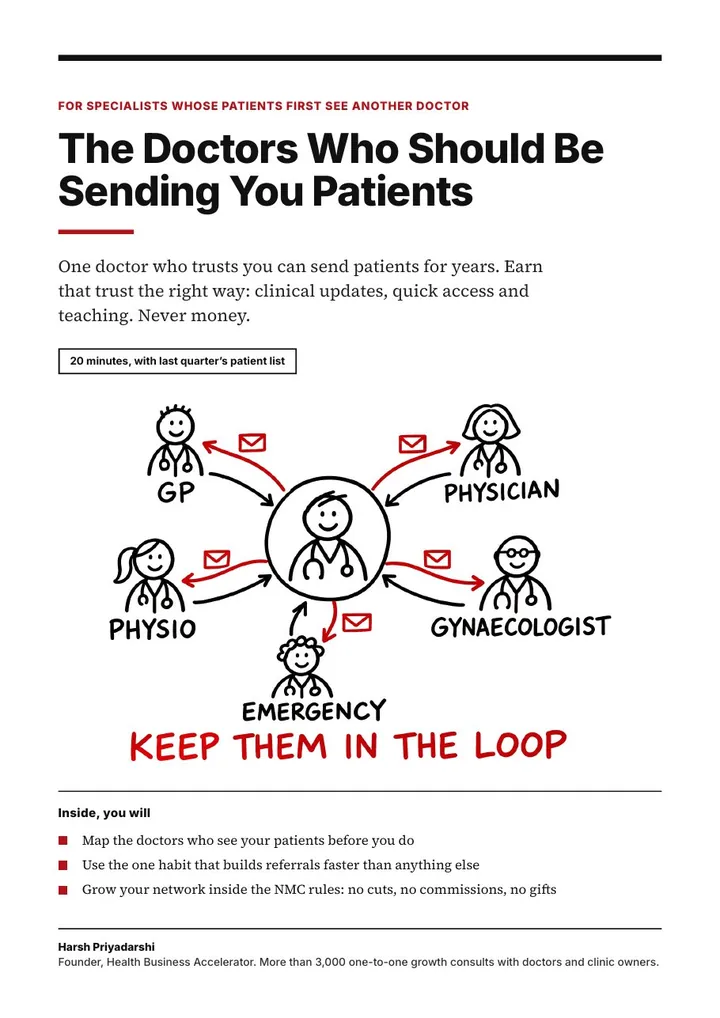
Other doctors. Paediatricians see children with recurring ear and throat problems long before you do. General practitioners and physicians see adults with chronic sinus trouble. Map them all, sort them into regular, occasional and never-referred, and make referring easy: a WhatsApp line, a one-page note on when to refer, and priority slots. Then send a short update after every patient, with consent. That habit builds referral networks faster than any dinner.
Search. People type "ENT doctor near me", "sinus surgery cost" and "hearing test near me" when they are ready. Google search ads and a strong Google profile catch them.
Rooms where your patients already gather. A talk on hearing at a senior citizens' group, where many in the audience have quietly struggled for years. A session on noise and hearing at a factory or call centre, where people wear headsets all day. A housing society talk on allergy and sinus trouble just before the season changes. Add a simple screening questionnaire, and call every sign-up within a day.
The season. ENT demand rises and falls with pollution, monsoon colds and allergy seasons. Plan your content and ad budgets around your own city's calendar, so you are visible before the rush rather than during it.
What should you fix before you spend on ads?
Ads amplify whatever is already happening at your front desk. So go through this check honestly:
- Is every enquiry logged in a single CRM with its source?
- Does a human contact each new enquiry within five minutes in working hours?
- Are your booking and show rates near 25 to 40% and 60 to 75%?
- Does the front desk ask who the patient is, since parents and adult children make so many ENT calls?
- Do you have a page each for sinus, children's ENT, ear problems and hearing?
- Do you have a written fee sheet with three options for hearing aids and an all-inclusive surgery package?
- Can you hold two same-day slots for acute ear or throat pain, so urgent callers aren't sent elsewhere?
If any answer is no, fix it first. Our conversion systems work usually starts with points two to four, because that is where ENT clinics leak most.
How should an ENT practice plan its channels over the first year?
Start with three channels: one free, one paid and one that builds trust.
Week one: reactivate your database. Message, with permission, everyone who had a hearing test and never got fitted, adults advised sinus surgery who never booked a date, and parents told "let's watch the tonsils for a few months".
Months one to three: your Google profile, a page for each lead problem, and Google search ads for the problems people search by name.
Months three to six: your first trust channel. A paediatrician and GP referral network if children's ENT leads, or a quarterly talk programme if hearing leads.
Months six to twelve: add Meta for hearing and snoring, a second trust channel, and insurance panels for the surgeries your patients' policies cover.
After that, steer every month by cost per treated patient, and never let one channel bring in more than half of your new patients. The full method is in Known Doctors Get Booked. We build this plan with ENT practices through our patient acquisition work, and a free growth call is the easiest place to start.
The short version
- A full OPD is not growth. Find the surgical and hearing pathways that carry most of the value.
- Lead with one problem, and remember that parents, adult children and spouses make many ENT decisions.
- Build referrals from paediatricians and GPs, talks in the right rooms, and search for problems people name.
- Fix speed, discovery and same-day slots before you buy more enquiries.
- Start with three channels, then add one at a time as the numbers settle.
Official sources
Rules change. Check the current version at the source before you act.
Frequently asked questions
What is the best marketing for an ENT clinic in India?
There is no single best channel. Most ENT clinics do well starting with a strong Google profile, Google search ads for sinus, tonsil and hearing searches, and a referral network with paediatricians and general practitioners. Add community talks for hearing and Meta for snoring and hearing aids once the first three are stable.
How can an ENT doctor get more surgery patients?
Look at the patients already in your OPD and database. Many have been advised sinus or ear surgery and never booked. Give every consultation a definite ending with a date, a written plan with an all-inclusive package and payment options, and a coordinator who follows up undecided patients on a fixed schedule.
Do paediatrician referrals matter for ENT doctors?
For children's ENT they are often the biggest source. Paediatricians see repeated ear, nose and throat problems first. Make referring easy, give their patients priority slots, send a short update after every child you see with the parents' consent, and send the child back for routine care. Never pay for referrals.
When should an ENT clinic start running Facebook ads?
Once your Google profile, condition pages and front desk are working. Meta suits problems people put off, like hearing loss and snoring, where an adult child or spouse often pushes the decision. Run doctor-led videos, qualify leads on the form and call every lead within five minutes.
On a free growth call, my team traces your last month from enquiry to treatment and shows you your biggest leak in rupees.