To grow a family medicine practice past one doctor, add the people who take routine work off you: a lead handler for calls and WhatsApp, a nurse for vitals and education, a practice manager, then an associate doctor. Track revenue per doctor hour, staff and rent ratios and visits per family. Then add services families already buy elsewhere, such as labs, pharmacy and health checks.
A busy family doctor can see a remarkable number of patients in a day. That is exactly the trap. When the OPD is full, the instinct is to see more, stay later and open on Sundays. Revenue rises for a while, then flattens at the limit of one person's hours and energy. The family doctors who build bigger practices did not see more patients themselves. They built a practice where much of the care, and almost all of the running, happens without them.
Why do family practices hit a ceiling?
Family medicine is usually a volume model. Each visit earns a modest fee, so revenue depends heavily on doctor hours. That makes two numbers critical.
Revenue per doctor hour. Total revenue divided by total doctor hours, for the practice and for each doctor. It tells you what your time is worth and whether it is going to the right work.
Owner dependence. How much of the clinic's income stops when you stop seeing patients. Above 50%, you still own a job. Below 10%, the clinic is turning into an asset that could be sold.
Example: Say the clinic earns ₹9 lakh a month and you work 200 hours in the OPD. ₹9,00,000 ÷ 200 = ₹4,500 per doctor hour. If an hour a day goes on billing queries, supplier calls and WhatsApp replies, that is roughly 25 hours a month at ₹4,500 of doctor time spent on work someone else could do.
Volume models can grow well at thinner margins than boutique specialities, as long as the systems are tight. The goal is not to work faster. It is to make every doctor hour count.
Who should a family doctor hire first?
Follow the levels. At ₹3 to 15 lakh a month you are the solo practitioner, and the most important hire is a front desk person who answers every call and reaches every enquiry quickly. Between ₹15 and 50 lakh, the doctor becomes the bottleneck and the team needs real roles.
| Role | What they take off the doctor | Measured on |
|---|---|---|
| Lead handler | Calls, WhatsApp, bookings, recall reminders | Answer rate, speed, booked visits that show up |
| Nurse or clinical assistant | Vitals, history taking, patient education, dressings | Patients prepared on time, education given |
| Phlebotomist | Sample collection in the clinic | Samples collected, reports on time |
| Pharmacist | Dispensing and counselling, if you run a pharmacy | Accuracy, stock levels |
| Practice manager | Staff, schedules, suppliers, complaints, weekly numbers | The eight weekly numbers, staff ratio |
| Associate doctor | Their own OPD sessions and follow-ups, your way | Patient feedback, revisits, quality checks |
Write a one-page role card for each: what they own, the numbers they are measured on and what a great week looks like. Give the practice manager real authority, with a written list of decisions they own, or you will still be approving every leave request.
When should you bring in an associate doctor?
When your calendar is full and families are waiting too long, every hour you spend building the team is worth more than an extra hour in the OPD.
Choose for manner as much as skill. Families stay for the way a doctor treats them. Sit the candidate in your OPD for a day and watch how they speak to patients, and then to your front desk.
Widen who you serve. A second doctor can add evening or weekend sessions, another language, or a woman doctor for families who prefer one for some visits.
Pay fixed plus a fair incentive, with quality checks beside it. Pay tied only to billing can push towards unnecessary tests.
Transfer trust on purpose. Introduce them in person to your regular families: "Dr Iyer works exactly the way I do, and we share every family's file." Start them on follow-ups and reviews, put them in your videos, and give them their own Google profile.
Protect the practice in writing. Confidentiality, patient records, notice period and non-solicitation, drafted by a lawyer for your situation.
Which numbers should a growing family practice watch?
Review the eight weekly numbers every Monday in a thirty-minute meeting with the team. Close the books by the seventh of each month. Then add these:
- Active families seen in the last 12 months.
- Visits per family per year.
- Revenue per doctor hour and per room hour. Before adding a third room, make sure the first two are not empty half the afternoon.
- Staff cost ratio. In my framework, salaries above 30% of revenue are a warning sign.
- Rent ratio. Around 10% of average monthly revenue is the sweet spot. Above 20% is a difficult place to be.
- Revenue by service line: consultations, tests, pharmacy, health checks, care plans.
What new services can a family practice add?
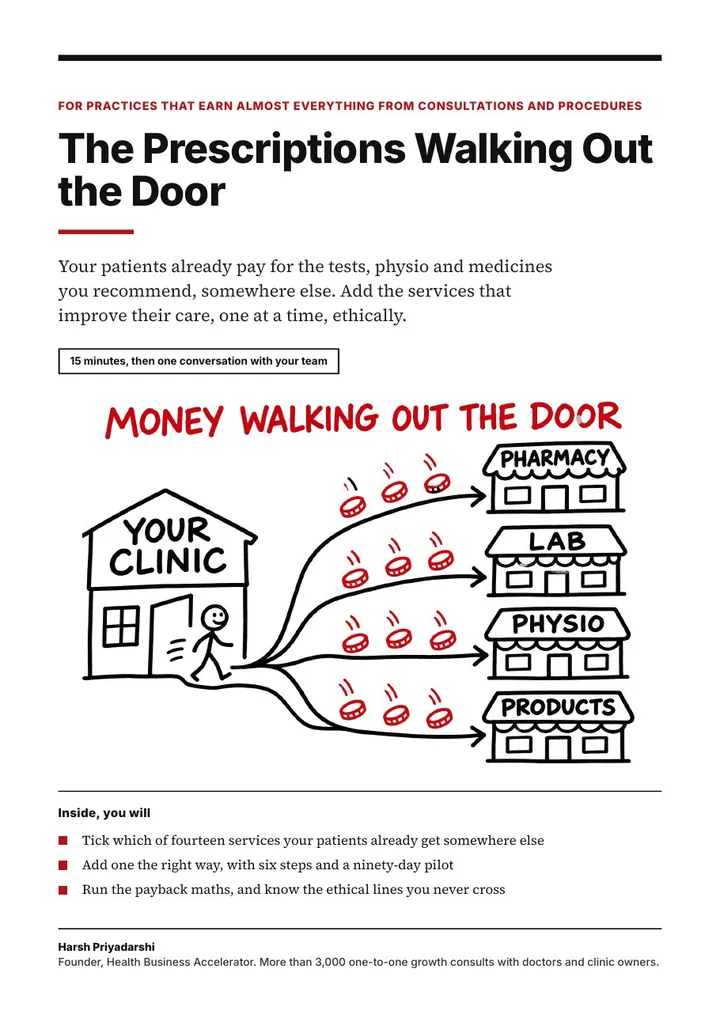
Follow your patients out of the door. They buy medicines, tests, physiotherapy and health checks somewhere else every week. The best new streams capture what they already need, from the doctor they already trust.
- A lab collection point with an established lab, then point-of-care tests.
- An in-house pharmacy with the right licence and a qualified pharmacist, or a partner who runs it from your premises.
- Health check packages for families and for local employers.
- Corporate health contracts: annual checks, on-site clinic days and wellness sessions. Family medicine is one of the best fits for this.
- Teleconsultations for suitable follow-ups.
- Home visits for elderly and housebound patients.
- Visiting specialist days. A dermatologist, physiotherapist or dietitian who runs fixed sessions at your clinic, paid for their own services.
Every stream must fit and improve care. Partner first, give each one owner and run a ninety-day pilot before scaling.
Example: A collection point costs ₹2 lakh to set up and earns ₹60,000 a month after costs. ₹2,00,000 ÷ ₹60,000 is a little over three months to pay back.
Never take money simply for sending a patient somewhere. That is a kickback, whatever it is called. For partnerships, licences, GST and company structure, confirm every decision with your chartered accountant and lawyer.
When is a family practice ready for a second branch?
Not when the first one is busy. When it runs without you. The test I use: the first clinic keeps its numbers for thirty days while you are not in the OPD, with an associate, a manager and written SOPs carrying the work. Keep at least twelve months of cash runway before you open another centre.
We help family doctors plan teams, dashboards and new services in our growth consulting work. See our family medicine page, read Rich Doctors Walk Away, or book a free growth call.
The short version
- Family practices hit a ceiling at the limit of one doctor's hours, so measure revenue per doctor hour.
- Hire in order: lead handler, nurse, manager, then an associate doctor.
- Transfer trust to the associate through shared files, follow-ups and introductions.
- Watch active families, visits per family, staff ratio and rent ratio.
- Add labs, pharmacy, health checks and corporate contracts one at a time, partner first.
Official sources
Rules change. Check the current version at the source before you act.
Frequently asked questions
How can a general practitioner increase clinic revenue?
Grow visits per family and services per visit, not just footfall. Book every review, add annual care plans and health check packages, and capture the tests and medicines patients already buy elsewhere through a lab collection point or pharmacy. Then free your hours with a team, so doctor time goes to clinical work.
When should a family doctor hire an associate doctor?
When your calendar is full, waits are growing and families are being turned away. At that point, hiring and training add more than another hour in the OPD. Choose for manner as well as skill, pay fixed plus a fair incentive with quality checks, and transfer trust through shared files and follow-ups.
What is a healthy staff cost for a family clinic?
In my framework, total salaries above 30% of revenue are a warning sign of overstaffing or weak systems. Very low staff costs can also be a problem, because the doctor may be doing work a team member should. Track it monthly alongside rent ratio and revenue per doctor hour.
What services can a family medicine clinic add to grow?
Services families already buy elsewhere: a lab collection point, an in-house or partner pharmacy, health check packages, corporate health contracts, teleconsultations, home visits and visiting specialist days. Add one at a time, partner first, pilot for ninety days and never take commissions for referring patients.
On a free growth call, my team traces your last month from enquiry to treatment and shows you your biggest leak in rupees.